
Key points
- A riflescope’s most important job is holding zero and tracking repeatably, not maximum magnification.
- First Focal Plane (FFP) keeps reticle subtensions true at every power; Second Focal Plane (SFP) keeps reticle thickness constant.
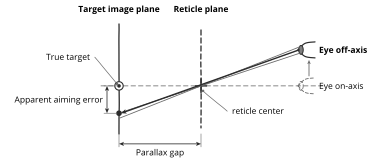
- Unadjusted parallax moves the reticle relative to the target whenever your eye shifts off center.
- Match your scope’s internal elevation travel and canted base (0, 20, or 30 MOA) to your cartridge’s reach.
Why it matters
You cannot evaluate a cartridge or hold an accurate wind call through an optic that drifts, tracks unevenly, or induces parallax error.
How it is done
How a riflescope works
A riflescope is a precision mechanical instrument with glass inside. Its primary job is holding zero under recoil and moving the point of aim by an exact, repeatable angle when you turn the dials. Crisp glass helps you spot bullet splash and read mirage, yet bright glass cannot compensate for turrets that drift or fail to return to zero.
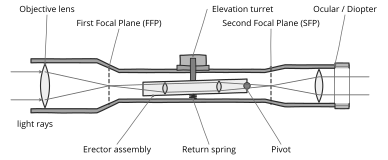
Six main assemblies do the work (see Figure 5-1):
- Objective lens. The front lens gathers light from the target and forms an inverted image at the first focal plane. Larger objective lenses gather more light and offer a wider exit pupil at high power, at the cost of extra weight and higher rings.
- Main tube. The outer aluminum housing—commonly 30 mm or 34 mm in diameter on precision scopes—holds the internal parts aligned. A larger tube does not transmit more light; it provides more physical room inside for the erector assembly to travel, giving greater total elevation adjustment.
- Erector assembly. An internal tube holding the lenses that turn the image right side up and change magnification. The elevation and windage turret screws push against the erector tube while an opposing spring pushes back. Every click pivots the erector tube by a fixed angle.
- Ocular lens and diopter. The rear lens assembly magnifies the reticle and image for your eye. Rotating the diopter ring focuses the reticle specifically for your vision.
- Turrets. Calibrated external dials marked in MIL (typically 0.1 MIL per click) or MOA (typically 1/4 or 1/8 MOA per click). Tactile, repeatable detents let you dial elevation and windage without looking away from the target.
- Zero stop. A mechanical collar or set-screw system inside the elevation turret that halts downward rotation right at (or slightly below) your zero distance. A zero stop lets you dial back to zero quickly in low light or under match pressure without losing track of full revolutions.
Iron sights (Service Rifle context). Traditional Service Rifle and smallbore matches often use metallic aperture (“peep”) sights instead of scopes. The rear sight is a small circular aperture close to the eye; the front sight is a vertical post or ring inside a protective hood. The human eye naturally centers the front sight in the brightest center of the rear aperture. Match rear sights use micrometer clicks—commonly 1/4 or 1/2 MOA—and obey the same mechanical verification rules as scope turrets.
CMP/NRA Service Rifle optics. Modern Civilian Marksmanship Program (CMP) and NRA Service Rifle rules allow riflescopes in place of iron sights, subject to strict limits: a maximum magnification of 4.5× and a maximum objective lens diameter of 34 mm. Competitors typically use either a fixed-power 4.5× scope or a 1–4.5× low-power variable optic (LPVO) with repeatable 1/4 MOA turrets and a post or simple crosshair reticle suited to round bullseye targets. Because an AR-15 upper receiver sits straight in line with the buttstock, Service Rifle scopes mount high above the bore—typically around 2.6 to 2.8 inches of sight height—which must be measured accurately and entered into any ballistic solver (see Chapter 4).
First Focal Plane (FFP) vs. Second Focal Plane (SFP)
A variable-power scope has two optical planes where the reticle can sit. Which plane the maker chooses changes how the reticle behaves when you zoom in or out.
- First Focal Plane (FFP). The reticle sits ahead of the magnification lenses. As you zoom in, the reticle grows in exact proportion to the target. A 1 MIL hash mark spans 1 MIL at 5x, 12x, and 25x alike. That lets you measure targets, call misses, and hold wind or elevation at any magnification without doing mental scaling. The trade-off is reticle thickness: a reticle thin enough for fine aiming at 25x can look very faint at 5x.
- Second Focal Plane (SFP). The reticle sits behind the magnification lenses. The target grows and shrinks as you zoom, while the reticle stays the exact same apparent thickness at every power. Because the target size changes relative to the fixed reticle, the reticle’s hash marks are accurate at only one designated magnification (usually maximum power, or a marked dot on the power ring). At half that power, every hash mark covers twice its labeled angle.
| Feature | First Focal Plane (FFP) | Second Focal Plane (SFP) |
|---|---|---|
| Subtension accuracy | True at every magnification. | True at one calibrated magnification only. |
| Apparent reticle size | Scales with zoom; can look thin at low power. | Constant thickness across all powers. |
| Best suited for | PRS, positional matches, field shooting, varied-range hunting. | Benchrest, F-Class, known-distance target shooting. |
| Main watch-out | Fine reticles can fade against dark timber at low power. | Holding wind or drop at the wrong magnification causes large errors. |
Reticle design
Choose a reticle that matches how you actually aim and correct shots.
- Duplex and fine crosshair. Thick outer bars narrow to a thin center crosshair or tiny dot. It offers an uncluttered sight picture for Benchrest, F-Class, and short-range hunting where you dial every correction or aim dead center, but it provides no built-in measuring ruler.
- Bullet Drop Compensator (BDC). Fixed drop marks calibrated for one assumed cartridge, muzzle velocity, and atmospheric density. BDC reticles are fast at moderate ranges, yet their marks lose accuracy as soon as your bullet, barrel length, or elevation differs from the factory assumptions.
- MIL or MOA hash (stadia) reticle. Evenly spaced angular marks along the vertical and horizontal axes—typically every 0.2 or 0.5 MIL, or every 1 or 2 MOA. A hash reticle works with any cartridge, any velocity, and any ballistic solver.
- Christmas-tree (grid) reticle. Extends a grid of windage dots below the horizontal crosshair so you can hold both elevation and wind simultaneously without touching a turret. Grid reticles shine in timed PRS stages and fast follow-up shots, though the extra markings can clutter the view when spotting subtle mirage or tiny paper bullet holes.
Parallax and eye-box discipline
Parallax is an optical error that occurs when the target’s image does not fall on the exact same focal plane as the reticle. When those two planes sit apart, shifting your eye slightly off the center of the scope’s exit pupil makes the reticle appear to slide across the target even though the rifle has not moved (see Figure 5-2). At 100 yards, severe unadjusted parallax can shift your point of aim by half an inch or more—enough to ruin a group test.
Remove parallax every time you change target distance:
- Confirm the ocular diopter is already focused for your eye (see Chapter 6). Never use the parallax knob to sharpen a blurry reticle.
- Aim at the target and turn the side-focus knob (or adjustable objective ring) until the target image looks crisp. Ignore the yardage numbers printed on the knob; they are only rough guides.
- Rest the rifle steadily on bags so it cannot move, then bob your head slightly up, down, left, and right behind the ocular lens while watching the crosshair on the target.
- If the crosshair appears to drift across the target, adjust the parallax knob in small increments and test again until the crosshair stays pinned to one spot regardless of eye movement.
Even after parallax is removed, maintain consistent eye-box discipline. Center your eye behind the ocular lens so no dark crescents (scope shadow) appear around the edges of the view. A repeatable cheek weld keeps your eye centered from shot to shot.
Close-range rimfire parallax. Many centerfire scopes only focus parallax down to 50 yards, which leaves significant parallax error on close targets. NRL22 and PRS Rimfire matches routinely place targets as close as 15 to 50 yards. If you shoot rimfire precision matches, choose a scope whose side-focus or adjustable-objective parallax focuses down to 15 to 25 yards so your reticle stays pinned on small close-range targets even from awkward barricade positions.
Rings, bases, and canted rails
A scope mount must hold the optic rigidly parallel to the action and provide enough internal elevation travel for your cartridge’s reach.
0 MOA versus 20 or 30 MOA bases. Every riflescope has a fixed total internal elevation travel—for example, 24 MIL (about 82 MOA). Mounted on a flat 0 MOA base, a 100-yard zero sits roughly near the center of the erector’s travel, leaving only about half the total travel (roughly 12 MIL) available to dial up for long-range shots.
A canted base—commonly 20 MOA (about 5.8 MIL) or 30 MOA (about 8.7 MIL)—tilts the scope downward relative to the bore. When you zero at 100 yards, the erector tube sits lower inside the main tube, freeing extra upward travel for distant targets.
Worked example. Example numbers.
A riflescope has 24.0 MIL of total internal elevation travel.
Flat 0 MOA base:
  Available up travel ≈ 24.0 / 2 = 12.0 MIL (12.0 MIL down remaining)

20 MOA canted base (20 / 3.438 = 5.8 MIL):
  Available up travel ≈ 12.0 + 5.8 = 17.8 MIL (6.2 MIL down remaining)

30 MOA canted base (30 / 3.438 = 8.7 MIL):
  Available up travel ≈ 12.0 + 8.7 = 20.7 MIL (3.3 MIL down remaining)
Do not add more base cant than your scope can absorb. If a scope has only 50 MOA of total travel (25 MOA from center to bottom), a 30 MOA rail can bottom out the erector tube before you can reach a 100-yard zero. As a rule of thumb, keep at least 3 to 5 MIL (10 to 15 MOA) of downward travel below your 100-yard zero so the erector does not press against the wall of the main tube.
Rimfire (.22 LR) canted rails. Subsonic .22 LR drops steeply past 100 yards, requiring roughly 12 to 14 MIL (42 to 48 MOA) of elevation to reach 300 yards from a 50-yard zero. Rimfire precision shooters who engage 200- to 300-yard targets commonly use 30 to 50 MOA canted rails or mounts to keep enough upward turret travel. Keep in mind that a 50-yard .22 LR zero uses roughly 2 MIL (about 7 MOA) more downward erector travel than a 100-yard zero—so confirm your scope has enough total internal travel to zero at 50 yards on a steep rail without bottoming out the erector.
Ring height and alignment. Select the lowest ring height that clears the objective bell (with lens caps) above the barrel while giving you a relaxed, natural cheek weld. Modern one-piece mounts and CNC-machined rings on a true one-piece Picatinny rail rarely need lapping. On older two-piece bases, check alignment with machined alignment bars before clamping the scope. Tightening rings onto misaligned bases bends the main tube, binding the erector assembly and causing erratic turret tracking.