
Key points
- Stable positions rely on bone support and rifle fit, not muscle tension.
- Natural Point of Aim (NPOA) keeps the rifle returning to the target without muscling.
- Straight-line recoil management lets you stay in the scope and spot your own impacts.
- Clean trigger control breaks the shot without disturbing sight alignment.
Why it matters
Every shot on paper records three sources of dispersion at once: the rifle, the ammunition, and the shooter. If shooter error is larger than rifle and ammunition dispersion, group testing measures your hold instead of your load. Sound fundamentals shrink human dispersion until the target reflects the rifle system.
How it is done
Precision marksmanship is repeatable mechanics. Build a position that holds the rifle without strain, align your eye behind the optic, press the trigger straight back, and manage recoil straight to the rear.
Building a stable prone and bench position
Muscles fatigue and tremble under load. Bones do not. Every stable shooting position routes the weight of the rifle through your skeletal frame and your support gear into the ground or the shooting bench.
Start with rifle fit before you fire a round. Adjust the length of pull so your trigger finger reaches the trigger face comfortably without stretching your wrist or crowding your shoulder. Adjust the comb height so your cheek rests firmly on the stock while your eye lands directly behind the center of the scope (see Chapter 4).
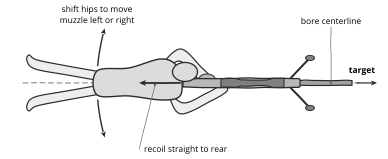
Straight-behind-the-rifle alignment. Lie flat behind the rifle in the prone position so your spine runs straight along the line of the bore. Spread your legs comfortably with your heels flat or toes turned outward to relax your lower back and glutes. Do not angle your torso sharply to the side unless heavy recoil or terrain forces a bladed stance. When your body lies straight behind the bore, recoil pushes straight back into your shoulder pocket instead of twisting the rifle sideways.
Place the buttpad squarely in the pocket of your shoulder, inboard of the shoulder joint and below the collarbone. Keep both shoulders level with the ground. Your non-firing hand manages the rear bag, squeezing or shifting it to raise or lower the muzzle without straining your firing arm.
Natural Point of Aim (NPOA). A rifle held on target by muscle tension springs back toward its resting line the instant recoil breaks your hold. That spring-back shifts the bullet off target before it clears the muzzle. Check your NPOA before every string:
- Build your prone or shooting-bench position and settle the reticle on the center of the target.
- Close your eyes for two to three seconds. Take a normal breath and let it out naturally.
- Open your eyes and see where the reticle rests.
- If the reticle drifted left or right, shift your hips and legs slightly in the opposite direction while keeping the bipod or front rest planted. If it drifted high or low, adjust your rear bag height or slide your body slightly forward or back.
- Repeat until you can close your eyes, breathe, open your eyes, and find the reticle still centered on the target with zero muscular effort.
Shooting-bench setup. At a shooting bench, sit squarely behind the rifle rather than twisting sideways across the tabletop. Keep your chest off the sharp edge of the tabletop if it transmits your heartbeat into the rifle. Set the stool height so your elbows rest evenly on the shooting bench without hunching your shoulders.
Free recoil versus pinned and loaded bipod. Precision disciplines manage rifle contact in two distinct ways, depending on rifle weight, recoil, and support gear:
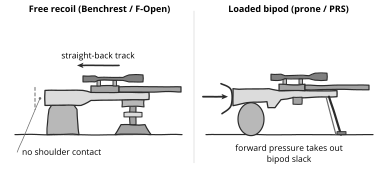
- Free recoil and bag riding (Benchrest and F-Open). Heavy Benchrest rifles and F-Open rifles ride on a wide, flat-bottomed forend (typically 3 inches wide) in a coaxial mechanical front rest and a heavy sand-filled rear bag with tall ears (no muzzle brake is allowed in F-Class). The rifle is balanced so it tracks straight back through the bags under recoil. Benchrest shooters often shoot pure free recoil—avoiding shoulder or cheek contact and touching only a very light trigger with the fingertip—while F-Open shooters use either free recoil or very light, consistent shoulder contact to manage heavier cartridges.
Setting up a rifle to track cleanly in bags requires deliberate alignment. Position the front-rest forend stop so the rifle returns to the exact same longitudinal index after every shot, and adjust front-bag clamping and rear-bag ear tension so the stock glides smoothly without binding or rocking. Before firing, perform a bag-tracking check: center the crosshair on the target, then slide the rifle gently back and forth about two inches in the bags while watching the reticle. If the crosshair climbs, drops, or drifts sideways during the slide, re-level the rest, square the rear bag to the line of fire, or adjust ear fill until the reticle tracks straight vertically without cant or hop. Standard sporter and tactical chassis stocks—with rounded forends, angled buttstocks, and higher recoil-to-weight ratios—rarely slide flat in bags and usually shoot far better when pinned firmly into the shoulder.
- Pinned rifle and loaded bipod (F-TR, PRS, and field prone). F-TR (F-Class Target Rifle) rifles shoot from a front bipod and rear bag with no muzzle brake, while practical precision and hunting rifles shoot from bipods, packs, or props rather than flat mechanical rests. A bipod has small amounts of mechanical play in its joints and feet. Before breaking the shot, lean your weight forward slightly into the rifle until the bipod legs take up all slack and stop moving. That steady forward pressure is called loading the bipod. It prevents the bipod feet from hopping backward and upward at ignition. Pair a steady bipod load with firm, consistent shoulder-pocket pressure and a hand on the rear bag.
Sight picture, breathing, and trigger control
Keep head position, breathing, and trigger press consistent so nothing disturbs alignment before the bullet clears the bore.
Cheek weld and eye box. Rest your cheek on the same comb spot with light, consistent pressure, looking straight through the scope’s center for a full, shadow-free image. A dark crescent shadow means your eye is off-axis, adding parallax error if side focus is imperfect (see Chapters 5 and 6). Keep your head upright so cant is easy to judge.
Natural respiratory pause. Breathing moves the muzzle vertically and causes vertical stringing. Take a normal breath, exhale naturally, and break the shot during the relaxed two- to four-second pause at the bottom of the exhale. Never force air out or hold your breath until your pulse thumps the reticle; if not settled within four seconds, breathe again.
Straight-back trigger control. Center the pad of your index finger on the trigger face with a small air gap beside the stock so finger motion cannot push it sideways. Keep the firing hand relaxed—squeezing the grip pulls the muzzle off target—and press straight rearward along the bore.
- Single-stage: Build steady rearward pressure until the sear breaks without anticipating the shot.
- Two-stage: Take up the lighter first stage to the stop, confirm sight picture, and press steadily through the break.
Follow-through. Several milliseconds pass between sear release and muzzle exit; lifting your head, relaxing your shoulder, or releasing the trigger early shifts impact. Keep the trigger pinned, cheek planted, and eye in the scope until recoil finishes and the rifle settles, then reset and cycle.
Recoil management and self-spotting
Self-spotting through the scope shows immediately whether a miss came from wind, elevation, or a poor break, allowing instant corrections without waiting on a spotter.
Staying in the scope. With straight-behind alignment and a square shoulder pocket, recoil lifts the reticle straight up and drops it back on target. A sharp jump up and right (for right-handed shooters) signals alignment, bipod-load, or grip-tension errors.
Keep your cheek on the comb rather than peeking over the scope. If recoil throws the target out of view, lower magnification—10x to 15x gives a wider field of view than 24x+ and makes spotting far easier. A muzzle brake, suppressor (see Chapter 4), or heavier rifle also cuts recoil velocity and muzzle jump.
Observing trace and splash. Staying in the scope at medium and long range reveals two cues:
- Bullet trace: The faint parabolic shimmer of disturbed air along the bullet’s arc, clearest in bright light with mild humidity against a dark, uniform background.
- Impact splash: The puff of dirt, gravel spray, or steel paint flake on impact. Read the base of the splash where the bullet struck, not the dust drifting downwind (see Chapter 10).