
Key points
- The gyroscopic stability factor, Sg, compares the bullet’s spin with the air’s push to turn it over. Below 1.0 the bullet tumbles.
- An Sg of 1.5 or more gives full BC with a margin. From 1.1 to 1.5 the bullet flies but yaws, which costs BC and opens groups.
- Length decides stability far more than weight. A polymer tip adds length but almost no mass, so it needs its own correction.
- Cold, dense air is the hard case. Sg falls as the air gets denser, so the coldest, densest day sets the margin.
- A hotter load barely helps. A faster twist or a shorter bullet is the fix.
Why it matters
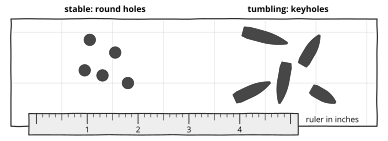
The powder’s work ends at the muzzle. From there the bullet has to fly point first. An unstable bullet will not group. A marginal one flies but wobbles, so it loses part of its ballistic coefficient, or BC. A BC compares a bullet’s drag with that of a standard projectile (see Chapter 19). A bullet below Sg 1.0 tumbles and leaves oblong holes. No amount of load tuning fixes that.
Stability is set by the barrel’s twist, the bullet’s length and weight, its velocity and the air. The twist is the costly part to change. So check stability before you buy bullets and before you build a load around them.
How it is done
What Sg measures
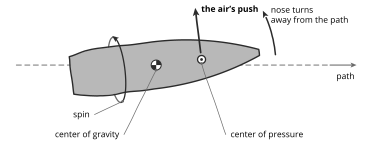
On a typical rifle bullet, the air’s push centers ahead of the center of gravity. So the air tries to turn the nose away from the path. Spin resists that turning, much as a spinning top resists falling over. Sg is the ratio of the spin’s resistance to the air’s overturning push.
Sg depends on the bullet’s mass, its moments of inertia, its spin rate, the air density, the aerodynamic overturning moment and the velocity. Simple formulas such as Greenhill’s and Miller’s are estimates. They are built on the bullet’s diameter, length and weight or density. They cannot see how the mass is spread inside the bullet or exactly where the air’s push centers.1
A bullet grows more stable as it flies. Its spin decays much more slowly than its forward speed. So the muzzle is where gyroscopic stability is lowest.
Sg measures gyroscopic stability only. A bullet can also be dynamically unstable, meaning its wobble grows in flight instead of settling out. Dynamic instability shows up mostly as the bullet slows through the transonic zone near the speed of sound (see Chapter 19).2
The thresholds
Table 18-1. How to read Sg.3
| Sg | Reading | What it means |
|---|---|---|
| 1.5 or more | Stable | Full BC, with margin for colder and denser air |
| 1.1 to under 1.5 | Marginal | The bullet flies but yaws. That can cost as much as 10 to 15% of its BC and open groups |
| 1.0 to under 1.1 | Insufficient | Flies point first for now, with no margin. Colder air or a slower load can take it below 1.0 |
| Below 1.0 | Insufficient, will not stabilize | The bullet tumbles and keyholes. No load tuning fixes it |
Some sources set the threshold for full stability at 1.4 instead of 1.5. Either way, that margin covers formula error and cold, dense air.1 The line at 1.0 is physics. The margin above it is insurance.
Spin, drag and the spin ceiling
More spin also lowers drag, up to a point. Mach 1.7 is 1.7 times the speed of sound. Doppler tests show that above about Mach 1.7 to 1.8, a bullet’s drag is lowest at an Sg of about 2.0. Transonic drag keeps falling as Sg rises.1
Spin has a ceiling too. A bullet can spin fast enough to come apart in flight. From about 250,000 rpm, thin-jacketed bullets have been known to fail.4
Spin rate (rpm) = muzzle velocity (fps) × 720
                  ÷ twist (inches per turn)
Example numbers. Not load data. A bullet at 3,000 fps from a 1:8 twist spins at 3,000 × 720 ÷ 8 = 270,000 rpm. That is past the 250,000 rpm caution, so a thin-jacketed bullet could come apart.
The Miller twist rule by hand
The Miller twist rule is the usual estimate.5
Sg = 30 × m ÷ (t² × d³ × l × (1 + l²))

m   bullet weight in grains
d   bullet diameter in inches
l   bullet length in calibers = length ÷ d
t   twist in calibers per turn = twist in inches ÷ d
The base rule assumes 2,800 fps, 59 °F and 29.92 inHg. Two factors adjust it.
Velocity factor = (v ÷ 2,800)^(1/3)
                  v = muzzle velocity in fps

Air factor      = ((T + 460) ÷ 519) × (29.92 ÷ Pst)
                  T   = air temperature in °F
                  Pst = station pressure in inHg

Sg corrected    = Sg × velocity factor × air factor
Below 1,120 fps the velocity factor stops changing. The rule holds it at its 1,120 fps value. Station pressure is the air pressure a barometer reads where you stand, not the sea-level figure in weather reports (see Chapter 19).
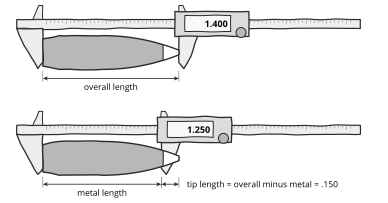
- Measure a few bullets with calipers and use the longest. Catalog lengths are often nominal.4 For a polymer-tipped bullet, also measure the metal length (see “Bullet length and tips” below).
- Convert the length and the twist to calibers.
- Work out the base Sg. For a tipped bullet, use the tip formula.
- Apply the velocity factor for your measured muzzle velocity. If you have not fired the load yet, use the published velocity (see The Handloading Handbook) adjusted for your barrel length (see Chapter 4).
- Apply the air factor for the coldest, densest day you expect.
- Read the result against the thresholds.
Worked example. Example numbers. Not load data.
A bullet of .264 inch diameter weighs 140 gr and measures 1.40 inches. The barrel has a 1:8 twist. The muzzle velocity is 2,700 fps.
l  = 1.40 ÷ 0.264 = 5.30 calibers
t  = 8 ÷ 0.264 = 30.3 calibers

Sg = 30 × 140 ÷ (30.3² × 0.264³ × 5.30 × (1 + 5.30²))
   = 4,200 ÷ (918 × 0.0184 × 154.2)
   = 1.61

Velocity factor      = (2,700 ÷ 2,800)^(1/3) = 0.988
Sg on a standard day = 1.61 × 0.988 = 1.59
On a mild sea-level day this bullet is stable, but only just.
Bullet length and tips
Length decides. In Miller’s rule, Sg falls roughly with the cube of the bullet’s length. Twist enters as a square, so a 1:7 barrel gives about 31 percent more Sg than a 1:8 barrel. Weight enters only once. Heavy bullets cause trouble mostly because they are long.
Several things make a bullet longer.
- A heavier bullet of the same design.
- A monolithic copper bullet. Copper bullets are longer than lead-core bullets of the same weight, so they may need a faster twist (see The Handloading Handbook).
- A polymer tip, which adds length but almost no mass.
A tip-corrected form of Miller’s rule accounts for a polymer tip.6 Use the metal length (total length minus tip length) in the (1 + lm²) term, which reflects how the bullet’s mass is distributed. Keep the full length l outside the parentheses, because the tip still shapes the airflow.
Sg = 30 × m ÷ (t² × d³ × l × (1 + lm²))

l    full length in calibers
lm   metal length in calibers = (length − tip length) ÷ d
Example numbers. Not load data. Give the bullet in the worked example a .15 inch polymer tip. Its metal length is 1.25 inches, or 4.73 calibers. Its Sg on a standard day becomes 1.98 instead of 1.59. Leaving the tip out of the formula makes a tipped bullet look less stable than it is. That is the classic false “unstable” verdict.
The tip formula treats the tip as weightless, so it reads slightly high for an aluminum tip. By contrast, a lead-free bullet with a light powdered-metal core inside a copper jacket is more stable than the formula predicts.3
Measuring matters most when the answer is close. Whenever Sg lands between 1.3 and 1.6, a nominal catalog length can flip the verdict.3 An estimated tip length is usually within .02 inch, which moves Sg about 3 percent.7
Why cold, dense air is the hard case
Dense air pushes harder on the nose, but the spin does not change with the weather. So Sg falls as air density rises. Air is densest when it is cold, at low altitude and under high pressure.
Carry the worked example into two kinds of weather.
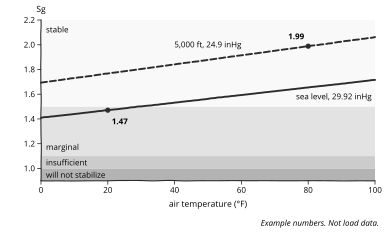
20 °F at sea level, 29.92 inHg:
  Air factor = (20 + 460) ÷ 519 × 29.92 ÷ 29.92 = 0.925
  Sg = 1.59 × 0.925 = 1.47     Marginal

80 °F at 5,000 feet, station pressure about 24.9 inHg:
  Air factor = (80 + 460) ÷ 519 × 29.92 ÷ 24.9 = 1.25
  Sg = 1.59 × 1.25 = 1.99      Stable
The same bullet and load reads 1.99 on a warm day at altitude and 1.47 on a cold day at sea level (see Figure 18-3). In a similar case, a bullet at Sg 1.5 on an 80 °F afternoon at 5,000 feet is about 1.1 on a 20 °F day at sea level.3 A rifle zeroed in summer and carried on a late-season hunt sees exactly this change.
Contested a hotter load rescues a marginal bullet
The claim. If a bullet is marginal, drive it faster. The idea comes up often at the range.
The physics. A faster bullet spins faster from the same twist. But the air’s overturning push also grows with speed. In Miller’s rule, the net gain grows only with the cube root of velocity.
The test. Work the velocity factor at two speeds.
The data. In the worked example, 200 fps more velocity raises Sg from 1.59 to 1.63. That is about 2 percent. Changing the twist from 1:8 to 1:7.5 raises it to 1.81.
The verdict. Folklore. The effect is real but weak. A hotter load cannot rescue a marginal bullet. It does keep the bullet supersonic a little longer. It also raises the spin rate, which matters near the 250,000 rpm caution. The real fixes are a faster twist, which is a barrel decision, or a shorter bullet. For a tipped bullet, first make sure the tip is in the formula.
Safety · See The Handloading Handbook. Never go past a published maximum to chase stability.
Signs at the target
A tumbling bullet hits the target sideways and leaves oblong holes (see Figure 18-4). That points to an Sg below 1.0. A marginal bullet usually cuts round holes at 100 yards, but its groups open up and it drops and drifts more at distance because yaw lowers its BC.
Notes
- Hornady, Hornady 4 Degree of Freedom (4 DOF) Trajectory Program, Version II user manual, 2017, static.hornady.media/site/hornady/files/ballistic/hornady-4dof-technical-paper-v2.pdf.
- Applied Ballistics, AB Mobile User Guide, version 2.2 (07/2018), appliedballisticsllc.com/wp-content/uploads/2019/11/ABMobileUserGuide.pdf.
- Empirical Precision, User Guide, linked from the app’s dashboard, 2026, section 15.4, empiricalprecision.com.
- Empirical Precision, User Guide, section 15.1.
- Don Miller, “A New Rule for Estimating Rifling Twist: An Aid to Choosing Bullets and Rifles,” Precision Shooting, pp. 43–48, March 2005.
- Michael Courtney and Don Miller, “A Stability Formula for Plastic-Tipped Bullets, Parts 1 and 2,” Precision Shooting, January and February 2012, arxiv.org/abs/1410.5340.
- Empirical Precision, User Guide, section 15.2.