
Key points
- Unusual force is a symptom. More force is never the fix. A pressure sign is never noise, and its absence is not proof of safety.
- Change one thing at a time, then measure enough shots to confirm what fixed the problem.
- Check mechanical and optic causes first: loose rings, base, or action screws, parallax error, cant, and turret tracking error masquerade as load problems.
- Small samples mislead, so many range faults are only noise. Judge stringing and far shots against chance.
- Vertical stringing is a velocity problem only when the slow shots are the low ones. At 100 yards it almost never is.
Why it matters
A fault at the range costs ammunition, barrel life, and trust in your data. Worse, shooters often blame a good load for a loose scope ring, a parallax error, a carbon ring in the chamber neck or rimfire leade, or normal small-sample scatter.
Most range problems trace to one mechanical, optical, environmental, or ammunition cause. A fix that changes two things at once teaches you nothing. If the fault comes back, you will not know which change mattered. At the range, some faults are real and others are noise from too few shots. The skill is telling the two apart. One fault is never noise: a pressure sign. For workshop-only reloading faults during sizing, priming, charging, or seating, see The Handloading Handbook.
How it is done
Problems at the range
- Stop at once at a pressure sign or at a shot that sounds or feels wrong. After a wrong shot, unload and check the bore for a stuck bullet before you fire again (see Chapter 2). If a round fails to fire, keep the muzzle downrange for at least 30 seconds before you open the action.1 Everything else can wait. Pressure signs are unreliable early warnings, and their absence does not prove a load safe (see The Handloading Handbook).
- Look at the target. A flyer may be a hole marked in the wrong place or a shot you pulled.
- Count your shots. Read every number with its interval.
- Find the symptom in the table below. Change one thing. Then shoot enough rounds to see whether the change worked (see Chapter 16).
- Record the conditions, the change and the result.
| Symptom | Likely causes | Check | Fix | See |
|---|---|---|---|---|
| Pressure signs: stiff bolt lift, ejector marks, flattened, cratered or pierced primers | Charge too high for this rifle. Components differ from the published test. Bullet in the lands or seated deeper than tested. Hot ammunition. Carbon ring in the throat. Bolt-action data used in a semi-automatic. | Stop firing. Compare components, charge and velocity with the published data. Inspect the throat for a carbon ring. In a semi-automatic, compare ejector and extractor marks with those at the start load. A primer sign means stop. | Do not fire the rest of the lot. Pull handloaded bullets or quarantine the factory lot. Remove any carbon ring. Work up again from the published start load. | 23 |
| A shot sounds or feels weak | A light or missing charge (a squib) can leave the bullet in the bore. | Unload. Look through the bore for a stuck bullet. | Do not fire until the bore is clear. Quarantine the rest of that batch or factory lot. | 2 |
| Click, no bang (a misfire) | A primer seated high or upside down. A light firing-pin strike. A contaminated primer. | The primer’s dent, and how the primer sat. | Keep the muzzle downrange for at least 30 seconds, then unload. Set the round aside as a reject. Have the rifle checked if the primer is not dented. Check that the bore is clear before you load another round.2 | 2 |
| Loaded round will not chamber, or the bolt closes hard on it | Shoulder not bumped enough (handload). Case too long. Bullet touching the lands. Carbon ring or debris in the chamber. In .22 LR match chambers, mild, uniform engraving resistance is normal, but a sudden increase in closing force points to a carbon ring or thickened cold wax. | Inspect the chamber, throat, and rimfire chamber mouth. Check a handload’s base-to-shoulder, length, and CBTO against your records (see The Handloading Handbook). | Stop. Do not force the bolt on a live round. Clean the chamber, throat, or rimfire chamber mouth and leade. Set aside rounds that fail to chamber and correct the sizing or seating step in the workshop. | 2, 23 |
| Velocity at or over your velocity ceiling, or well above your records at the same temperature | Hot ammunition. A new lot. A new barrel speeding up. Carbon ring pinching the neck or rimfire chamber mouth. A charge or component error. | Ammunition temperature, the lots, the barrel’s round count, throat cleanliness, and the batch record. | Stop firing that batch. Clean any carbon ring. For a charge or component error, work up again from the published start load. For a new lot, a new barrel or hot ammunition, drop the charge and work up from below to your velocity ceiling. | 23 |
| Carbon ring: velocity climbs, SD worsens, or groups open at high round count | Hard carbon buildup at the front of the chamber neck (centerfire) or chamber mouth and leade (rimfire). | Inspect the neck-throat junction or rimfire leade with a borescope, or feel for a tight spot with a sized brush. Check velocity history for an upward creep. | Clean the chamber neck or rimfire chamber mouth and leade deliberately with carbon solvent and a properly sized nylon or bronze brush. Re-check velocity and groups, and tighten your cleaning cadence. | 23 |
| Rimfire (.22 LR) sluggish cycling, failure to extract/chamber, or sudden POI shift in cold weather | Cold-weather bullet-wax thickening, or wax and carbon buildup on the breech face, extractor groove, and chamber mouth. | Inspect the breech face, extractor claw, and chamber mouth for waxy paste. Note ammunition temperature and whether the rifle ran cleanly when warm. | Wipe the breech face, bolt face, extractor, and chamber mouth clean with a dry patch or light solvent. Keep ammunition at a steady temperature in an insulated box or inside pocket, or test a lot whose lube stays supple in cold air. | 23 |
| Semi-automatic short-stroking or failure to lock back on an empty magazine | Under-gassed cycle, worn gas rings, misaligned or leaking gas block, dry or heavily fouled bolt carrier group, or weak magazine spring. | Check gas-ring seal (bolt should support the carrier upright), inspect around the gas block for carbon leaks, and test with a known-good magazine and full-power factory load. | Clean and lubricate the bolt carrier group, replace worn gas rings, align and secure the gas block, or open an adjustable gas block slightly until lock-back is positive with margin. | 23 |
| Semi-automatic violent ejection, bent rims, or torn case heads | Over-gassed cycle, early unlocking, excessive chamber pressure, or rough/dirty chamber walls. | Check ejection pattern and case rims for extractor swipe or bent rims. Chronograph the load and inspect primers and headstamps for pressure signs. | Stop if pressure signs appear. Clean the chamber and locking lugs. Reduce gas flow with an adjustable gas block or heavier buffer, or reduce charge weight if handloading. | 2, 23 |
| Semi-automatic erratic velocity, pressure signs, or shortened cartridges after chambering | Bullet setback during aggressive semi-automatic feeding (insufficient neck tension or lack of light crimp). | Measure COAL of a round before and after chambering it from a loaded magazine at full bolt speed. | Do not fire set-back rounds. Switch factory SKUs if a commercial load sets back, or increase neck tension and verify feeding in the workshop (see The Handloading Handbook). | 2, 23 |
| Semi-automatic POI shifts between bench and sling/bipod positions | Handguard or sling pressure flexing the barrel or contacting the gas block on a non-free-floated rail. | Inspect clearance between the gas block, barrel, and handguard under sling or bipod load. Compare bench-rested zero against slung prone or bipod-loaded groups. | Use a rigid free-float handguard with generous gas-block clearance, verify barrel-nut torque, and keep sling or bipod pressure off the barrel. | 4, 8 |
| Sudden flyers, wandering zero, or double grouping | Loose scope rings, base screws, or action screws. Damaged optic internals. Barrel contacting the stock. | Check witness marks and torque on action screws, rail, rings, and scope caps. Check free-float clearance along the barrel channel. | Degrease threads if needed, retorque all fasteners to maker specifications, restore barrel clearance, and shoot a new hardware baseline. If zero still wanders, test with a known-good scope. | 4, 14 |
| Groups open up or POI shifts with head position | Parallax error. | Place the rifle on bags aimed at the target and move your eye slightly side to side and up and down. If the reticle shifts across the target, parallax is off. | Adjust the side focus or objective ring until the reticle stays locked on the aim mark regardless of eye movement. | 5, 20 |
| Horizontal miss grows steadily with distance or dialed elevation | Rifle cant (scope tilted off vertical). Reticle not plumb to the bore. | Check your bubble level and verify the reticle against a plumb line. | Level the reticle to a plumb line when mounting, zero the scope level to match, and check the bubble before breaking every long-range shot. | 6, 20 |
| Impacts fall consistently short or tall of dialed elevation across distances | Turret tracking error (actual click value differs from marked click value). | Run a tall-target test at 100 yards along a plumb line and compare measured impact shift against dialed MOA or MIL. | Enter the measured click correction factor in your ballistic solver, or have the scope serviced if tracking is erratic or non-linear. | 6, 20 |
| Velocity SD higher than expected | Too few shots. Uneven charges or neck tension. Low case fill with a ball powder. Carbon ring. Chronograph error. | The shot count and the SD’s interval. The per-shot log. | Shoot more before you judge. Clean the throat if due. Fix ammunition causes in the workshop (see The Handloading Handbook). Prefer a Doppler chronograph. | 7, 14, 15, 23 |
| One shot far slower or faster than the rest | Erratic ignition or inconsistent neck tension. A chronograph misread. A blown primer. | Find the shot in the log. Inspect that case. | A blown primer is a pressure sign: stop. Otherwise fix the cause in the workshop or switch factory lots. Keep the reading unless the misread is documented. | 15 |
| Vertical stringing | Velocity spread, at long range. Barrel heat. Uneven primer strikes from a weak firing-pin spring. A barrel touching the stock. Position or rest. | Vertical spread against horizontal. Velocity against shot height. | If the slow shots are low and gravity drop explains the offset, work on velocity SD. If not, look at the rifle, the rest and the heat. | 4, 14, 15 |
| Horizontal stringing | Wind, bipod or trigger push. | Horizontal spread against vertical. Your wind notes. | Shoot in steadier wind. Check how you load the bipod and press the trigger. | 8, 14 |
| A flyer | A pulled shot. A hole marked in the wrong place. The normal tail of the group. A loose scope mount. | Look at the hole. Read your shot notes. Check ring and base torque. | Keep it unless you documented the error when it happened. | 15 |
| Groups much larger or smaller than last time | Small samples. A change between groups in heat, wind, position or rest. | The shot count. The mean radius interval. | Composite more groups before you decide. | 15, 16 |
| Velocity climbs through a string | Barrel and chamber heat. A round left in a hot chamber. | The per-shot log in firing order. | Pace your shots. Do not leave a round in a hot chamber. | 14, 23 |
| Point of impact moves between sessions | Temperature. Elevation. Storage humidity.3 A hardware change. | Where the group prints, its velocity and the air for each session. The scope mounts. | Record the air every session. Treat a hardware change as a new baseline. Hold the ammunition at a steady temperature. | 4, 14, 19, 23 |
| Keyholes or oblong holes | Bullet not stable in this twist.4 | Stability in the coldest, densest air you expect. | Choose a shorter bullet or a faster twist. A hotter load will not fix it. | 18 |
| Drops match up close and miss far out | A wrong muzzle velocity, which short ranges hide. An optimistic BC, or a BC in the wrong drag model.5 Turret tracking error. | That the BC and the drag model match. The measured velocity. Tall-target turret check. | True the velocity first, then the drag. | 20 |
Stringing
Compare the spread up and down with the spread side to side. Vertical much larger than horizontal is vertical stringing. Suspect velocity spread or uneven primer strikes from a weak firing-pin spring. A barrel touching the stock does it too (see Chapter 4). Horizontal much larger than vertical points at wind, the bipod or trigger push.
Judge stringing against chance, not against a fixed ratio. A rule that calls a group strung whenever one axis is 1.5 times the other would call almost half of all round 5-shot groups strung.6 Use the lines in Table 24-1 instead. A round group is then called strung about 1 time in 20.
- Find SD horizontal and SD vertical from the group’s center, as in the mean radius worked example (see Chapter 15).
- Divide the larger SD by the smaller.
- Call the group strung only when the ratio reaches the line for your shots.
For a composite, measure each shot from its own group’s center. Then divide each sum of squares by the shots minus the number of groups, not by the shots minus 1.
Table 24-1. When to call a group strung, and when to call velocity linked to height.
| Shots | Strung when the larger SD ÷ the smaller SD reaches | Velocity linked to height when the correlation reaches |
|---|---|---|
| One 5-shot group | 3.10 | .88 |
| Two 5-shot groups | 2.11 | .67 |
| One 10-shot group | 2.01 | .63 |
| One 20-shot group | 1.59 | .44 |
| Four 5-shot groups | 1.66 | .48 |
| Six 5-shot groups | 1.51 | .40 |
The ratio lines come from the F-test on two SDs (see Appendix A.8), applied to the two axes. Both columns are two-sided lines at 0.05. Test a load’s composite once, not each group in turn. Each extra test is another chance for luck (see Chapter 16).
Worked example. Example numbers. Not load data.
The 10-shot group in Chapter 15 has an SD of .33 inch across and .25 inch up and down. The ratio is .33 ÷ .25 = 1.3, well short of 2.01. That group is not strung.
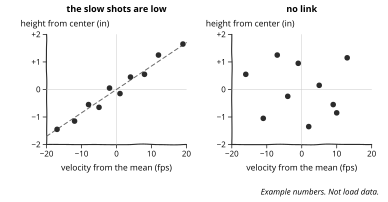
Next, ask whether velocity is causing the vertical.
- Take each shot’s velocity from the string’s average (dv) and its height from the group’s center (dh). In a composite, take both from each group’s own averages.
- Work out the correlation between the two. CORREL of the two columns in a spreadsheet gives the same number.
correlation = Σ(dv × dh) ÷ √(Σdv² × Σdh²)- If the correlation is positive and reaches the line in Table 24-1, the slow shots are the low ones. Velocity is moving your vertical, and a lower SD will tighten it. Below the line, a lower SD is not shown to help this group.
Distance matters a great deal here. Take a 140 gr 6.5 Creedmoor load at 2,700 fps. Example numbers. Not load data. There, 10 fps of velocity moves the bullet about .18 inch at 300 yards. At 1,000 yards it moves it about 3 inches.7 At 100 yards velocity explains almost none of the vertical.6 Look at the rifle, the rest and the barrel heat first.
Check the drop from gravity, not only the correlation. A positive correlation alone does not mean velocity caused a shot to land low. In a short string, a slow shot can happen to land low purely by chance, producing a high correlation coefficient ($r$). Always check the physical drop against what gravity actually does.
The change in bullet drop from a velocity change $\Delta v$ is:
drop change = drop(v + Δv) − drop(v)or approximately from time of flight $t$ and total gravity drop from the bore axis $y$:
drop change ≈ −2 × y × (Δv ÷ v)At 100 yards with the example 6.5 Creedmoor load, a shot 20 fps slow has its gravity drop increased by only about .04 inch. If that shot printed .75 inch below the group center, velocity explains only .04 inch of that displacement (about 5 percent). The other .71 inch came from rifle dispersion, aim, cant or rest movement. When the observed vertical displacement is several times larger than the ballistic drop, velocity did not cause the vertical error, even if the correlation happens to be positive.
This is also why real groups almost always remain circular. If velocity variation were a primary driver of vertical dispersion, targets would routinely stretch into vertical ellipses. When your vertical and horizontal spreads are roughly equal (the ratio in Table 24-1 is below the line), velocity variation is not the limiting factor.
From neck tension to the target (for handloaders). You can apply the same correlation formula to test the full chain: neck tension (or seating force) to muzzle velocity, and velocity to target height. If you log seating force at the bench and match each round to its chronograph reading, compute the correlation between seating force and velocity. You will usually find very little correlation across normal neck interference. And because velocity explains very little vertical dispersion inside 300 to 600 yards, neck tension variation rarely reaches the target at all.
Flyers
Every committed shot counts (see Chapter 15). A wide shot is often just normal dispersion: about 14 shots in 100 land beyond two standard deviations, so a 30-shot composite holds about four (see Figure 24-3).
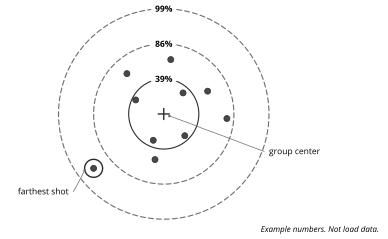
Judge a suspected flyer against the average radial distance of all other shots (excluding the farthest prevents it from inflating the yardstick):
- Measure each shot’s distance from its group center (see Chapter 15), average all except the farthest, and divide the farthest distance by that average.
- Flag it as a far shot worth investigating only when the ratio exceeds 3.
This threshold holds for 5- to 30-shot groups and composites (testing the single farthest shot once against all others). Even then, ~1 clean target in 20 flags by chance. Investigate causes (such as a loose scope mount), but keep the shot unless you documented the error when fired.
Worked example. Example numbers. Not load data. In Chapter 15’s group, shot 9 is farthest at .711 inch; the other nine total 2.888 inches (average .321 inch). The ratio .711 ÷ .321 = 2.2 (< 3) marks shot 9 as normal tail dispersion.
Common questions
| Question | Short answer | See |
|---|---|---|
| Should I choose a MIL or MOA scope? | Either works if reticle and turrets match. MIL (0.1 mrad) simplifies decimal math and dominates practical rifle; MOA (1/4 or 1/8 MOA) gives finer steps for F-Class and benchrest. | 3, 5 |
| Should I choose a First Focal Plane (FFP) or Second Focal Plane (SFP) scope? | FFP keeps subtensions true at all magnifications (ideal for PRS and hunting); SFP keeps reticle thickness constant at max power (preferred for F-Class and benchrest). | 5 |
| How do I know if my scope turrets track accurately? | Run a 100-yard Tall Target Test along a plumb line: dial a known value (e.g., 10 MIL or 30 MOA), compare actual to dialed shift, and enter any correction factor in your solver. | 6, 20 |
| How many shots do I need to evaluate a factory lot or handload? | 5–10 shots rule out a bad load; proving a good load takes a 20–30-shot composite; separating two close loads takes 35+ shots per load. | 15, 16 |
| My rifle shot a tiny group last week and a big one today. What changed? | Maybe nothing—one of two 5-shot groups from the same load is ≥1.5× larger 30% of the time. Check ring and action torque, then shoot a larger composite. | 15, 16, 24 |
| What velocity SD is good enough? | Depends on cartridge, target, range, and wind. Inside 300 yards, a 15 fps SD adds ~0.3″ vertical in centerfire but ~4–5″ in subsonic .22 LR; 1,000-yard F-Class uses 5–7 fps to protect the 10/X-ring. | 15, 21 |
| Why do my drops match at 100 yards and miss at 800 yards? | Short range hides velocity, BC, sight-height, and tracking errors. Verify zero, sight height, and tracking first; true velocity supersonically before adjusting drag near Mach 0.9. | 6, 20 |
| Should I use G1 or G7 ballistic coefficients? | Use G7 for sleek boat-tail bullets, G1 for centerfire flat-bases, and RA4 or custom Doppler curves for .22 LR (where G1 diverges downrange). Never mix G1 BCs into G7 settings. | 19 |
| Do I need to handload to shoot a precision rifle well? | No. Modern factory match ammunition often meets practical hit-probability goals out of the box. Test by lot with real sample sizes and buy winning lots in bulk. | 12, 16, 23 |
| How do I tune a .22 LR rimfire rifle if I cannot handload? | Structured lot testing across match brands/lots (interleaving same-brand lots; patching and seasoning between different waxes) is primary. Track cold-bore shift, clean chamber/carbon ring, and avoid over-cleaning the bore. | 12, 14, 16, 23 |
| How do I set my ethical maximum hunting range? | Take the shorter of two limits: where impact velocity drops to the bullet’s minimum expansion velocity, or where field-position vital-zone hit probability falls below 90%. | 21, 22 |
| When is the cosine rule accurate for uphill or downhill shots? | Within ~0.1–0.2 MIL under 20–25° and 400–500 yards. For steeper angles or longer ranges, enter slant range and look angle directly into a solver. | 11, 20 |
| Why is my new barrel speeding up, and when should I finalize my DOPE? | New barrels smooth out and typically gain 20–80 fps over their first 100–200 rounds. Wait for velocity to stabilize before finalizing long-range DOPE. | 20, 23 |
| How often should I clean my barrel, and should I clean to bare metal? | Clean on a consistent round-count cadence guided by target and velocity logs, keeping the chamber neck (or rimfire mouth/leade) free of carbon rings. Stripping to bare metal every trip adds no proven benefit and requires re-fouling. | 14, 23 |
Notes
- Browning, X-Bolt Rifle Owner’s Manual, safety rule 10, ammunition malfunction, browning.com/support/owners-manuals/x-bolt-rifle.html.
- Browning, X-Bolt Rifle Owner’s Manual; SAAMI, Frequently Asked Questions, What should I do if my firearm fails to fire when the trigger is pulled? saami.org/faqs/.
- Bryan Litz, Modern Advancements in Long Range Shooting, Volume III, Applied Ballistics Books, 2022; Cal Zant, “Powder Temperature Sensitivity: The Hidden Factor Affecting Your Long-Range Accuracy,” Precision Rifle Blog, 2025, precisionrifleblog.com/2025/03/08/powder-temperature-sensitivity/; “Effects of Humidity on Powder Performance,” AccurateShooter Daily Bulletin, 2025, bulletin.accurateshooter.com/2025/01/effects-of-humidity-on-powder-performance-podcast-info-2/.
- Western Powders, Handloading Guide 8.0, 2020, “Bullet Stabilization Problems,” hodgdonpowderco.com/wp-content/uploads/2023/04/WesternPowdersHandloadingGuide8.0_WEB-1.pdf.
- Empirical Precision, User Guide, linked from the app’s dashboard, 2026, section 16, empiricalprecision.com.
- Empirical Precision, User Guide, section 9.
- Empirical Precision, User Guide, section 15.3.