
Key points
- DuPont’s four-digit IMR codes began as internal laboratory specification numbers rather than a burn-rate scale; competing brands adopted famous numbers such as
4350,4895,4831, and4064as shorthand for burn-rate niches. - Four active commercial propellants carry the
4350designation (IMR 4350,Hodgdon H4350,Accurate 4350, andShooters World SW4350), representing four distinct formulations made across three continents. - Military spherical propellants use Olin/St. Marks
WCandSMPfactory codes, while commercial retail lines translate those families into brand numbers and descriptive trademarks. - Modern European makers—Vihtavuori, ADI Mulwala, Explosia Lovex, Nitrochemie Reload Swiss, and Eurenco Bofors—encode chemical base, burn-rate order, or factory heritage directly into their naming systems.
The DuPont IMR Four-Digit System
Modern rifle nomenclature owes its most persistent confusion to a single 1930s convention. When E. I. du Pont de Nemours and Company replaced its early two-digit Improved Military Rifle (IMR) formulations (IMR 15½, IMR 17½, and IMR 25½) with cleaner, coated single-base extrusions in the mid-1930s, the company assigned four-digit laboratory specification numbers to each commercial release.1 IMR 3031 arrived in 1934, followed by IMR 4064, IMR 4198, IMR 4227, and IMR 4320 in 1935, and IMR 4350 in 1940.2
Those four-digit numbers were never a burn-rate ladder. They originated as internal development and specification identifiers at DuPont’s Carneys Point laboratories and plant.3 Ordering the classic IMR series from fastest to slowest illustrates why the digits cannot be read numerically:
- Fast rifle:
IMR 4227(fastest of the classic group), thenIMR 4198. - Medium-fast to medium rifle:
IMR 3031, thenIMR 4895, thenIMR 4064, thenIMR 4320. - Medium-slow to magnum rifle:
IMR 4350, thenIMR 4831, thenIMR 7828.
Notice the reversals. IMR 4198 burns far faster than IMR 3031, even though its number is higher. IMR 4895 burns faster than IMR 4064 and dramatically faster than IMR 4350, yet its number is higher than both. Only at the slow end of the catalog (4350, 4831, 7828) do the digits happen to climb as burn rate slows.
Because DuPont’s four-digit powders defined American rifle handloading for decades, their numbers entered the vocabulary as shorthand for cartridge applications rather than proprietary trademarks. When surplus salvagers and rival packagers introduced propellants targeting the same bottleneck niches after World War II, reusing the familiar four-digit number immediately signaled the intended burn-rate window to shooters. Over eighty years, that commercial shortcut produced overlapping naming families whose canisters look similar on a shelf but contain chemically distinct propellants.
The 4350 Family: Four Canisters, Three Continents
No number illustrates commercial naming overlap better than 4350. Today, four widely distributed bottleneck rifle propellants carry 4350 on the label. They are not relabeled copies of one formula; they are four distinct propellants produced by three different industrial plants across North America, Australia, and Europe (Figure 8-1).
- IMR 4350. Introduced by DuPont in 1940 as a slow-burning, single-base extruded cylinder for cartridges such as the
.270 Winchesterand.30-06 Springfield.4 Modern production takes place at General Dynamics Ordnance and Tactical Systems – Canada (GD-OTS Canada) in Valleyfield, Quebec, using legacy solvent-extruded nitrocellulose tooling.5 - Hodgdon H4350. Packaged by Hodgdon Powder Company as a flagship member of its Extreme extruded line, H4350 is manufactured in Mulwala, New South Wales, by Thales Australia (Australian Munitions) under the domestic code
ADI AR2209.6 It is a single-base extruded propellant engineered with ADI’s temperature-insensitive surface treatment, giving it flatter thermal behavior across ambient temperature swings than traditional IMR 4350.7 - Accurate 4350. Introduced by Accurate Arms (later Western Powders, acquired by Hodgdon in 2020) as a shorter-cut competitor in the 4350 burn-rate band.8 Historically, Accurate sourced its extruded rifle powders from Explosia a.s. in the Czech Republic before Western Powders shifted production of Accurate 4350 to GD-OTS Canada at Valleyfield to Accurate’s own proprietary specifications.9 Even when made under the same roof in Quebec, Accurate 4350 was blended to separate specifications and was never an identical twin of IMR 4350.
- Shooters World SW4350. Imported into North America by Shooters World and manufactured in Pardubice-Semtín, Czech Republic, by Explosia a.s. under its domestic designation
Lovex S070.10 It is a European single-base extruded cylinder targeting the same medium-slow bottleneck niche as the other three canisters.
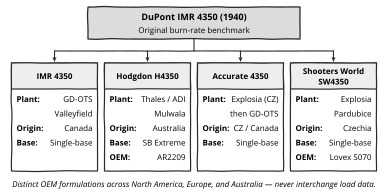
All four powders sit close together on empirical burn-rate charts and serve cartridges such as the 6.5 Creedmoor, .270 Winchester, and .30-06 Springfield. Their bulk densities, grain lengths, deterrent packages, and charge-pressure curves differ enough that load data for one 4350 canister never transfers directly to another.
Other Legacy Four-Digit Lineages: 4895, 4831, 4064, 4198, and 3031
The same post-war salvage history and burn-rate targeting multiplied other famous DuPont numbers across rival brands.
The 4895 lineage
DuPont developed IMR 4895 as a military propellant for the .30-06 Springfield M2 Ball cartridge used in the M1 Garand during World War II.3 In 1947, Bruce Hodgdon purchased 50,000 pounds of war-surplus 4895 and sold it to civilian shooters as H4895, launching the Hodgdon Powder Company.4 When World War II surplus stockpiles ran dry, Hodgdon contracted new commercial manufacture first in Scotland (Nobel/ICI) and later with ADI in Mulwala, Australia. Modern H4895 is manufactured at Mulwala as ADI AR2206H—a shorter-cut, temperature-insensitive Extreme single-base extrusion distinct from Valleyfield-made IMR 4895.6 Accurate later echoed the number with Accurate 2495 (retaining the 495 cadence with a 2 prefix), originally sourced from Explosia in the Czech Republic and later moved to GD-OTS Valleyfield to Accurate’s own specifications.9
The 4831 lineage
Unlike 4895 and 4350, the 4831 commercial name began with Hodgdon rather than DuPont. In 1950, Bruce Hodgdon salvaged war-surplus DuPont single-base extruded propellant originally manufactured for 20mm Oerlikon anti-aircraft cannons and marketed it as H4831.4 Its slow burning profile proved ideal for overbore hunting cartridges such as the .270 Winchester and .300 Winchester Magnum. As surplus supplies dwindled, Hodgdon transitioned H4831 to newly manufactured Scottish production and eventually to Thales/ADI Mulwala (ADI AR2213).6 To improve metering through mechanical powder measures, ADI introduced a shorter grain cut—ADI AR2213SC, packaged in North America as Hodgdon H4831SC (SC for Short Cut)—engineered to match standard H4831 ballistically while packing slightly denser.11 DuPont answered Hodgdon’s success in 1973 by releasing its own commercial canister IMR 4831 (manufactured today at Valleyfield), which is slightly faster-burning than H4831 and chemically distinct.
The 4064 and 4198 lineages
DuPont released IMR 4064 and IMR 4198 in 1935 as classic single-base extruded cylinders.12 IMR 4064 gained fame for its versatility in .308 Winchester and .30-06 Springfield despite its notoriously long, hard-to-meter tubular grains. Accurate targeted that market with Accurate 4064, a shorter-cut single-base extrusion historically sourced from Explosia and later produced at GD-OTS Valleyfield to independent specifications.9 Similarly, IMR 4198 (made at Valleyfield) gained a parallel Australian counterpart when Hodgdon sourced H4198 from ADI Mulwala as ADI AR2207—a shorter, temperature-insensitive Extreme single-base extrusion in the fast bottleneck class.6
The 3031 lineage
IMR 3031 (1934) remained unique to the IMR catalog rather than spawning identically numbered rivals. Competitors instead targeted its medium-fast burn-rate slot under original names, including ADI’s Benchmark (BM2), Accurate 2015, and Vihtavuori’s N133 and N135. Even here, however, the legacy four-digit format shaped marketing expectations for decades; when IMR later released modern short-cut and Enduron lines (IMR 8208 XBR, IMR 4166, IMR 4451, IMR 4955, IMR 7977, IMR 8133), it preserved the four-digit numeric style even though IMR 8208 XBR was made in Australia by ADI rather than in Quebec.6
Military-to-Canister Codes: Olin and St. Marks (WC and SMP)
Spherical (“ball”) propellants followed a completely different naming lineage anchored in U.S. military procurement. When Fred Olsen developed the water-slurry spherical propellant process for the Western Cartridge Company (later Olin Corporation) in the 1930s, factory formulations received WC prefixes (for Western Cartridge).13 After Olin built its dedicated spherical plant in St. Marks, Florida, in 1970 (later acquired by General Dynamics as St. Marks Powder), modern commercial and military factory codes also adopted the SMP prefix (for St. Marks Powder).14
Two military WC designations shaped post-war commercial rifle propellants:
WC 844. The standard military spherical propellant for5.56x45mm NATO(M193 and M855) ammunition, whose commercial canister counterpart isHodgdon H335.15WC 846. The standard military spherical propellant for7.62x51mm NATO(M80) ammunition, closely related to the commercial lineage behindHodgdon BL-C(2)andWinchester 748.15
Military WC propellants and commercial canister propellants differ in an important operational respect. Military procurement specifications optimize a lot for one fixed cartridge, projectile, primer, and weapon system, allowing wider lot-to-lot burn-rate swings because the arsenal adjusts charge weight per production lot. Commercial canister propellants (H335, BL-C(2), W748, W760) are blended to tight canister-grade repeatability across lots so published reloading tables remain valid from year to year.16
Under the SMP factory designation system, individual base blends map onto multiple retail brands packaged by Hodgdon (including the licensed Winchester brand) and Alliant:
- Winchester numeric codes such as
W748,W760(SMP 760, identical in OEM base to discontinuedHodgdon H414),Supreme 780, and magnum-handgun/300 Blackoutboundary powderW296(Hodgdon H110).17 - Descriptive commercial families introduced in the 2000s–2020s, where branding highlights a specific functional additive or engineering goal rather than a numeric code: Hodgdon’s
CFE(Copper Fouling Eraser:CFE 223,CFE BLK),Leverevolution, andSUPERFORMANCE; Winchester’s temperature-insensitiveStaBALLseries (StaBALL Match,StaBALL 6.5,StaBALL HD); and Alliant’sPower Prospherical rifle line (1200-R,2000-MR,4000-MR,Varmint).18
European and Australian Systematic Numbering
While American nomenclature evolved through lab codes, surplus salvage, and marketing names, European and Australian plants built systematic codes that tell the reader far more about a powder’s chemistry and burning speed.
Vihtavuori (N100, N500, and 20N29/24N41)
Finland’s Nammo Vihtavuori Oy uses one of the clearest numbering architectures in the industry.19 Centerfire rifle propellants divide cleanly into two primary series by chemical base:
N100series (N120,N130,N133,N135,N140,N150,N160,N165,N170). Single-base extruded nitrocellulose powders. Within the series, higher numbers correspond systematically to slower burning speeds—from fast small-boreN120and benchrestN133through mid-boreN140/N150to magnumN160,N165, andN170.19N500series (N530,N540,N550,N555,N560,N565,N568,N570). Nitroglycerin-infused high-energy double-base extruded propellants. The second and third digits intentionally mirror the burn-rate territory of the correspondingN100number:N540sits in theN140mid-bore class,N550and temperature-stabilizedN555occupy theN150/4350 window, andN560,N565,N568, andN570step progressively slower through magnum and extreme-long-range cartridges.19- Heavy-caliber legacy codes (
20N29and24N41). Vihtavuori’s ultra-slow.50 BMGand large-magnum single-base extrusions retain older factory nomenclature derived from 20mm-class and heavy-ordnance grain geometry codes rather than theN100/N500rifle grid.19
ADI Mulwala (AR22xx and BM)
Thales Australia’s Mulwala plant labels its domestic Australian rifle catalog with two prefixes: AR (Australian Rifle) and BM (Bench Mark).7 In the AR22xx series, the final two digits reflect development sequence rather than strict burn-rate order at the fast end (AR2207 and AR2219 both burn faster than AR2206H), whereas the medium-to-magnum sequence climbs cleanly from faster to slower: AR2208 (Varget) → AR2209 (H4350) → AR2213SC (H4831SC) → AR2217 (H1000) → AR2225 (Retumbo).6
Two suffixes carry specific technical meanings at Mulwala:
SCdenotes Short Cut (AR2213SC=H4831SC), signaling reduced grain length for smoother metering.6HinAR2206H(H4895) distinguishes the modern temperature-insensitive Hodgdon-specification formulation from the older, discontinuedAR2206.7
The BM prefix covers short-cut precision extruded powders engineered for benchrest metering: BM2 (packaged as Hodgdon Benchmark) and BM8208 (packaged as IMR 8208 XBR, paying tribute to DuPont’s famous experimental short-cut 8208 / T32 benchrest propellant of the 1960s).6
Explosia Lovex versus Shooters World
Czech manufacturer Explosia a.s. uses an explicit chemistry-first code for its Lovex commercial line.20 Every designation opens with a letter indicating chemical base:
S= Single-base extruded nitrocellulose (S060,S062,S065,S070,S071).D= Double-base nitrocellulose/nitroglycerin (D060,D063,D073.04,D073.05,D073.06,D100). Note thatDindicates double-base chemistry rather than grain shape alone:D060is a double-base extruded tubular propellant, whereas theD073.0xfamily (D073.04,D073.05,D073.06) consists of double-base spherical ball propellants.20
Within both S and D rifle families, higher numeric codes generally indicate slower burning rates (S060 → S062 → S065 → S070; D073.04 → D073.05 → D073.06). When Shooters World packages Lovex propellants for North American retail, it replaces those technical codes with application-oriented English names—Precision Rifle (S062), Long Rifle (S065), SW4350 (S070), AR Plus (D073.04), Tactical Rifle (D073.05), and Match Rifle (D073.06)—so shooters can read the intended role straight off the canister.21
Nitrochemie Reload Swiss (RS30–RS80)
Launched in 2013 by Nitrochemie Wimmis AG, the Reload Swiss (RS) catalog uses a strictly monotonic numeric burn-rate ladder.22 RS20 is a handgun propellant and RS30 sits at the magnum-pistol boundary, while bottleneck rifle grades step cleanly from fastest to slowest: RS36, RS40, RS50, RS52, RS60, RS62, RS70, RS76, and RS80.22
Adjacent mid-bore numbers also encode paired chemistries: RS50 and RS62 are traditional single-base extrusions, whereas RS52 and RS60 (twin to Alliant Reloder 17) are their EI® high-energy counterparts.22
Bofors RP, Norma, and Alliant Reloder
Sweden’s Eurenco Bofors AB historically assigned RP (Swedish Röksvagt Pulver) internal factory codes—including the RP11 lineage behind medium-burn .308 Winchester grades—and supplies two major retail brands.23
Norma Precision pairs a 200-series (200, 201, 202, 203-B, 204, and slow magnum 217) with descriptive acronyms for its flagship high-energy lines: URP (Ultra Rifle Powder, 4350 band) and MRP (Magnum Rifle Powder).24
Alliant Powder markets its extruded rifle line under the legacy Hercules Reloder trademark (7, 10x, 15, TS 15.5, 16, 17, 19, 22, 23, 25, 26, 33, and 50), stepping generally from small-bore to .50 BMG, with TS denoting Temperature Stable.25 Crucially, the sequence spans two European OEMs: Eurenco Bofors (Sweden) produces 7, 10x, 15, TS 15.5, 16, 19, 22, 23, 25, and AR-Comp, whereas Nitrochemie (Switzerland/Germany) produces the EI®-impregnated 17, 26, 33, and 50.26
Notes
- Philip B. Sharpe, Complete Guide to Handloading, Funk & Wagnalls, 1937; Julian S. Hatcher, Hatcher’s Notebook, 3rd edition, Stackpole Books, 1962.
- Philip B. Sharpe, Complete Guide to Handloading; Hodgdon Powder Company, About Hodgdon: Company History, hodgdonpowderco.com/about/.
- Julian S. Hatcher, Hatcher’s Notebook.
- Hodgdon Powder Company, About Hodgdon.
- General Dynamics Ordnance and Tactical Systems – Canada, Valleyfield Operations: Energetics and Propellants, gd-otscanada.com/.
- Australian Munitions, Powder Equivalents, Thales Australia, adiworldclass.com.au/powder-equivalents/.
- Australian Munitions, ADI World Class Handloaders’ Guide, Thales Australia, adiworldclass.com.au/.
- Hodgdon Powder Company, Hodgdon Powder Company Acquires Western Powders (Accurate and Ramshot), October 2020, 2020, hodgdonpowderco.com/.
- Western Powders and GD-OTS Canada Valleyfield, Safety Recall Notice: Accurate 2495, Accurate 4064, and Accurate 4350, November 2019, 2019, hodgdonpowderco.com/.
- Explosia a.s., Lovex Smokeless Powders Reloading Guide, Explosia a.s., explosia.cz/en/streliviny/bezdymne-prachy/; Shooters World, Propellant Guide and Technical Specifications, shootersworldpowder.com/.
- Australian Munitions, Powder Equivalents; Australian Munitions, ADI World Class Handloaders’ Guide.
- Philip B. Sharpe, Complete Guide to Handloading.
- Fred Olsen, Propellent Powder, U.S. Patent 2,027,114, 1936, patents.google.com/patent/US2027114A/en; General Dynamics Ordnance and Tactical Systems, St. Marks Powder: BALL POWDER Propellants, gd-ots.com/energetics/propellants/.
- General Dynamics Ordnance and Tactical Systems, St. Marks Powder.
- Hodgdon Powder Company, About Hodgdon; General Dynamics Ordnance and Tactical Systems, St. Marks Powder.
- SAAMI, ANSI/SAAMI Z299.4: Voluntary Industry Performance Standards for Pressure and Velocity of Centerfire Rifle Ammunition for the Use of Commercial Manufacturers, 2015, saami.org/.
- “Hodgdon Discontinues H414 and IMR 4320,” AccurateShooter Daily Bulletin, 2020, bulletin.accurateshooter.com/; General Dynamics Ordnance and Tactical Systems, St. Marks Powder.
- General Dynamics Ordnance and Tactical Systems, St. Marks Powder; Alliant Powder, Rifle Propellants Product Catalog, The Kinetic Group, alliantpowder.com/products/rifle.aspx.
- Nammo Vihtavuori Oy, Vihtavuori Rifle Powders Technical Specifications, vihtavuori.com/powders/n100-n500-series/.
- Explosia a.s., Lovex Smokeless Powders Reloading Guide.
- Shooters World, Propellant Guide and Technical Specifications.
- Nitrochemie Wimmis AG, Reload Swiss Technical Data and EI Propellant Technology, reload-swiss.com/en/reload_swiss/index.php.
- Eurenco, Propellants and Bofors Energetics Capabilities, Eurenco Group, eurenco.com/; Norma Precision AB, Norma Reloading Powders, norma-ammunition.com/en-gb/products/reloading-components/powder.
- Norma Precision AB, Norma Reloading Powders.
- Alliant Powder, Rifle Propellants Product Catalog.
- Eurenco, Propellants and Bofors Energetics Capabilities; Nitrochemie Wimmis AG, Reload Swiss Technical Data and EI Propellant Technology; Alliant Powder, Rifle Propellants Product Catalog.