
Key points
- Firing and sizing harden the case neck. A hard neck springs back more and splits sooner.
- Annealing heats the neck and shoulder to soften them. The case head must stay hard.
- Anneal after the coarse clean and the inspection, before lube and sizing. The sizing die then works on brass that is already softened.
- It is very hard to tell whether annealing worked. Temperature-indicating paint and your sizing numbers are indirect checks. Color is not a sign of a successful anneal.
- Annealing extends neck life. A benefit on target is plausible but unproven at large sample sizes.
Why it matters
Brass hardens when it is bent and stretched. This is called work hardening. Each firing expands the neck, and each sizing squeezes it back. After several cycles the neck is harder than it was when new. A harder neck springs back more after sizing. Its grip on the bullet and its shoulder position can vary more from case to case. In time the neck splits.
Annealing heats the neck and shoulder until the worked metal re-forms its grains and softens again. The neck can then bend without cracking. It also responds to sizing more as it did when new.
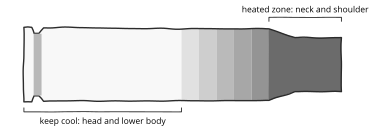
The case head is different. It holds the case against chamber pressure, so it must stay hard. Never heat the head. Keep the heat in the neck and shoulder (see Figure 21-1). Too much heat also harms the neck, which can end up softer than new. That is why the setup below uses the shortest time that works.
How it is done
Do you need to anneal?
Annealing earns its place when neck work hardening is what ends your brass’s life. Your workshop log shows why each case was discarded (see Chapter 18). If necks split first, annealing should add firings. If primer pockets loosen first, or heads show the stretch ring first, annealing will not help. It treats only the neck and shoulder.
Some loaders anneal every firing to keep neck hardness the same from one loading to the next. In theory, necks of the same hardness grip the bullet the same way. Velocity should then be more consistent too. In a 2024 survey, 69 percent of top Precision Rifle Series (PRS) shooters annealed.1 Popularity is not proof (see “Test it on target yourself” below).
When to anneal
Anneal after the coarse clean and the inspection, and before lube and sizing (see Chapter 17). Lube would burn on the case. Sizing after annealing sets your dimensions on brass in its final state.
Choose a schedule, every firing or every few, and keep it. Every case in a brass batch should share the same history. If you start annealing a batch partway through its life, anneal every case in it. A half-annealed batch has two histories.
Safety at the annealer
Set up by measurement
The three methods are flame, induction and molten salt (see Chapter 7). Whatever the method, keep the heat source, distance and case position fixed. Change only the time.
- Start with clean, dry cases. No lube, and no water inside.
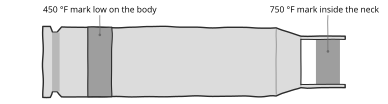
- Mark a test case with temperature-indicating paint. Put a 750 °F mark inside the neck.2 Put a 450 °F mark low on the body, near the head. It catches heat that spreads too far down the case (see Figure 21-2).3
- Run the test case at a short time. Look at both marks. Raise the time in small steps, with a fresh test case for each step (see Figure 21-3).
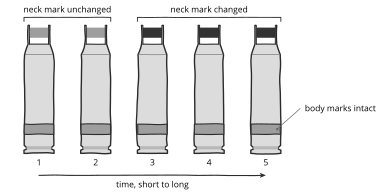
- Stop at the shortest time that changes the neck mark. The body mark must not change. Write down the time and every setting in your log. Repeat the setup for each new lot or cartridge.
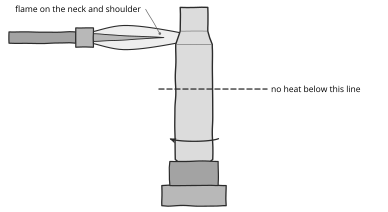
- Anneal the batch at that setting. Keep the case position the same for every case (see Figure 21-4). Scrap any case whose head changed color.
- Let the cases cool. Air cooling and a drop into water both work. Water does not harden brass the way it hardens steel. After a salt bath, wash the salt off the cases in clean water, away from the pot.4 Dry every quenched or washed case fully (see Chapter 18) before you lube and size it.
Annealed necks often show a band of color. It is not a sign of a successful anneal, so never judge an anneal by its color. Color can only warn of failure. A neck that glows red in a lit room got too hot.5 If you suspect a batch was overheated, scrap it.
How to tell it worked
Because you cannot see brass hardness directly, use these three indirect checks:
- Did the neck get hot enough while the body stayed cool? The indicator test at setup answers this.
- Does the brass size more evenly? Size 20 annealed and 20 unannealed cases from the same batch, with one die, one lube and one session. Compare the SD of the sized base-to-shoulder readings, and of the neck diameters, with the F-test on two SDs (see The Precision Rifle Handbook, Chapter 16 and Appendix A.8). It needs a comparator that reads to .0005 inch or finer.
- Do the necks last longer? Keep a tally of firings and neck splits for each brass batch.
Sized base to shoulder, 20 cases each (inch)
Not annealed   highest 1.6300   lowest 1.6280   spread .0020   SD .00060
Annealed       highest 1.6295   lowest 1.6285   spread .0010   SD .00030

F           = (.00060 ÷ .00030)² = 4.0
two-sided p = 2 × F.DIST.RT(4.0, 19, 19) = 0.004
Example numbers. Not load data. A p-value this small is strong evidence that the annealed cases size more evenly. Confirm the result on a second batch before you rely on it.
Test it on target yourself
- Split one batch at random into two halves, giving each its own brass batch name, and anneal one half while prepping both identically.
- Load both halves with one load you already shoot.
- Fire interleaved blocks at separate aim marks: about 35 shots per half for mean radius, or 50 for velocity SD (see The Precision Rifle Handbook, Chapter 16).
- Compare mean radius and velocity SD with the F-test (see The Precision Rifle Handbook, Chapter 16 and Appendix A.8), and repeat after several more firings as the unannealed half hardens.
Notes
- Cal Zant, “How Do the Best Shooters Reload? What the Pros Use,” Precision Rifle Blog, 2024, precisionrifleblog.com/2024/11/10/how-do-the-best-shooters-reload/.
- Enterprise Services LLC, “Tempilaq 750 Heat Indicating Liquid,” Anneal-Rite, 2022, cartridgeanneal.com/tempilaq/; John Barsness, “Annealing Rifle Brass,” Handloader, June/July 2017, handloadermagazine.com/annealing-rifle-brass.
- Enterprise Services LLC, “Tempilaq 750 Heat Indicating Liquid.”
- G. Chambers, “Annealing Temperatures for Reloading Brass Cartridge Cases,” Ballistic Recreations, Annealing Knowledge Centre, Test Procedure, 2021, ballisticrecreations.ca/salt_home_legacy/annealing-knowledge-centre/annealing-temperatures-for-reloading-brass-cartridge-cases/.
- AMP Annealing, Mark II Instruction Guide, ampannealing.com/instructions/; John Barsness, “Annealing Rifle Brass.”
- Alex Findlay and Matt Findlay, “Annealing Under the Microscope, Part 4,” AMP Annealing, 2019, ampannealing.com/articles/55/annealing-under-the-microscope/.
- Mitch Campana, “Reloading Brass Life,” RCBS Reloading Articles, 2026, rcbs.com/reloading-articles/reloading-brass-life/; Hornady, Case Neck Annealing Kit Product Instructions, static.hornady.media/presscenter/docs/1410993058-Case-Neck-Annealing-Kit-Instructions.pdf.
- Hornady, “Let’s Talk Annealing,” The Hornady Podcast, episode 136, 2024, hornadymanufacturing.libsyn.com/ep-136-lets-talk-annealing; John Masek, “Annealing Torture Test: Does Annealing Multiple Times Matter?” Ultimate Reloader, 2025, ultimatereloader.com/2025/07/16/annealing-torture-test-does-annealing-multiple-times-matter/.