Key points
- Accuracy is how close your group center sits to the point of aim; precision is how tightly your shots cluster together.
- Every precision discipline—Benchrest, PRS, F-Class, Service Rifle, ethical hunting, rimfire precision competitions and trainers, and bullseye pistol—runs on the same measurement science.
- A 3-shot group is a tiny sample. It can make a poor cartridge or rifle look good and a good one look poor.
- The Law of Large Numbers: an average settles only as the number of shots grows.
- Evidence means enough recorded impacts from one rifle, measured by one method, and an honest statement of the uncertainty.
Why it matters
Every precision shooter asks the same basic question: where will the next bullet land? The answer looks slightly different across disciplines, yet the underlying problem is identical.
- Benchrest and F-Class. Shooters chase the smallest possible dispersion at known distances from stable rests or prone supports. Every tenth of an inch matters.
- PRS and practical precision. Shooters engage steel targets at varied ranges from barricades, tripods, and awkward positions under time pressure. First-round hit probability matters more than a single tiny group.
- Service Rifle. Shooters hold sling-supported positions across slow-fire and rapid-fire stages with iron sights or low-power optics, balancing position repeatability with mechanical precision.
- Ethical long-range hunting. Hunters need a cold-bore first-round hit inside a vital zone, paired with enough terminal velocity and energy to make a clean kill (see Chapter 22).
- Rimfire precision competitions and trainers (NRL22, PRS Rimfire, smallbore) and bullseye pistol. Precision .22 LR matches and trainers demand the same wind-reading skill, lot-testing rigor, and positional fundamentals at short range for a fraction of the cost. Even bullseye pistol shooting follows the same statistical laws of dispersion, shot calling, and sample size.
Whether you shoot commercial factory ammunition or handloads you assembled yourself (see The Handloading Handbook), precision shooting shares one weak spot. Modern rifles, optics, and ammunition invite constant tinkering, and every change invites a test. Many range tests are too small to answer the question they ask. A shooter changes one thing—a new box of ammunition, a different bipod, a torque setting—fires 3 shots, and sees a smaller group. The change seems to work. It may have done nothing. The group may have been small by chance.
Telling the difference takes measurement. Real-world analysis is neither cheap nor easy. Many mid-priced modern rifles already shoot very well with good factory ammunition. Improving on that takes time, discipline, and often a lot of money. There are no shortcuts, gadgets, lucky charms, or rituals that allow you to skip the process. Treat measurement as an essential skill.
From three shots to evidence
My father had me zero my own rifle one afternoon. I remember that day fondly. We used a simple method that nobody questioned. Fire 3 shots. Adjust the scope. Repeat until the shots were “dead nuts on.” Maybe throw out a few “flyers” I must have pulled. We left the range with a little less than half a box of .30-30 Winchester ammunition still in its yellow cardboard box. It was a rite of passage, and it “just worked.”
For years I carried that tradition forward. I relied on 3-shot and 5-shot groups to tell me everything I thought I needed to know about a rifle. The process was cheap, it was simple and it “just worked.” It was the way it had always been done.
Time passed. The targets stretched farther out and the rifles changed. The old ways began to show their cracks. But the process still “just worked.” Didn’t it?
Then the internet arrived. It brought a flood of forum posts, competing theories and endless arguments. Everyone had a system. Many claimed theirs was the only system that “just worked.”
I met a competition shooter at the range. I was intrigued. I always knew those shooters existed (F-Class, benchrest and the like). I just thought they were good ol’ boys with more money than sense, playing with shiny rifles and reloading to save money. It turned out they were much more serious than I could have imagined. They were the real deal. They all had a system too, and it “just worked.”
That caused the first reckoning in me. Being told a process “just worked” was no longer good enough. I wanted to know exactly how well it worked. I wanted to know how well one process works compared to another. I wanted to know how to change my process so it works better. And I wanted to know whether a change actually made an improvement.
Then I had a second reckoning. I made a pan of cheap weeknight lasagna. I took a square from the corner. It was as close to perfect as any I have ever made. It was browned on top, with crispy cheese on the sides. It was not too sloppy and not too dry. It was just what I wanted. Then I got a second cut from near the center. It was still cold. The cheese was not even melted. How could this be? The answer was obvious. I had no right to call my lasagna perfect on the strength of one square cut from my favorite corner. A 3-shot group is that corner square.
Those early range days are a great memory. They are one of my favorites. But what worked for an old .30-30 with ammunition from the local hardware store was not working for me anymore. As the saying goes, “In God we trust; all others must bring data.”1 So let’s go get some data.
How it is done
Accuracy versus precision
Shooters often use “accuracy” and “precision” as if they mean the same thing. In measurement science, they describe two separate properties of a group of shots.
- Precision is how tightly your shots cluster together, regardless of where they land on the target. Tight groups mean high precision (low dispersion).
- Accuracy is how close the center of your group sits to the point of aim. A zeroed rifle whose group center sits on the bullseye is accurate.
A rifle can be precise without being accurate: all 10 shots punch a tiny hole two inches left of the bullseye. You fix that with a turret adjustment (see Chapter 10). A rifle can also be accurate on average without being precise: 10 shots scatter across a four-inch circle centered on the bullseye. No turret click can shrink that spread. Shrinking dispersion takes better ammunition, better rifle hardware, or better marksmanship fundamentals.
Every long-range hit requires both. Precision keeps your cone of fire smaller than the target, and accuracy places the center of that cone on the target.
Anecdote versus evidence
An anecdote is an observation offered as proof. “This load shoots” after only one small group is an anecdote. Anecdotes are not lies. They are claims resting on samples too small to back them up.
Evidence has four marks: enough shots to answer the question asked, every shot recorded (including the ones you dislike), the same method of measurement for every load, and an honest statement of the uncertainty that remains.
Extraordinary claims require extraordinary evidence. “My rifle groups well at 100 yards” is a modest claim that only needs a modest sample of shots. “This 0.1 gr change halved my group size” is an extraordinary claim. Large tests rarely find effects that big from changes that small (see Chapter 17). Before you believe it, you need enough shots to rule out everything else, including luck (see Chapters 14, 15 and 16).
The Law of Large Numbers
The Law of Large Numbers says that the average of a sample moves toward the true average as the sample grows. Short runs are noisy and obscure the truth. Long runs settle toward the truth. Three examples from outside shooting show how strong the effect is.
The casino. A gambler bets on black at a roulette table and wins three times in a row. In that sample of three, black has won every time. Should the gambler assume he has found a winning method? The casino is not worried. An American wheel has 38 pockets, and 18 of them are black. Over the long run, black wins 47.4 percent of spins. Over 10,000 spins, the share of black settles close to that figure. The house keeps its edge of about 5.26 percent on every even-money bet.
The shooting parallel. A 3-shot group is the gambler’s three wins. It feels like a winning method. It may be a lucky cluster of noise.
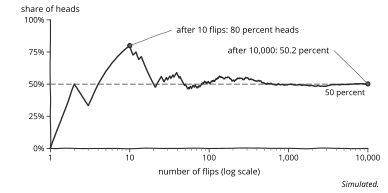
The coin. Flip a fair coin 10 times. Eight heads and two tails is an ordinary result. A split of 8 to 2 or worse, in either direction, happens about 11 times in 100. Stop there, and your data says the coin lands heads 80 percent of the time. Flip the same coin 10,000 times. The share of heads will land between 49 and 51 percent about 9,500 times in 10,000.
The shooting parallel. A rifle shoots one tiny group, with 2 shots outside it written off as “flyers.” One group, and especially one group with the “flyers” removed, cannot separate a good rifle from good luck. Only more shots and honest shots can prove a rifle.
The medical trial. A drug company gives a new heart medicine to five patients. Each patient gets a different dose. Patients 3 and 4 improve. Has the company found the perfect dose? No regulator would approve the drug on that evidence. Five patients cannot separate the drug’s effect from chance. Regulators want large trials to wash out that noise. A late-stage trial typically enrolls 300 to 3,000 patients.2
The shooting parallel. A ladder test fires one shot at each charge. Two neighboring charges that land close together are patients 3 and 4 (see Chapter 17). Two bad results do not condemn a load, and two good results do not prove one.
The problem with small groups
Small groups mislead in three major ways.
- High volatility (“They swing widely”). Two small groups fired from the same rifle and ammunition often look completely different by chance alone. Fire two 5-shot groups from the same load, and one will be at least 1.5 times the size of the other about 30 times in 100. With 3-shot groups, that happens 46 times in 100.
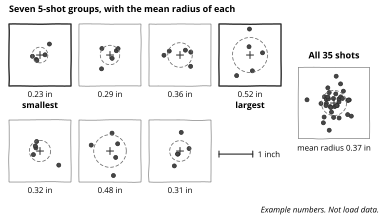
- Selection bias (“The best of several is flattering”). Picking the best group and ignoring the rest gives a false picture of precision. Across seven 5-shot groups from the same load, the smallest group averages 0.66 times the load’s true 5-shot average. The largest averages 1.38 times that average. The smallest group is usually just the luckiest of the seven.
- Statistical center bias (“They read small”). You measure a group from the center of the shots on the target, not the true center the load would show over many shots. Because that center is pulled toward the shots you just fired, the group reads smaller than the load’s true spread. Mean radius (the average distance of shots from the center) reads low by:
- about 18 percent for a 3-shot group
- about 11 percent for a 5-shot group
- about 5 percent for a 10-shot group
The fewer shots in the group, the more it understates your true spread (see Chapter 15).
All three sets of figures are calculations that assume normally distributed shots.
It is not just groups. A velocity standard deviation (SD) from a 5-shot string swings from one string to the next even more widely than a 5-shot group does (see Chapter 15).
A larger sample fixes all three problems. It also tells you when two loads really differ.
Small samples are not useless. A few shots can reject a gross fault, such as a loose scope (see Chapter 4). They cannot prove a small gain.
The price of certainty
The shots you need depend on the size of the difference you want to detect, not on whether you want to prove a load good or reject it as poor. A gross fault shows in a few shots. A small gain or loss takes dozens. The usual statistical standards allow a false alarm 1 time in 20 and ask for an 80 percent chance of catching a real difference. By those standards, you need about 35 shots per load (seven 5-shot groups) to tell apart two loads whose true group sizes differ by 1.5 to 1. A 1.25 to 1 difference takes about 110 shots per load (see Chapter 16).
Uncertainty does not shrink in a straight line. It shrinks with the square root of the shot count. To cut your uncertainty in half, you must fire four times as many shots (for example, 40 shots instead of 10). Going from 3 shots to 30 cuts your uncertainty to less than a third. Going from 30 shots to 60 cuts it by only about 30 percent more, so the extra time and ammunition buy a much smaller gain.
The workflow on one page
The work follows a continuous path that loops from the rifle to the final application:
- Firearm and optic. Record the rifle specifications, mount and level the scope, verify mechanical tracking, and lock the hardware baseline (Part II).
- Safety and verified ammunition. Confirm the ammunition is safe and functional for your chamber, whether commercial factory ammunition or a handload that completed a safe work-up (Chapter 2 and The Handloading Handbook).
- Fundamentals and zero. Build a repeatable shooting position, establish a verified zero, and practice honest shot calling (Part III).
- Testing and records. Measure velocity and group dispersion with enough shots to separate signal from chance, and log every shot and environmental condition (Part IV).
- Comparison and selection. Compare cartridges, lots, or hardware changes with proper statistical tests. If a handload falls short, take that data back to the workshop (see The Handloading Handbook); if factory ammunition falls short, test another cartridge or lot.
- Ballistics and truing. Check bullet stability, build a ballistic solution, and true it against measured impacts at distance (Part V).
- Shoot for record. Build your drop chart and error budget, know your hit probability, and take your verified system to a match or a hunt.
- Maintain and re-verify. Track barrel wear, seasonal shifts, and lot changes, and re-verify when the system drifts (Part VI).
Even a proven setup comes back round. Barrels wear, seasons change, and ammunition lots run out (see Chapter 23).
Notes
- Sharon Lohr, Lies, Damned Lies, and Statistics Misquotations, 2023, often credited to W. Edwards Deming, though it is not found in his writings, sharonlohr.com/blog/2023/10/31/statistics-misquotations.
- U.S. Food and Drug Administration, Step 3: Clinical Research, 2018, fda.gov/patients/drug-development-process/step-3-clinical-research.