
Key points
- The four universal firearm safety rules block every negligent-discharge failure mode.
- Precision rifles add specific hazards: muzzle brake blast, suppressor alignment and heat, and hot-chamber cook-off.
- Only test known-good ammunition verified safe for your chamber; stop immediately on pressure signs.
- Squibs and hangfires require disciplined stop-and-wait procedures.
Why it matters
A precision rifle generates 50,000 to 65,000 psi inches from your face and sends projectiles miles downrange. Safe habits protect everyone on the line and keep every test session calm and repeatable.
How it is done
The four universal rules and what each prevents
Negligent discharges almost never come from a single mistake. They happen when two or more safety habits fail at the same time. The four universal firearm safety rules act as overlapping barriers so that one lapse does not injure anyone.
| Rule | Failure mode blocked | Precision rifle application |
|---|---|---|
| 1. Treat every firearm as if it is loaded. | Complacency after “clearing” a gun or trusting someone else’s word. | Visually and physically inspect the chamber every time you pick up a rifle, even after dry fire or cleaning. |
| 2. Never point the muzzle at anything you are not willing to destroy. | Injury from a mechanical failure, slam-fire, or unintended trigger press. | Keep the muzzle pointed downrange or safely vertical when moving between props, adjusting a bipod, or clearing a malfunction. |
| 3. Keep your finger off the trigger until your sights are on the target and you have decided to shoot. | Startle reflex, stumble, or premature press on a light match trigger. | Precision triggers often break under 2 pounds. Keep your finger straight along the chassis or stock until the reticle settles on target. |
| 4. Be sure of your target, what is in front of it, and what is beyond it. | Ricochets, pass-throughs, or striking foreground cover because of sight height. | High-velocity rifle bullets travel several miles if they clear a berm. Remember that the bore sits 1.5 to 2.5 inches below the scope, so a clear sight picture can still strike a barricade edge or hilltop. |
Precision rifle hardware hazards
Precision rifles carry hardware that introduces hazards beyond ordinary range handling.
- Chamber flags. An open bolt is hard to verify from ten feet away. Insert a bright chamber flag (empty chamber indicator) whenever the rifle is not on the firing line or when the range goes cold. During positional matches, a chamber flag lets range officers and squadmates confirm a safe rifle at a glance while you move between stages.
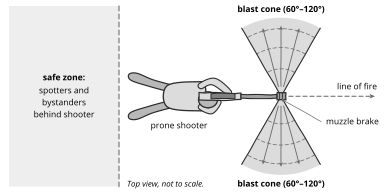
- Muzzle brakes and blast zones. A muzzle brake vents high-pressure propellant gas—often 4,000 to 10,000 psi or more at the muzzle—outward to the sides and slightly rearward to cut recoil.1 That blast throws dirt and gravel sideways and delivers sharp concussion to anyone beside the muzzle. Keep spotters and bystanders behind the shooter, never abreast of the muzzle. Wear double hearing protection (foam plugs under earmuffs) whenever firing or spotting near braked rifles, especially under covered firing lines.
- Suppressor alignment and heat. A suppressor that sits slightly off the bore axis risks a baffle strike, which can destroy the tube and launch jacket fragments off line. Check alignment with a calibrated bore alignment rod whenever mounting a suppressor on a new barrel or muzzle mount. Check tightness periodically during a session, because vibration and thermal expansion can back a direct-thread or quick-detach mount loose. Suppressors also trap intense heat. A few rapid strings can heat the outer tube hot enough to cause severe burns and melt nylon rifle cases or shooting mats. Let the suppressor cool before packing it, and use a heat-resistant cover if heat mirage obscures your sight picture.
- Hot-chamber cook-off. Leaving a live cartridge sitting inside a hot chamber transfers heat directly into the powder charge. Even before cook-off, a heated round burns faster, spiking chamber pressure and muzzle velocity and ruining group data. In an overheated chamber, a round can ignite on its own without a trigger press. Keep the bolt open between strings so air cools the bore, and chamber a round only when you are ready to fire.
Verifying known-good ammunition
Precision evaluation begins with ammunition already proven safe and functional for the specific rifle.
- Match the headstamp to the barrel stamp. Read the chambering stamped on the rifle barrel and verify that every box and every cartridge headstamp matches it. Do not trust loose ammunition from an unlabeled box. Similar cartridges can chamber in the wrong rifle—for example, a smaller-diameter bullet firing loosely down a larger bore, or a shorter case chambering into a longer throat—causing dangerous pressure spikes or case failure.
- Inspect factory ammunition. Before loading a magazine, scan the rounds for crushed shoulders, deeply seated or crooked bullets, high or inverted primers, and mixed headstamps. Record the factory lot number in your log so you can trace any malfunction or performance shift back to that lot (see Chapter 13).
- Verify handloaded ammunition. If you shoot handloads, confirm the recipe completed a safe work-up from a published start load in that specific rifle without exceeding published maximums (see The Handloading Handbook). Never shoot someone else’s unverified handloads.
- Stop immediately on pressure signs. Watch fired brass and bolt feel on every string. In centerfire rifles, heavy bolt lift, flattened or cratered primers, shiny ejector smears on the case head, pierced or blown primers, split necks or case bodies, and sudden unexplained velocity jumps are warning signs of excessive pressure. In rimfire rifles, watch for split rims, ruptured case heads, or hot gas escaping back from the breech. Pressure rises far faster than velocity, and some overpressure loads show few external signs until a case fails.2
Squibs, hangfires, and range discipline
Abnormal ignition requires calm, practiced reactions rather than haste.
- Hangfires (the 30-second rule). If the firing pin falls without firing, keep the muzzle downrange and wait at least 30 seconds before opening the action.3 A delayed primer or powder burn can detonate out of battery if you open the bolt early, venting gas and brass toward your face and hands.
- Squib loads and bore obstructions. In a squib, the primer fires without a full powder burn, lodging the bullet in the bore; the report is muffled, recoil is light, and nothing hits the target. Stop, unload, remove the bolt, and inspect from the breech or run a cleaning rod through the bore. Firing into a lodged bullet, mud, snow, patch, or bore-sighting tool can rupture the barrel.
- Eye and ear protection. Wear impact-rated eye protection (ANSI Z87.1 or equivalent) and hearing protection whenever uncased rifles are on a live line. Hearing damage is cumulative and permanent; a single unmuffled centerfire rifle shot can cause lasting loss.
- Lead hygiene. Primers, exposed bullet bases, and steel splatter leave lead dust on hands, brass, and gear. Keep food and open drinks off the bench, and wash hands and face with cold water and soap before eating or drinking (cold water keeps pores closed). Wash range clothes separately and keep range shoes out of living areas, especially around children.4
Notes
- Philip H. Dater and Jason M. Wong, “Barrel Length Studies in 5.56mm NATO Weapons,” Small Arms Defense Journal, first issued in 2010 as Effects of Barrel Length on Bore Pressure, Projectile Velocity and Sound Measurement, 2012, sadefensejournal.com/barrel-length-studies-in-5-56mm-nato-weapons/; SilencerCo, What Does Caliber Mean? The Real Suppressor Spec, silencerco.com/blog/caliber-vs-psi-suppressors.
- Karl W. Kleimenhagen, “Chronographs and Pressure,” Karl’s Soapbox, 2006, http://kwk.us/chronographs.html; John Barsness, “The Least Reliable ‘Pressure Indicator’,” Rifles and Recipes, excerpt from The Big Book of Gun Gack III, chapter 30, 2022, riflesandrecipes.com/ammunition/the-least-reliable-pressure-indicator/.
- SAAMI, Frequently Asked Questions, What should I do if my firearm fails to fire when the trigger is pulled? saami.org/faqs/; Browning, X-Bolt Rifle Owner’s Manual, safety rule 10, ammunition malfunction, browning.com/support/owners-manuals/x-bolt-rifle.html.
- Centers for Disease Control and Prevention, People at Increased Risk for Childhood Lead Poisoning, 2026, cdc.gov/lead-prevention/risk-factors/index.html; NIOSH, NIOSH Pocket Guide to Chemical Hazards: Lead, respirator recommendations, Centers for Disease Control and Prevention, cdc.gov/niosh/npg/npgd0368.html.