Key points
- MIL (mrad) and MOA are angular units, not linear inches; their linear size grows with distance.
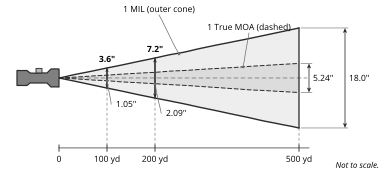
- 1 MIL equals 1/1,000 of the distance (3.6 inches at 100 yards; 10 cm at 100 meters).
- True MOA is 1.047 inches at 100 yards; Shooter’s MOA (IPHY) is 1.000 inch at 100 yards.
- Using your reticle as a ruler removes guesswork when measuring impacts, holding wind, and dialing corrections.
Why it matters
External ballistics, scope turrets, group dispersion, and wind calls all speak in angles. Fluent angular math turns every shot impact into an exact correction.
How it is done
What an angle is and why shooters use angles
Linear units—inches, feet, centimeters—measure physical size on a target. They fail as a universal shooting language because the rifle pivots around you in an angle, not in inches.
A 2-inch group at 100 yards is mediocre for a precision rifle. A 2-inch group at 1,000 yards is extraordinary. The physical size is the same, yet the angular dispersion at 1,000 yards is ten times smaller. The same rule governs your riflescope. Turning an elevation turret by one click tilts the scope’s internal erector assembly by a fixed angle. At 100 yards, that angle moves the point of impact a fraction of an inch. At 1,000 yards, the exact same click moves the point of impact ten times as many inches.
Working in angles solves this problem. Drop charts, wind calls, scope turrets, reticle hashes, and group dispersion all share one angular language that scales automatically with distance.
MIL (milliradians)
A radian is the angle formed when an arc along a circle equals the circle’s radius. One milliradian (1 mrad, written 1 MIL in shooting) is 1/1,000 of a radian.
Because MIL is base-10, its math is simple in any unit of distance. For the small angles used in shooting, 1 MIL subtends (covers) 1/1,000 of the distance to the target:
- At 100 yards (3,600 inches), 1 MIL = 3.6 inches.
- At 1,000 yards, 1 MIL = 36 inches (1 yard).
- At 100 meters (100,000 mm), 1 MIL = 10 cm (100 mm).
- At 1,000 meters, 1 MIL = 1 meter.
Most MIL riflescopes adjust in 0.1 MIL clicks. One click moves the point of impact 0.36 inch at 100 yards (1 cm at 100 meters).
1 MIL in inches = 3.6 × (distance_yd / 100)
1 MIL in cm     = 10 × (distance_m / 100)
MIL correction  = linear_offset_in / (3.6 × distance_yd / 100)
Worked example. Example numbers.
You fire at a steel plate at 400 yards and measure your impact 7.2 inches low.
1 MIL at 400 yards = 3.6 × (400 / 100) = 14.4 inches
MIL correction     = 7.2 / 14.4        = 0.5 MIL (5 clicks of 0.1 MIL)
Dial up 0.5 MIL to bring the point of impact onto the center of the plate.
MOA (True MOA vs. IPHY)
A full circle contains 360 degrees, and each degree divides into 60 minutes. One Minute of Angle (1 MOA) is 1/60 of a degree, or 1/21,600 of a full circle.
At a radius of 100 yards (3,600 inches), the circumference of a full circle is 2 × pi × 3,600 = 22,619.5 inches. Dividing by 21,600 gives 1.0472 inches per 100 yards, usually rounded to 1.047 inches. This exact geometric value is True MOA. In metric units, 1 True MOA = 2.91 cm (29.1 mm) at 100 meters.
Many shooters approximate 1 MOA as 1.000 inch per 100 yards for quick mental arithmetic. That rounded unit is called Shooter’s MOA or IPHY (Inches Per Hundred Yards).
At 100 yards, the 4.7 percent difference between True MOA and IPHY is tiny (0.047 inch on a 1-inch group). At long range, it adds up fast. Suppose a ballistic solver calculates a drop of 30.0 True MOA at 1,000 yards (314.2 inches). If your scope actually tracks in IPHY (1.000 inch per 100 yards per click) and you dial 30.0 MOA, the scope moves only 300.0 inches. You miss 14.2 inches low—about 1.35 MOA—purely from mixing True MOA and IPHY. Know whether your scope and your solver use True MOA or IPHY, and verify your scope’s real click value with a Tall Target Test (see Chapter 6).
Most MOA riflescopes adjust in 1/4 MOA clicks (0.262 inch at 100 yards; 7.3 mm at 100 meters). Benchrest and F-Class scopes often use 1/8 MOA clicks (0.131 inch at 100 yards; 3.6 mm at 100 meters) for finer zeroing on tiny scoring rings.
Converting between MIL, MOA, and linear units
Use these plain-text formulas to move between MIL, True MOA, and linear measurements at any distance:
1 MIL        = 3.4377 True MOA (about 3.44 MOA)
1 True MOA   = 0.2909 MIL      (about 0.291 MIL)

Linear size (in) = MIL × 3.6 × (distance_yd / 100)
Linear size (in) = True_MOA × 1.0472 × (distance_yd / 100)
Linear size (cm) = MIL × 10 × (distance_m / 100)
Linear size (cm) = True_MOA × 2.909 × (distance_m / 100)

MIL      = linear_in / (3.6 × distance_yd / 100)
True MOA = linear_in / (1.0472 × distance_yd / 100)
True MOA = linear_cm / (2.909 × distance_m / 100)| Distance | 1 MIL | 0.1 MIL click | 1 True MOA | 1/4 True MOA click | 1/8 True MOA click |
|---|---|---|---|---|---|
| 50 yards | 1.80″ | 0.18″ | 0.52″ | 0.13″ | 0.065″ |
| 100 yards | 3.60″ | 0.36″ | 1.05″ | 0.26″ | 0.13″ |
| 100 meters | 10.0 cm | 1.0 cm | 2.91 cm | 7.3 mm | 3.6 mm |
| 200 yards | 7.20″ | 0.72″ | 2.09″ | 0.52″ | 0.26″ |
| 300 yards | 10.80″ | 1.08″ | 3.14″ | 0.79″ | 0.39″ |
| 500 yards | 18.00″ | 1.80″ | 5.24″ | 1.31″ | 0.65″ |
| 1,000 yards | 36.00″ | 3.60″ | 10.47″ | 2.62″ | 1.31″ |
Worked example. Example numbers.
You fire a group at 300 yards and measure its size on paper as 2.10 inches.
True MOA = 2.10 / (1.0472 × 3) = 2.10 / 3.1416 = 0.67 True MOA
MIL      = 2.10 / (3.6 × 3)    = 2.10 / 10.8   = 0.19 MIL
Notice that 0.67 × 0.2909 = 0.195 MIL, matching the direct calculation.
Using the reticle as a ruler
With a matched scope (MIL reticle with MIL turrets, or MOA with MOA), you can skip inches and use the reticle as a calibrated ruler; mixing units forces you to multiply or divide by 3.44 under time pressure, inviting mistakes.
- Measure impacts directly. If a 600-yard splash lands 0.8 MIL low and 0.4 MIL left, skip inches: dial up 0.8 MIL and right 0.4 MIL, or hold 0.8 MIL high and 0.4 MIL right.
- Dial vs. hold. Dialing centers the crosshair for elevation changes, deliberate shots, and small targets; holding is faster under time pressure, follow-ups, and shifting wind. Many shooters dial elevation and hold wind.
- Estimate range. Measuring a known-size target (such as an 18-inch steel plate) in MIL or MOA lets you compute distance without a laser rangefinder (see Chapter 11).