
Key points
- Black powder hit a hard physical ceiling in the late nineteenth century: low energy density, heavy solid fouling, dense smoke, and degressive burning limited service-rifle velocity and practical rate of fire.
- Paul Vieille’s Poudre B (1884), Alfred Nobel’s Ballistite (1887), and British Cordite (1889) established the two enduring families of smokeless small-arms propellants—single-base and double-base—from which rifle, artillery, pistol, and shotgun powders later diverged.
- Propellant base classes differ in energetic plasticizers: single-base relies on nitrocellulose alone, double-base adds nitroglycerin or DEGDN, and triple-base adds nitroguanidine to cool flame temperature in heavy ordnance.
- Nitric ester bonds decompose slowly over time, releasing nitrogen dioxide that triggers autocatalytic heating unless intercepted by sacrificial chemical stabilizers.
The mechanical ceiling of black powder
For more than five centuries, firearms relied on a single mechanical mixture: black powder. Standard military black powder combined roughly 75 percent potassium nitrate (saltpeter), 15 percent charcoal, and 10 percent sulfur, milled into an intimate physical blend, pressed into cake, broken into grains, and glazed with graphite.1 It was not a chemical compound but a compacted mixture of oxidizer and fuel. That distinction dictated every limitation of nineteenth-century small arms.
More than half of a black powder charge converts to solid combustion products—chiefly potassium carbonate, potassium sulfate, and potassium sulfide—rather than expanding gas.2 Those solids coated rifle bores within a few shots, degrading accuracy and forcing soldiers and target shooters to wipe barrels or accept oversized fouling tolerances. The suspended particulate cloud hung over firing lines in thick white smoke, blinding riflemen and betraying firing positions immediately.3
Thermochemically, black powder delivered a modest specific heat of explosion of roughly 2,700 to 3,000 kJ/kg, with low gas yield per gram compared with nitrated organic polymers.4 Worse still, black powder burned degressively: even when pressed and screened into coarse granulation, each irregular grain shrank in surface area as it burned, producing a sharp early pressure peak followed by rapidly falling gas generation down the bore.5 Large-bore service cartridges such as the .45-70 Government and .577/450 Martini-Henry pushed heavy lead bullets at roughly 1,300 to 1,400 fps, and even bottleneck black-powder express rifles struggled to pass 2,000 fps without excessive fouling and recoil. Breaking past that barrier required a propellant that converted almost entirely to hot gas and burned at a controlled, mathematically predictable rate.
Nitrocellulose and the three foundational inventions
The chemical breakthrough began in 1846, when Swiss-German chemist Christian Friedrich Schönbein nitrated cotton fibers with a mixture of nitric and sulfuric acids, producing guncotton (cellulose nitrate).6 Early guncotton was powerful and nearly smokeless, converting overwhelmingly to gaseous carbon monoxide, carbon dioxide, nitrogen, water vapor, and hydrogen. Yet in raw fibrous form it was disastrously unsuitable for gun barrels. Microscopic hollow cotton capillaries allowed hot combustion gases to penetrate the entire charge almost instantaneously, transitioning from orderly deflagration to violent detonation that shattered iron and steel breeches. Early storage magazines also exploded spontaneously because residual manufacturing acid remained trapped inside unwashed fibers.6
Two separate problems therefore stood between Schönbein’s discovery and a usable rifle propellant: chemical purification and physical gelatinization.
In 1865, British chemist Sir Frederick Abel solved the purification problem at the Royal Gunpowder Factory at Waltham Abbey. By pulping nitrated cotton in paper-mill beaters and boiling it repeatedly in fresh water, Abel flushed trapped nitrating acid out of the hollow fiber lumens, yielding chemically clean guncotton suitable for blasting and military demolition.6 Even purified, however, fibrous guncotton still burned far too violently for small-arms barrels.
Poudre B (1884)
The decisive transformation came in 1884 from French physicist and engineer Paul Vieille at the Laboratoire Central des Poudres et Salpêtres in Paris. Vieille dissolved a blend of soluble and insoluble nitrocellulose in a volatile mixture of ethyl ether and ethyl alcohol, kneading the fibers into a dense, horn-like dough called a colloid.7 Rolled into thin sheets, dried to drive off the solvent, and cut into uniform square flakes, the resulting non-porous solid—designated Poudre B (after General Georges Boulanger, or simply poudre blanche to distinguish it from black powder)—burned strictly from the outside surface inward in parallel layers.6
Adopted immediately by the French Army in the 8×50mmR Lebel cartridge (1886), Poudre B tripled the effective flat-shooting range of infantry rifles, eliminated concealing battlefield smoke, cut bore fouling dramatically, and launched a 232-grain jacketed bullet past 2,000 fps from a compact bottleneck case.8 Every military power in Europe and North America was forced into an overnight race to adopt smokeless small-arms ammunition.
Ballistite (1887)
Three years after Vieille’s single-base colloid, Swedish chemist Alfred Nobel took a different chemical path. Rather than relying solely on volatile solvents that evaporated away during drying, Nobel plasticized lower-nitrogen nitrocellulose directly with liquid nitroglycerin (about 40 to 50 percent in his original 1887–1888 patent, stabilized with camphor and later diphenylamine or aniline derivatives).7 Because nitroglycerin served as both a gelatinizing plasticizer and a high-energy liquid explosive, the resulting propellant—Ballistite—packed far greater chemical energy per gram than Poudre B and required little or no volatile solvent recovery.2 Italy adopted Ballistite for its 1891 Carcano service rifle, and flattened Ballistite flakes became foundational across both European rifle cartridges and early smokeless pistol and shotshell loads.9
Cordite (1889)
Britain sought its own double-base propellant while avoiding Nobel’s patent claims. In 1889, Sir Frederick Abel and Sir James Dewar patented Cordite, combining high-nitrogen guncotton (insoluble in nitroglycerin alone) with nitroglycerin using acetone as a mutual volatile solvent, plus roughly 5 percent mineral jelly (petroleum Vaseline) added originally as a die lubricant that unexpectedly acted as a coolant and mild stabilizer.6 Extruded through dies into long spaghetti-like strands—hence the name—Cordite Mk I contained roughly 58 percent nitroglycerin, 37 percent guncotton, and 5 percent mineral jelly.10
Cordite proved powerful and reliable in the .303 British service rifle, yet its high nitroglycerin content produced ferocious flame temperatures that eroded rifle barrels and naval cannon tubes rapidly. Britain subsequently introduced Cordite MD (Modified, 1901), inverting the ratio to roughly 65 percent guncotton, 30 percent nitroglycerin, and 5 percent mineral jelly to lower flame temperature and extend barrel life.10
One chemical root, many later branches
During the first two decades of the smokeless era, rifle, artillery, handgun, and shotshell propellants overlapped heavily in chemistry and manufacturing plants. Early shotgun powders such as Schultze and E.C. used partially gelatinized nitrocellulose granules; Laflin & Rand’s Bullseye (1898/1904) adapted double-base nitroglycerin-nitrocellulose flake chemistry to handguns; and early German Rottweil and Troisdorf flakes powered Mauser military rifles alongside sporting cartridges.10 Only as small-arms cartridges diverged in chamber pressure, bore volume, and velocity demands did industrial makers separate thin, porous, fast-burning handgun and shotshell flakes from the thick-webbed, surface-deterred, thermally engineered propellants required by modern bottleneck rifles.
Nitration chemistry and propellant base classes
At the molecular level, cellulose is a linear polymer of anhydroglucose rings, each carrying three hydroxyl (-OH) groups capable of esterification by nitronium ions (NO₂+) in a mixed nitric-sulfuric acid bath.11 Replacing all three hydroxyl groups on every ring produces theoretical cellulose trinitrate with 14.14 percent nitrogen by mass. Practical industrial nitration stops below that ceiling because physical equilibrium and water dilution limit complete substitution, and because nitrogen percentage directly controls both energy content and solubility in industrial solvents.12
- Pyrocellulose (soluble nitrocellulose, ~12.5–12.6% N). Readily dissolves in ether-alcohol mixtures. It became the traditional U.S. military single-base feedstock (Pyro DG) and remains central to classical solvent-extruded single-base rifle propellants.13
- Guncotton (high-nitrogen nitrocellulose, ~13.1–13.4% N). Delivers higher specific energy and gas yield, does not dissolve completely in ether-alcohol alone, and is blended with lower-nitrogen nitrocellulose or colloided with acetone and energetic plasticizers.12
- Feedstock origin. High-purity cotton linters (short fibers left on cotton seeds after ginning) were the historical gold standard for high-nitrogen nitrocellulose. Refined alpha-cellulose wood pulp emerged during the twentieth century as an economical, scalable industrial alternative; modern plants qualify either cotton linters or high-purity chemical wood pulp depending on nitration grade, viscosity target, and regional supply.14
From nitrocellulose as the structural polymer backbone, smokeless propellants split into distinct chemical base classes, illustrated in Figure 1-1 and summarized in Table 1-1.
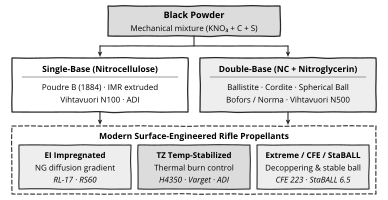
- Single-base propellants. Built on nitrocellulose as the sole energetic ingredient, plus stabilizers, surface deterrents, and minor functional additives. Single-base extruded propellants exhibit relatively low flame temperatures, gentle barrel-throat erosion, and a long history of thermal stability, though their specific heat of explosion is lower than nitroglycerin-bearing formulations.15
- Double-base propellants. Combine nitrocellulose with a liquid nitric ester plasticizer—most commonly nitroglycerin (NG) in commercial small-arms powders, or diethylene glycol dinitrate (DEGDN) in select European and military formulations designed for cooler combustion.15 Adding nitroglycerin raises energy density (
Qex), reduces moisture uptake because NG is hydrophobic, and eases extrusion or spherical droplet formation, at the cost of higher flame temperature and faster throat erosion.16 - Impregnated and infused rifle propellants. A modern hybrid class—exemplified by Nitrochemie’s EI® (extruded impregnated) process and Vihtavuori’s N500 series—starts with an extruded single-base grain skeleton and diffuses nitroglycerin into the grain after extrusion, combining extruded geometry and progressive surface deterrence with double-base energy output.17
- Triple-base propellants. Add crystalline nitroguanidine (picrite) to a nitrocellulose-nitroglycerin matrix. Because nitroguanidine produces a high volume of cool nitrogen-rich gas, triple-base propellants deliver high impetus with dramatically reduced flame temperature and muzzle flash.15 They are standard in heavy naval and tank artillery but rarely used in small-arms bottleneck rifle cartridges because nitroguanidine reduces bulk energy density and complicates fine-web small-arms extrusion.14
| Class | Principal energetics | Typical Qex (kJ/kg) | Relative flame temperature | Primary role |
|---|---|---|---|---|
| Black powder | KNO₃, charcoal, sulfur (mechanical mix) | 2,700–3,000 | Low (high solid slag) | Historical baseline; muzzleloaders |
| Single-base | Nitrocellulose (NC) | 3,100–3,800 | Cool to moderate | Standard & precision bottleneck rifles |
| Double-base (NG / DEGDN) | NC + nitroglycerin or DEGDN | 3,600–5,200 | Moderate to high | Spherical rifle, magnum, pistol, shotshell |
| Impregnated / infused | Extruded NC skeleton + infused NG | 3,800–4,200 | Moderate to high | High-velocity & overbore bottleneck rifles |
| Triple-base | NC + NG + nitroguanidine | 3,200–3,800 | Cool (high N₂ gas yield) | Large-caliber artillery & naval ordnance |
Table 1-1. Representative energetic ranges and roles across propellant classes. Exact heat-of-explosion (Qex) values vary with nitration level, plasticizer ratio, and deterrent content.18*
Chemical instability, magazine disasters, and sacrificial stabilizers
Nitric esters—both nitrocellulose and nitroglycerin—are thermodynamically metastable. The oxygen-nitrogen ester bond (R-O-NO₂) is relatively weak and undergoes slow homolytic cleavage and hydrolytic breakdown even at ambient room temperature.12 Left unchecked, that slow cleavage releases acidic nitrogen oxides, chiefly nitrogen dioxide (NO₂) and nitric oxide (NO). In the presence of trace moisture, those oxides form nitric and nitrous acids that attack neighboring nitrate ester chains, accelerating further bond cleavage and releasing heat. Because reaction rate rises roughly exponentially with temperature, an unstabilized or poorly purified mass of nitrocellulose enters autocatalytic decomposition: heat accelerates acid generation, acid accelerates heat release, and a confined stockpile can spontaneously ignite.19
The early smokeless era learned this chemistry through catastrophe. In March 1907, spontaneous decomposition of aged Poudre B ignited the aft magazine of the French pre-dreadnought battleship Iéna in dry dock at Toulon, killing more than a hundred sailors; four years later, in September 1911, the battleship Liberté suffered a similar magazine explosion in Toulon harbor.6 Investigation traced the disasters to inadequately stabilized Poudre B exposed to warm shipboard magazines, where amyl alcohol—used as an early nominal stabilizer—evaporated or failed to neutralize acidic nitrogen oxides effectively.2
Modern propellant longevity rests on sacrificial chemical stabilizers compounded directly into the colloid at roughly 0.5 to 2.0 percent by mass.20 Stabilizers do not stop nitric ester cleavage from occurring; instead, they react rapidly with liberated NO₂ and acid radicals before those products can catalyze further breakdown of the nitrocellulose matrix:
- Diphenylamine (DPA). The classic stabilizer for single-base propellants, introduced widely in the early twentieth century. DPA reacts sequentially with nitrogen oxides through N-nitrosodiphenylamine and nitrodiphenylamine derivatives, neutralizing acidic radicals across decades of cool storage.7 DPA is generally avoided in high-nitroglycerin double-base propellants because its basicity can promote hydrolysis of nitroglycerin.11
- Ethyl centralite (N,N’-diethyl-N,N’-diphenylurea) and methyl centralite. Mildly basic urea derivatives developed in Germany (at the Centralstelle für Wissenschaftlich-Technische Untersuchungen, hence centralite) that serve simultaneously as chemical stabilizers, plasticizers, and surface deterrents in double-base propellants.7
- Akardite II (N-methyl-N’,N’-diphenylurea). A modern high-efficiency stabilizer widely adopted in contemporary European single-base, double-base, and impregnated rifle propellants, prized for clean thermal aging and reduced formation of nitrosamine byproducts compared with legacy DPA.4
Because stabilizers act sacrificially, every smokeless propellant has a finite chemical service life governed by storage temperature and humidity (detailed in Chapter 12). Cool, dry storage preserves stabilizer reserves for decades; sustained heat consumes them rapidly.
Notes
- Tenney L. Davis, The Chemistry of Powder and Explosives, John Wiley & Sons, 1943; Jack Kelly, Gunpowder: Alchemy, Bombards, and Pyrotechnics — The History of the Explosive That Changed the World, Basic Books, 2004.
- Tenney L. Davis, The Chemistry of Powder and Explosives.
- Jack Kelly, Gunpowder.
- Rudolf Meyer, Josef Köhler, and Axel Homburg, Explosives, 6th edition, Wiley-VCH, 2007.
- Julian S. Hatcher, Hatcher’s Notebook, 3rd edition, Stackpole Books, 1962.
- Tenney L. Davis, The Chemistry of Powder and Explosives; G. I. Brown, The Big Bang: A History of Explosives, Sutton Publishing, 1998.
- Tenney L. Davis, The Chemistry of Powder and Explosives; Tadeusz Urbanski, Chemistry and Technology of Explosives, Volumes 2 and 3, Pergamon Press, 1965–1967.
- Julian S. Hatcher, Hatcher’s Notebook; G. I. Brown, The Big Bang.
- G. I. Brown, The Big Bang.
- Tenney L. Davis, The Chemistry of Powder and Explosives; Julian S. Hatcher, Hatcher’s Notebook.
- Tadeusz Urbanski, Chemistry and Technology of Explosives.
- Tadeusz Urbanski, Chemistry and Technology of Explosives; U.S. Army Materiel Command, Engineering Design Handbook: Solid Propellants, Part One, AMCP 706-175, Headquarters, U.S. Army Materiel Command, 1964.
- Tenney L. Davis, The Chemistry of Powder and Explosives; U.S. Army Materiel Command, Engineering Design Handbook.
- U.S. Army Materiel Command, Engineering Design Handbook.
- Tadeusz Urbanski, Chemistry and Technology of Explosives; Rudolf Meyer, Josef Köhler, and Axel Homburg, Explosives.
- U.S. Army Materiel Command, Engineering Design Handbook; Bryan Lawton, “Thermo-Chemical Erosion in Gun Barrels,” Wear, 251(1–12): 827–838, 2001.
- Nitrochemie Wimmis AG, EI Propellants: Extruded Impregnated Propellant Technology, Nitrochemie, nitrochemie.com; Vihtavuori, Reloading Guide 2026, Nammo Vihtavuori Oy, 2026, vihtavuori.com/wp-content/uploads/2026/04/Vihtavuori_Reloading_Guide_2026_ENG_web.pdf.
- Rudolf Meyer, Josef Köhler, and Axel Homburg, Explosives; Tadeusz Urbanski, Chemistry and Technology of Explosives; U.S. Army Materiel Command, Engineering Design Handbook.
- Tadeusz Urbanski, Chemistry and Technology of Explosives; Tenney L. Davis, The Chemistry of Powder and Explosives.
- U.S. Army Materiel Command, Engineering Design Handbook; Tadeusz Urbanski, Chemistry and Technology of Explosives.
- SAAMI, Smokeless Powder: Properties & Storage, 2022, saami.org/wp-content/uploads/2025/08/Info-Doc-Smokeless-Powder-11-8-2022.pdf.