
Key points
- Nearly all modern commercial bottleneck rifle propellants come from one of two industrial architectures: solvent extrusion (tubular rods) or Fred Olsen’s water-slurry spherical process (Ball Powder).
- Grain geometry—specifically web thickness, the shortest solid wall consumed during combustion—sets baseline burning duration independently of chemical energy.
- Surface engineering governs modern rifle performance: diffused deterrents, post-extrusion energetic impregnation (EI / N500), temperature-stabilization coatings (Extreme / TZ), decoppering agents, flash suppressants, and graphite glazing tailor gas generation to high-pressure bottleneck cases.
- Bottleneck rifle cartridges demand far greater geometric, thermal, and surface precision than handgun or shotshell powders because they must sustain controlled pressure across high expansion ratios and long barrels.
Solvent-extruded tubular manufacturing
Solvent extrusion is the direct industrial descendant of Paul Vieille’s colloiding process, refined over a century by plants such as DuPont (later GD-OTS Canada at Valleyfield), Thales/ADI (Mulwala), Vihtavuori (Laukaa), Eurenco Bofors (Karlskoga), Nitrochemie (Wimmis), and Explosia (Pardubice). Although proprietary solvent ratios and drying cycles vary by facility, the core chemical-engineering sequence remains remarkably consistent.1
- Cellulose preparation and nitration. Purified cotton linters or refined chemical wood pulp are dried, shredded, and immersed in metered nitric-sulfuric acid baths. Acid ratio, water content, temperature, and residence time fix the target nitrogen percentage (typically 12.6 to 13.3 percent for rifle grades).2
- Purification and pulping. Spent acid is centrifuged away. Nitrated fibers undergo boiling, pulping in beater mills to open internal lumens, and alkaline poaching washes until residual acid falls below strict stability limits.1
- Dehydration. Wet nitrocellulose holds roughly 25 to 30 percent water for safe handling. Hydraulic presses force ethanol through compressed blocks, displacing water without ever creating dry guncotton dust.2
- Incorporation (colloiding). Alcohol-wet nitrocellulose enters jacketed sigma-blade mixers with ethyl ether (or acetone for high-nitrogen or double-base blends), stabilizers, flash suppressants, and optional plasticizers, forming a rubbery colloidal dough.2
- Blocking, screening, and extrusion. Hydraulic blocking presses force the dough through fine macaroni screens to remove grit and uncolloided fibers. Extrusion presses then push it through steel dies fitted with centered pins that form the continuous axial perforation.2
- Cutting and solvent recovery. Rotating knives slice the strands into uniform cylinders. Closed recovery chambers strip and condense ether and alcohol vapors, followed by water-steeping or warm-air drying to fix residual solvent and moisture.2
- Surface treatment, glazing, and blending. Dried grains enter tumbling drums for deterrent coating, optional energetic impregnation, graphite glazing, screening, and multi-batch blending to hit target ballistic specs.2
Extruded manufacturing excels at geometric precision: die diameter, pin diameter, and cut length hold tight tolerances, producing single-perforated cylinders whose burning surface stays nearly constant. Its drawbacks are batch labor, solvent recovery overhead, and coarser volumetric metering when cut lengths are long.3
Water-slurry spherical (Ball) powder manufacturing
In the late 1920s and early 1930s, chemist Fred Olsen at Western Cartridge Company (later Olin Corporation, East Alton, Illinois) devised an entirely different architecture—patented in 1936—that eliminated dry colloiding, extrusion presses, and cutting knives altogether.4 Today, General Dynamics St. Marks Powder (Florida) and PB Clermont (Engis, Belgium) are the world’s premier practitioners of this spherical process.
Every hazardous mechanical step runs submerged in water:5
- Slurry formation and lacquer dissolution. Water-wet nitrocellulose (including salvaged stocks, a major economic breakthrough) is suspended in heated, agitated water with chalk (calcium carbonate) to neutralize residual acid. Water-immiscible ethyl acetate and dissolved stabilizers convert the fibers into liquid lacquer suspended in the water.2
- Globule formation. A protective colloid (such as animal glue or gum arabic) and sodium sulfate are added while tuned agitators shear the lacquer into fine droplets pulled into smooth spheres by surface tension.6
- Solvent distillation. Raising tank temperature boils off ethyl acetate through condensers while the suspended spheres solidify into dense, non-porous nitrocellulose balls.2
- Screening and nitroglycerin impregnation. Vibrating screens sort wet spheres into tight diameter bands—coarse for slow rifle grades, fine for pistol and shotshell powders. For double-base rifle grades, emulsified nitroglycerin migrates selectively out of warm water into the hydrophobic nitrocellulose spheres.2
- Mechanical rolling (flattening). To tune web thickness precisely without changing diameter fraction, wet spheres often pass between precision-gapped steel rolls that flatten them into oblate or cracked-ball profiles.2
- Surface deterrence, drying, and glazing. Heated slurry stills diffuse surface deterrents (such as dibutyl phthalate or centralite) into the outer shell to counteract naturally degressive geometry, followed by drying, graphite glazing, and final blending.2
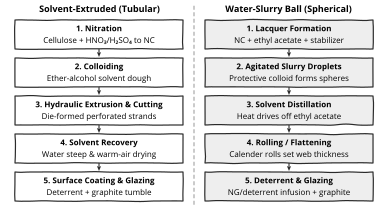
Figure 2-1 contrasts the solvent-extruded and water-slurry spherical production streams side by side.
Spherical manufacturing runs safer (wet-process handling reduces static and dust ignition risks), scales continuously to massive defense-contract volumes, and produces high-bulk-density grains that meter smoothly through automated ammunition-loading equipment.7
Grain geometry and web thickness
Once chemical formulation fixes a propellant’s intrinsic linear burning rate at a given pressure, grain geometry controls how long the grain burns and how rapidly its gas-generation surface area evolves.
The single most important geometric dimension of any propellant grain is its web thickness (w), defined as the minimum solid thickness of propellant between opposing burning surfaces.8 Because smokeless propellant burns inward from every exposed surface simultaneously at the same linear rate, total burning time at a fixed pressure is proportional to half the web thickness (w / 2). Doubling a grain’s web roughly doubles its burn duration—allowing the exact same nitrocellulose chemistry to fuel either a fast small-bore cartridge or a slow magnum rifle simply by changing die and pin geometry or roll-flattening gap.
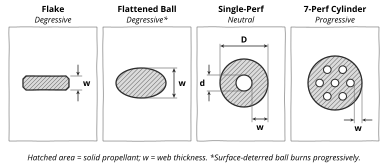
Four primary grain cross-sections dominate small-arms and ordnance propellants (Figure 2-2):
- Flake (disc or square wafer). Very thin web thickness (
wequals wafer thickness), high surface-to-mass ratio, and rapid burnout. Ideal for low-expansion-ratio handgun and shotshell cartridges; rare in modern bottleneck rifles except early historical formulations such as Poudre B and Rottweil rifle flakes. - Spherical and flattened ball. In an unrolled sphere,
wequals the full diameter; passing the sphere through calendar rolls compresses it into an oblate disc whose web equals its flattened minor thickness, fine-tuning burn time while preserving high bulk density and smooth volumetric flow.2 - Single-perforated cylinder (tubular / stick). The classic bottleneck rifle geometry. Web thickness equals half the difference between outer grain diameter (
D) and inner perforation diameter (d), sow = (D − d) / 2. As the outer wall shrinks inward, the inner perforation expands outward, keeping total burning surface area nearly constant until the wall burns through.9 - Multi-perforated cylinder (typically 7 perforations). Standard in large-caliber artillery and ultra-slow heavy rifle cartridges such as .50 BMG. Six outer perforations arranged around one central perforation create multiple expanding internal burning fronts, causing total surface area to grow substantially during combustion until the webs coalesce into residual slivers.8
Cut length (L) also matters mechanically in tubular rifle propellants. Long-cut cylinders bridge inside narrow bottleneck case necks and shear under volumetric powder-measure rotors; short-cut (“SC”) extruded versions—such as Hodgdon H4831SC relative to standard H4831—shorten cut length while adjusting web or coating so the powder packs more densely and meters more uniformly while maintaining comparable burn-rate behavior.
Surface engineering, impregnation, and functional additives
Bare nitrocellulose grains rarely match the pressure-time demands of modern bottleneck rifles. Instead, twentieth- and twenty-first-century propellant plants turned the grain’s outer micrometer-scale shell into an engineered chemical gradient.
Surface deterrents
A deterrent (also called a moderant) is a slow-burning or non-energetic organic plasticizer diffused into the outer skin of a dried propellant grain to a controlled penetration depth.1 When the primer ignites the charge, combustion starts slowly through the cooler, deterred outer layer while the bullet is still seated in the throat and chamber volume is minimal. As the flame front burns past the deterred shell into the undeterred energetic core—just as the bullet accelerates down the bore and internal volume expands—gas generation ramps upward. This chemical progressivity is essential to spherical ball powders, compensating for their naturally shrinking geometric surface area, and is equally central to modern progressive tubular rifle powders.2
Historically, 2,4-dinitrotoluene (DNT) and dibutyl phthalate (DBP) served as workhorse deterrents across single-base extruded and spherical rifle lines. Under European Union REACH chemical regulations enforced from 2018 onward, both DNT and DBP faced severe authorization restrictions due to toxicity concerns, accelerating industry migration toward ethyl/methyl centralite, polyester-based polymeric deterrents, and non-phthalate surface coatings (Chapter 7).10
Impregnated and temperature-stabilized architectures
Two landmark late-twentieth- and early-twenty-first-century advances reshaped bottleneck rifle propellants:
- Post-extrusion energetic impregnation. Conventional double-base extrusion mixes nitroglycerin uniformly throughout the dough prior to pressing, which limits die geometry and often heightens temperature sensitivity. By contrast, Nitrochemie’s EI® (Extruded Impregnated) process and Vihtavuori’s N500 high-energy process first extrude a mechanically robust single-base nitrocellulose cylinder and then infuse liquid nitroglycerin (together with surface deterrents) into the grain in a controlled post-extrusion step.11 The resulting concentration gradient delivers high specific energy and velocity potential while preserving progressive combustion and manageable thermal behavior.
- Temperature-zone stabilization. Conventional deterrent skins burn faster when warm and slower when cold because ambient grain temperature changes the enthalpy needed to reach surface ignition. Modern temperature-stabilized systems—pioneered commercially by Thales/ADI’s Extreme extruded line in the 1990s, Eurenco Bofors’s TZ® (Temperature Zone) technology in Sweden, and later stabilized spherical lines from General Dynamics St. Marks—pair specialized deterrent chemistry and tailored diffusion profiles so that burning-rate temperature dependence flattens across wide cold-to-hot ambient ranges.12
Decoppering, flash suppression, and glazing
Beyond burn-rate control, rifle propellants incorporate targeted trace additives (Table 2-1):
- Decoppering agents. High-velocity gilding-metal rifle jackets smear microscopic copper deposits onto barrel lands, gradually constricting bore diameter and altering friction. Trace additions of bismuth, tin, or zinc compounds (such as bismuth trioxide or tin dioxide, originally developed for military machine-gun and cannon propellants and popularized commercially in Hodgdon’s CFE line and Vihtavuori’s decoppering formulations) react with copper fouling in the hot bore gas stream to form brittle, low-melting intermetallic alloys that scour out with subsequent shots.13
- Flash suppressants. Unburned hot carbon monoxide (
CO) and hydrogen (H₂) exiting a rifle muzzle mix with atmospheric oxygen and reignite in a bright secondary muzzle flash. Adding 0.5 to 2.0 percent alkali-metal salts—chiefly potassium sulfate (K₂SO₄) or potassium nitrate (KNO₃)—releases potassium ions into the exhaust plume that quench free-radical chain branching and suppress secondary flash, at the minor cost of slightly increased solid particulate smoke.1 - Graphite glazing. Tumbling finished grains with roughly 0.1 to 0.3 percent fine powdered graphite coats each grain in a conductive, low-friction dark sheen. Graphite bleeds dangerous electrostatic charges during pneumatic conveying and metering, prevents grains from clumping in storage, increases bulk density slightly, and gives most commercial smokeless powders their familiar charcoal-gray color.2
| Additive class | Representative compounds | Primary function | Technical or regulatory note |
|---|---|---|---|
| Stabilizers | Diphenylamine (DPA), ethyl centralite, Akardite II | Scavenge NO₂ and acid radicals to prevent autocatalysis | Sacrificially consumed over storage life |
| Surface deterrents | 2,4-DNT, DBP, centralites, polymeric coatings | Slow initial outer-shell burn for progressive pressure curve | DNT and DBP restricted under EU REACH (2018+) |
| Energetic plasticizers | Nitroglycerin (NG), DEGDN | Raise Qex and impetus; reduce hygroscopicity | Increases flame temperature and throat erosion |
| Decoppering agents | Bismuth, tin, and zinc oxides/salts | Form friable alloys with bore copper fouling | Reduces copper buildup in high-velocity bores |
| Flash suppressants | Potassium sulfate (K₂SO₄), potassium nitrate | Quench secondary CO/H₂ muzzle-plume ignition | Slightly increases solid smoke residue |
| Glazing agents | Powdered graphite (0.1–0.3%) | Dissipate static electricity; improve flow and bulk density | Gives smokeless powders charcoal-gray finish |
Table 2-1. Principal chemical additive families in modern bottleneck rifle propellants.14*
Why bottleneck rifle propellants demand peak engineering
Handgun and shotshell cartridges operate in a comparatively forgiving internal-ballistic regime. A 12-gauge shotshell runs near 11,500 psi in a straight-walled hull with a wide bore; a 9mm Luger runs near 35,000 psi with a barrel only four to five inches long. In both cases, propellant combustion must finish within a fraction of a millisecond using thin-webbed, fast-burning flakes or fine spheres, and variations in ambient temperature or bore friction rarely carry dramatic downrange consequences.
Bottleneck rifle cartridges push every physical boundary simultaneously. Standard centerfire rifle cartridges operate at SAAMI Maximum Average Pressures of 55,000 to 65,000 psi (380 to 448 MPa) and C.I.P. ceilings up to 440 MPa, driving jacketed bullets down 16- to 30-inch barrels at 2,500 to 4,000 fps.15 The narrow bottleneck bore restricts gas expansion behind a massive propellant charge, turning small errors in web thickness, deterrent penetration, or thermal burn-rate shift into steep chamber pressure excursions or unacceptable velocity swings. Semi-automatic service rifles add a further constraint: chamber pressure must peak safely early yet remain within a narrow port-pressure window farther down the barrel to cycle the gas system without beating the action. That combination of high pressure, long dwell time, intense throat heat, and tight ballistic tolerance is why bottleneck rifle propellants sit at the apex of industrial small-arms chemistry—and why the remainder of this treatise focuses specifically on them.
Notes
- U.S. Army Materiel Command, Engineering Design Handbook: Solid Propellants, Part One, AMCP 706-175, Headquarters, U.S. Army Materiel Command, 1964; Tadeusz Urbanski, Chemistry and Technology of Explosives, Volumes 2 and 3, Pergamon Press, 1965–1967.
- U.S. Army Materiel Command, Engineering Design Handbook.
- U.S. Army Materiel Command, Engineering Design Handbook; Thales Australia / ADI World Class Powders, ADI Handloaders’ Guide, Australian Munitions, adiworldclass.com.au.
- Fred Olsen, Propellant Powder and Process of Making the Same, U.S. Patent 2,027,114, 1936; Julian S. Hatcher, Hatcher’s Notebook, 3rd edition, Stackpole Books, 1962.
- Fred Olsen, Propellant Powder and Process of Making the Same; U.S. Army Materiel Command, Engineering Design Handbook.
- U.S. Army Materiel Command, Engineering Design Handbook; Fred Olsen, Propellant Powder and Process of Making the Same.
- U.S. Army Materiel Command, Engineering Design Handbook; Julian S. Hatcher, Hatcher’s Notebook.
- U.S. Army Materiel Command, Engineering Design Handbook: Ballistics Series — Interior Ballistics of Guns, AMCP 706-150, Headquarters, U.S. Army Materiel Command, 1965; U.S. Army Materiel Command, Engineering Design Handbook.
- U.S. Army Materiel Command, Engineering Design Handbook.
- Tadeusz Urbanski, Chemistry and Technology of Explosives; Nitrochemie Wimmis AG, EI Propellants: Extruded Impregnated Propellant Technology, Nitrochemie, nitrochemie.com.
- Nitrochemie Wimmis AG, EI Propellants; Vihtavuori, Reloading Guide 2026, Nammo Vihtavuori Oy, 2026, vihtavuori.com/wp-content/uploads/2026/04/Vihtavuori_Reloading_Guide_2026_ENG_web.pdf.
- Thales Australia / ADI World Class Powders, ADI Handloaders’ Guide; Eurenco Bofors AB, Temperature Zone (TZ) Propellants Technical Overview, Eurenco, eurenco.com.
- Hodgdon Powder Company, CFE (Copper Fouling Eraser) Propellant Technical Information, Hodgdon Powder Company, hodgdonpowderco.com; Vihtavuori, Reloading Guide 2026.
- U.S. Army Materiel Command, Engineering Design Handbook; Tadeusz Urbanski, Chemistry and Technology of Explosives; Hodgdon Powder Company, CFE (Copper Fouling Eraser) Propellant Technical Information; Vihtavuori, Reloading Guide 2026.
- SAAMI, SAAMI Z299.4-2025: Voluntary Industry Performance Standards for Pressure and Velocity of Centerfire Rifle Ammunition for the Use of Commercial Manufacturers, 2025, saami.org/wp-content/uploads/2026/04/SAAMI-Z299.4-CFR-2025-Centerfire-Rifle-Approved-2-10-2025-2026-04-27.pdf; C.I.P., “Tables of Dimensions of Cartridges and Chambers (TDCC),” C.I.P. homologation database, bobp.cip-bobp.org/en/tdcc_public.