
Key points
- Five physical properties govern how a propellant behaves in a chamber: heat of explosion (
Qex), impetus (F), covolume (b), flame temperature (Tv), and bulk density. - Barrel throat erosion scales steeply with propellant flame temperature (
Tv) and hot reactive gas species, creating an unavoidable engineering trade-off between maximum velocity and barrel life. - Propellant combustion follows Piobert’s parallel-layer law and Vieille’s pressure-dependent burn law (
r = a × p^n), modulated by grain geometry (degressive, neutral, progressive) and surface deterrence. - Bottleneck expansion ratio—usable case capacity relative to bore cross-sectional area—and barrel length determine why small-bore, mid-bore, and overbore magnum cartridges require completely different burn-rate regimes.
Thermochemical energy, gas yield, and barrel erosion
Inside a sealed cartridge chamber, burning propellant converts solid chemical potential energy into high-pressure, high-temperature gas—predominantly carbon monoxide (CO), carbon dioxide (CO₂), water vapor (H₂O), nitrogen (N₂), and hydrogen (H₂). Five thermochemical and physical quantities describe that transformation (Table 3-1).1
- Specific heat of explosion (
Qex, kJ/kg or J/g). The total chemical energy released per unit mass of propellant burned in a constant-volume calorimeter bomb (with water vapor or liquid state specified by test convention). Single-base rifle propellants typically span roughly 3,100 to 3,800 kJ/kg, whereas double-base and NG-infused rifle propellants commonly reach 3,800 to 4,200 kJ/kg or higher.2 - Adiabatic isochoric flame temperature (
Tv, K). The peak temperature reached by combustion gases burning at constant volume with zero heat loss to the barrel steel, typically roughly 2,600 to 3,400 K across small-arms single- and double-base rifle propellants.1 - Impetus or force constant (
F, J/g or kJ/kg). The true measure of mechanical pressure-generating capacity per gram of propellant. Because pressure depends on both gas temperature and the number of moles of gas produced per kilogram (n), impetus equals the product of gas yield, the universal gas constant (R), and flame temperature:
F = n × R × TvA propellant that generates lighter, smaller gas molecules (higher n, such as hydrogen- or nitrogen-rich mixtures) can achieve high impetus at a cooler flame temperature than a denser-gas formulation with identical Qex.3
- Covolume (
b, cm³/g or m³/kg). At rifle chamber pressures exceeding 60,000 psi (414 MPa), combustion gases are compressed to densities approaching liquid water. Ideal gas assumptions fail because gas molecules themselves occupy non-negligible space. The Noble-Abel equation of state corrects for that excluded molecular volume (b, typically near 0.95 to 1.05 cm³/g for rifle propellants):3
p × (v − b) = F
p = F / (v − b)
where p is gas pressure and v is specific volume (available chamber volume divided by burned propellant mass). As loading density climbs and (v − b) shrinks, chamber pressure rises sharply and nonlinearly.
- Bulk density (
kg/m³org/L). The mass of poured propellant grains—including air gaps between grains—per unit volume. Spherical ball powders pack densely (roughly 900 to 1,000+ g/L), whereas long-cut single-base tubular powders pack more loosely (roughly 800 to 930 g/L). Bulk density determines how much total chemical energy physically fits inside a given bottleneck case.
| Parameter | Standard units | Physical role in the chamber | Practical trade-off |
|---|---|---|---|
| Heat of explosion (Qex) | kJ/kg (or J/g) | Total chemical energy released per unit mass | Higher Qex raises velocity potential and heat load |
| Impetus / force (F) | kJ/kg (or J/g) | Mechanical pressure-generating work per unit mass | Governs efficiency; rises with gas moles and Tv |
| Flame temperature (Tv) | K (or °C) | Thermal intensity of combustion gases | Dominant driver of barrel-throat erosion |
| Covolume (b) | cm³/g | Volume occupied by compressed gas molecules | Amplifies pressure rise at high loading densities |
| Bulk density | g/L (or kg/m³) | Mass of poured grains fitting inside case volume | High density enables heavier charges; affects fill ratio |
Table 3-1. Core thermochemical and physical parameters governing bottleneck rifle propellants.4*
Why flame temperature governs barrel throat erosion
Barrel life in high-velocity bottleneck rifles is limited far less by mechanical bullet friction than by thermal-chemical throat erosion in the first few inches ahead of the chamber.5 During each shot, transient gas temperatures exceeding 2,800 to 3,200 K sweep across the steel leade at supersonic velocity. A microscopic surface layer of barrel steel briefly exceeds its austenitic transformation temperature (~1,000 K), absorbs carbon and reactive gas species (CO, H₂O, H₂) that form brittle low-melting iron compounds, quenches rapidly back into stressed martensite after the shot, develops microscopic heat-checking cracks (“firecracking”), and washes away under the high-velocity gas jet of subsequent rounds.6
Experimental erosion studies demonstrate that erosion rate per round rises exponentially with maximum bore-surface temperature, which in turn scales tightly with propellant flame temperature (Tv) and total charge mass burned per unit bore cross-sectional area.6 For that reason, high-energy double-base and NG-infused propellants typically deliver measurably higher muzzle velocity in a given cartridge than cooler single-base propellants, yet wear out competition rifle throats noticeably faster—a fundamental thermochemical trade-off rather than a manufacturing defect.
Burning mechanics: Piobert’s law, Vieille’s law, and form functions
Smokeless rifle propellant does not detonate; it deflagrates—burning subsonically by conductive and radiative heat transfer across the solid grain surface. Two empirical laws govern that combustion.3
First, Piobert’s law (1839) states that homogeneous, non-porous propellant grains burn in parallel layers strictly perpendicular to every exposed surface. Because gas generation equals solid density times burning surface area times linear burning rate, maintaining intact, uncracked grains is essential to predictable chamber pressure. If mechanical crushing, severe cold embrittlement, or defective porosity fractures grains inside a chamber, total exposed surface area multiplies suddenly, causing rapid overpressure.7
Second, Vieille’s burning-rate law (1893) expresses linear regression rate (r, mm/s) as a power function of instantaneous chamber pressure (p):3
r = a × p^nwhere a is the burning-rate coefficient (sensitive to chemical composition and initial grain temperature) and n is the pressure exponent (typically roughly 0.7 to 1.0 across small-arms rifle pressures). Because r rises steeply with pressure, smokeless combustion is self-reinforcing: higher pressure burns propellant faster, generating more gas, which drives pressure higher still until bullet motion down the bore expands chamber volume faster than new gas is produced.
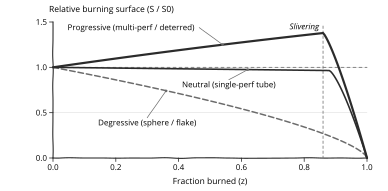
How gas generation evolves across the burn depends on the grain’s form function—the curve of relative burning surface area versus fraction burned (z), shown in Figure 3-1:3
- Degressive burning (solid sphere, thin flake, unperforated rod). Surface area shrinks continuously from ignition to burnout. Peak gas generation occurs immediately, producing a steep early pressure spike when bore volume is smallest.
- Neutral burning (single-perforated cylinder). As the outer cylindrical diameter decreases, the inner axial perforation expands at an equal radial rate, keeping total exposed surface area nearly flat (declining only slightly as end faces burn inward) until the web is consumed.
- Progressive burning (multi-perforated cylinder or surface-deterred grain). Exposed surface area—or effective chemical energy release rate—increases through most of the burn, holding peak chamber pressure lower while sustaining broad, steady pushing pressure as the bullet accelerates down the barrel.
Ignition dynamics, loading density, and temperature sensitivity
Steady-state Vieille burning assumes all grains ignite uniformly. In reality, combustion begins with a violent millisecond-scale ignition transient driven by the primer’s hot incandescent particles and gas jet penetrating the propellant column.8 Two physical variables—loading density and initial propellant temperature—strongly influence how consistently that transient unfolds.
Loading density and fill ratio
Loading density is charge mass divided by total available internal case volume behind the seated bullet; fill ratio expresses the fraction of usable case volume physically occupied by the poured powder column. Bottleneck rifle propellants perform most consistently at relatively high fill ratios (typically above roughly 80 percent of usable capacity without crushing grains). At high fill ratios, powder position relative to the flash hole barely changes from shot to shot, minimizing ignition-delay variance.8
Conversely, severely reduced fill ratios in large bottleneck cases—especially with slow-burning, heavily deterred propellants—can leave powder spread thinly along the lower case wall. Poor initial gas pressurization slows ignition, causes erratic velocity swings, and in extreme under-loaded scenarios with slow ball or magnum powders can trigger unpredictable secondary pressure excursions (often termed Secondary Explosion Effect, or SEE) when flame propagation and pressure waves reflect unevenly along the empty headspace.3 At the opposite extreme, heavy mechanical compression that fractures brittle extruded grains violates Piobert’s law by creating unpredictable extra surface area.
Temperature sensitivity
Propellant temperature directly affects chamber pressure and muzzle velocity through two mechanisms: warmer grains require less thermal energy to reach surface decomposition temperature (shortening ignition delay), and higher initial enthalpy increases the burning-rate coefficient a in Vieille’s law.3 Because pressure drives burning rate recursively, a modest initial shift in grain temperature amplifies into a measurable swing in peak pressure and muzzle velocity between winter hunting conditions and hot summer competition stages.
Contested single-base propellants are always less temperature-sensitive than double-base propellants
The claim. Shooters and older technical manuals often treat base chemistry as a binary rule: single-base extruded propellants are temperature-stable, while double-base and spherical ball propellants always swing wildly with ambient temperature.
The physics. Historically, that rule rested on real chemistry. Unstabilized double-base spherical propellants relied on nitroglycerin and conventional phthalate or centralite surface deterrents whose burning-rate temperature coefficients were noticeably steeper than classic single-base extruded formulations.9 Yet temperature sensitivity is governed not just by whether nitroglycerin is present, but by deterrent chemistry, diffusion-layer architecture, ignition pressure matching, and surface-coating formulation.10
The evidence. Controlled temperature-chamber firing tests of modern bottleneck rifle propellants show wide overlap across base classes. Surface-engineered single-base lines (such as Thales/ADI Extreme powders) achieve very low velocity drift across freezing-to-hot swings, while several legacy undeterred or older single-base extrusions exhibit substantial seasonal drift.11 Simultaneously, modern temperature-stabilized double-base and infused formulations—including Eurenco Bofors TZ® extruded powders and St. Marks StaBALL spherical powders—deliver thermal stability rivaling or matching top single-base competition powders in controlled testing.12
The verdict. As a historical generalization about mid-twentieth-century propellants, the single-base rule was broadly true. For twenty-first-century bottleneck rifle propellants, it is obsolete; thermal stability must be evaluated by specific formulation and surface-engineering technology rather than base class alone.
Bottleneck cartridge geometry and burn-rate matching
A propellant’s “burn rate” is not an absolute physical constant like density or melting point—it is a relative engineering balance between a grain’s chemical burning rate, web thickness, and surface deterrence on one side, and a cartridge’s internal geometry on the other.
The governing geometric ratio for bottleneck rifles is the expansion ratio (closely related to the informal term “overbore”): the ratio of usable cartridge case capacity to bore cross-sectional area, evaluated together with bullet mass and barrel length.8 Because bore cross-sectional area scales with the square of bullet diameter (π × d² / 4), changing caliber transforms gas-expansion physics dramatically:
- Small-bore moderate cases (e.g., .223 Remington, 55,000 psi SAAMI MAP). Small case volume and modest bullet mass accelerate rapidly out of the chamber, leaving short residence time before the bullet exits a 16- to 24-inch barrel. These cartridges require relatively fast-burning rifle propellants with thinner webs so combustion reaches full pressure and completes before muzzle exit.13
- Mid-bore balanced cases (e.g., 6.5 Creedmoor and .308 Winchester, 62,000 psi SAAMI MAP). Moderate case capacity paired with mid-weight bullets and medium bore cross-sections matches medium-burn-rate extruded or stabilized spherical propellants—the heart of modern target and hunting rifle production.14
- Overbore magnums (e.g., .338 Lapua Magnum, 65,000 psi SAAMI MAP; .300 Win Mag; 6.5/7mm PRC). Large propellant charges funnel hot gas through a comparatively narrow bore behind heavy, high-inertia bullets. A fast powder would peak violently while the bullet has barely moved; only slow-burning, thick-webbed, heavily deterred or infused propellants can fill the large case safely, keep peak pressure within SAAMI or C.I.P. limits, and sustain broad pushing pressure down a 24- to 30-inch barrel.15
Figure 3-2 illustrates how burn-rate matching shapes the chamber pressure-time curve inside a single bottleneck rifle cartridge.
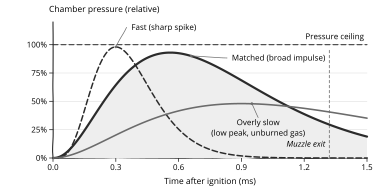
The physical goal of burn-rate matching is clear from the area under those curves. Because muzzle kinetic energy reflects the integral of base pressure acting on the bullet over bore travel, a propellant that is too fast hits the chamber pressure ceiling too early and runs out of gas halfway down the barrel, sacrificing velocity. A propellant that is too slow fills the case to capacity before generating efficient operating pressure, leaving unburned grains and high residual muzzle pressure that produces fierce blast without full velocity. A matched propellant reaches safe working pressure cleanly at high loading density and holds a broad, progressive pressure plateau down the bore—the exact internal-ballistic problem that drove a century and a half of propellant innovation explored in Part II.
Notes
- U.S. Army Materiel Command, Engineering Design Handbook: Ballistics Series — Interior Ballistics of Guns, AMCP 706-150, Headquarters, U.S. Army Materiel Command, 1965; Rudolf Meyer, Josef Köhler, and Axel Homburg, Explosives, 6th edition, Wiley-VCH, 2007.
- Rudolf Meyer, Josef Köhler, and Axel Homburg, Explosives.
- U.S. Army Materiel Command, Engineering Design Handbook; Donald E. Carlucci and Sidney S. Jacobson, Ballistics: Theory and Design of Guns and Ammunition, 3rd edition, CRC Press, 2018.
- U.S. Army Materiel Command, Engineering Design Handbook; Rudolf Meyer, Josef Köhler, and Axel Homburg, Explosives; Donald E. Carlucci and Sidney S. Jacobson, Ballistics.
- Bryan Lawton, “Thermo-Chemical Erosion in Gun Barrels,” Wear, 251(1–12): 827–838, 2001; Julian S. Hatcher, Hatcher’s Notebook, 3rd edition, Stackpole Books, 1962.
- Bryan Lawton, “Thermo-Chemical Erosion in Gun Barrels.”
- U.S. Army Materiel Command, Engineering Design Handbook.
- Donald E. Carlucci and Sidney S. Jacobson, Ballistics.
- U.S. Army Materiel Command, Engineering Design Handbook: Solid Propellants, Part One, AMCP 706-175, Headquarters, U.S. Army Materiel Command, 1964.
- Eurenco Bofors AB, Temperature Zone (TZ) Propellants Technical Overview, Eurenco, eurenco.com; Thales Australia / ADI World Class Powders, ADI Handloaders’ Guide, Australian Munitions, adiworldclass.com.au.
- Thales Australia / ADI World Class Powders, ADI Handloaders’ Guide; Cal Zant, “Powder Temperature Sensitivity: The Hidden Factor Affecting Your Long-Range Accuracy,” Precision Rifle Blog, 2025, precisionrifleblog.com/2025/03/08/powder-temperature-sensitivity/.
- Eurenco Bofors AB, Temperature Zone (TZ) Propellants Technical Overview; Cal Zant, “Powder Temperature Sensitivity.”
- SAAMI, SAAMI Z299.4-2025: Voluntary Industry Performance Standards for Pressure and Velocity of Centerfire Rifle Ammunition for the Use of Commercial Manufacturers, 2025, saami.org/wp-content/uploads/2026/04/SAAMI-Z299.4-CFR-2025-Centerfire-Rifle-Approved-2-10-2025-2026-04-27.pdf; Donald E. Carlucci and Sidney S. Jacobson, Ballistics.
- SAAMI, SAAMI Z299.4-2025.
- SAAMI, SAAMI Z299.4-2025; C.I.P., “Tables of Dimensions of Cartridges and Chambers (TDCC),” C.I.P. homologation database, bobp.cip-bobp.org/en/tdcc_public; Donald E. Carlucci and Sidney S. Jacobson, Ballistics.