
Key points
- Bottleneck cartridge geometry—specifically the ratio of case capacity to bore cross-sectional area—sets the primary burn-rate window for a rifle propellant.
- Small-bore cartridges and gas-operated rifles place tight constraints on dwell time, volumetric metering, and gas-port pressure.
- Mid-bore cartridges span the broadest range of extruded and spherical formulations, rewarding propellants that achieve high, consistent loading density without heavy compression.
- Overbore magnum and extreme long-range cartridges require thick-webbed, progressive propellants and force a direct tradeoff between high-energy velocity and flame-temperature throat erosion.
- Relative burn-rate windows guide propellant class selection, never charge-weight substitution; published data for the exact cartridge, projectile, and canister always governs.
Geometry Before Chemistry: The Expansion Ratio
Two cartridges can fire bullets of identical weight at similar chamber pressures yet require completely different propellants. The reason is internal geometry. A bottleneck rifle cartridge mates a relatively wide powder reservoir to a narrower bore, and the proportion between that case volume and the bore’s cross-sectional area controls how quickly the internal volume expands once the projectile starts moving.1
Internal ballisticians summarize that geometry with two closely related quantities: the overall expansion ratio of the rifle and the case-capacity-to-bore-area ratio (often called the overbore ratio).
Bore area (A_b)  = π × (bore diameter ÷ 2)²
Swept volume     = A_b × effective barrel travel (L_b)
Expansion ratio  = (case volume + swept volume) ÷ case volume
Overbore ratio   = case capacity ÷ A_b
When a cartridge has a small case relative to its bore—such as a .308 Winchester compared with a .300 Winchester Magnum—each inch of bullet travel opens a large percentage of additional volume behind the projectile base. Pressure falls rapidly unless the propellant generates gas early in the cycle. A faster-burning propellant matches that rapid volume expansion, reaching peak pressure close to the chamber and sustaining push before muzzle exit.2
When a cartridge has a large case relative to its bore, the reverse happens. Moving the bullet down the first several inches of rifling adds only a modest fraction to the initial combustion volume. A fast-burning powder would spike chamber pressure sharply while the bullet has barely cleared the throat, capping charge weight well below the case’s physical capacity and leaving velocity on the table. A slower, more progressive propellant—with thicker grain web, deeper surface deterrence, or multi-perforated geometry—holds early pressure in check while continuing to feed gas as the bullet accelerates down the bore.3
Two additional mechanical variables shift the optimal burn-rate window inside any given cartridge:
- Projectile mass and bearing length. Heavier bullets carry greater inertia and longer bearing surfaces, resisting initial acceleration and lingering longer in the throat. That extra residence time raises early chamber pressure, pushing optimal propellant selection slightly slower than for light-for-caliber projectiles in the same cartridge.4
- Barrel length. Slower, progressive propellants rely on barrel travel to convert late-burning gas into kinetic energy. As barrels shorten, unburned or late-burning gas exits the muzzle as blast and flash rather than projectile velocity, favoring slightly faster propellants that complete combustion earlier in the bore.2
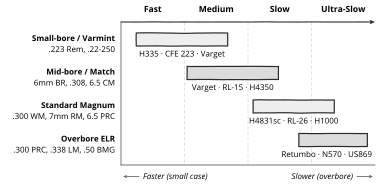
Small-Bore Varmint and Service-Rifle Cartridges
Small-bore bottleneck cartridges—typified by the .204 Ruger, .223 Remington / 5.56×45mm NATO, and .222 Remington—pair modest case capacities with narrow .204- to .224-inch bores. They sit toward the faster end of the rifle burn-rate spectrum, where thin-webbed single-base extrusions and fine-grained spherical powders dominate.5
Physical grain size matters disproportionately in small-bore cases. Narrow case necks bridge easily when fed long tubular sticks, creating irregular charge drops and air voids during high-volume loading. That mechanical reality explains why fine spherical propellants from St. Marks Powder and PB Clermont—such as H335, BL-C(2), CFE 223, Ramshot X-Terminator, Ramshot TAC, and Accurate 2230—became staples in .223 Remington and 5.56mm NATO production. Short-cut extruded formulations engineered specifically for small cases, including H322, Benchmark, IMR 8208 XBR, Vihtavuori N133, and Alliant AR-Comp, bridge the gap by pairing fine tubular metering with reduced thermal sensitivity.
Gas-Port Timing in Semi-Automatic Rifles
In bolt-action rifles, internal ballistics ends at muzzle exit. In gas-operated semi-automatic rifles—direct-impingement AR-15 and AR-10 platforms, M1 Garand and M14 actions, and gas-piston service rifles—propellant burn rate also drives the mechanical operating cycle. A small port drilled through the barrel wall taps high-pressure propellant gas at a fixed distance from the chamber to unlock the bolt and cycle the action.3
Gas-port pressure depends directly on the shape of the pressure-time curve at the exact millisecond the bullet passes the port:
- Propellants matched to the gas system reach peak pressure near the chamber and decay along a predictable slope, delivering enough impulse at the port to cycle reliably without excessive carrier speed.
- Overly slow propellants shift gas generation farther down the bore. Even when peak chamber pressure stays within safe SAAMI limits, residual bore pressure at the gas port remains elevated. In rifles with fixed gas ports and non-adjustable operating rods—most famously the long-stroke M1 Garand in
.30-06 Springfield—excessive port pressure accelerates the operating rod, increases extraction stress while brass is still clinging to the chamber wall, and risks mechanical damage.6 - Overly fast propellants decay too steeply after peak pressure, leaving insufficient gas impulse at rifle-length ports and causing short-stroking or failure to lock open.
The .22-250 Remington illustrates how geometry overrides bullet diameter alone. Although it fires the same .224-inch projectiles as the .223 Remington, its substantially larger case capacity creates a much higher overbore ratio. As a result, its effective burn-rate window shifts noticeably slower—into the territory occupied by medium-fast to medium rifle powders such as Varget, H380, IMR 4064, Vihtavuori N140, and Winchester 760.
Mid-Bore Competition and Standard Hunting Cartridges
Mid-bore bottleneck cartridges form the center of gravity of the commercial rifle propellant market. They span compact benchrest cases (6mm PPC, 6mm BR Norma), modern short-action competition and hunting standards (6mm Creedmoor, 6.5 Creedmoor, .308 Winchester), and classic long-action cartridges (.284 Winchester, .30-06 Springfield). Because their overbore ratios sit in an efficient middle band, these cartridges accommodate the widest variety of propellant chemistries and grain geometries.
Within this broad class, internal geometry still carves out distinct burn-rate neighborhoods:
- Compact high-efficiency benchrest cases (
6mm PPC,6mm BR Norma) have short powder columns and small capacities relative to their6mmbore. Fast-to-medium single-base extrusions such asVihtavuori N133,Benchmark,H322, andAccurate LT-32fill the case cleanly and burn completely in match barrels. - Standard
.308-class cases (.308 Winchester,7mm-08 Remington) pair moderate capacity with wider.284- to.308-inch bores. Medium-rate extruded powders (Varget,IMR 4064,IMR 4895,H4895,Vihtavuori N140,N150,Reloder 15,Norma 203-B) and temperature-stabilized spherical grades (Winchester StaBALL Match,CFE 223) anchor this window. - Longer-column mid-bores (
6mm Creedmoor,6.5 Creedmoor,.284 Winchester,.30-06 Springfield) carry higher case-capacity-to-bore-area ratios, especially with long, high-ballistic-coefficient match bullets seated deep into the case. Medium-slow propellants—the historic4350class (H4350,IMR 4350,SW4350), modern temperature-stabilized grades (Reloder 16,Vihtavuori N555,Winchester StaBALL 6.5), and NitrochemieEI®formulations (RS60/Reloder 17)—match their slower expansion curve.
Loading Density and Ignition Consistency
Mid-bore cartridges clearly demonstrate the role of loading density, the fraction of usable internal case volume occupied by the propellant charge. When a propellant’s burn rate and bulk density match a cartridge well, working charges typically fill roughly 85 to 100 percent of the space below the seated bullet base. At high loading density, the primer’s hot gas and incandescent particles traverse a uniform, tightly constrained bed of grains regardless of whether the rifle points uphill, level, or downhill.7
By contrast, selecting a propellant substantially faster than the case geometry calls for leaves excessive air space (ullage) above the powder bed. Depending on rifle orientation before firing, the charge can lie forward against the bullet base or back against the flash hole, altering ignition delay, flame-spread geometry, and shot-to-shot pressure uniformity. Conversely, choosing a powder far too slow for the case volume forces heavy compression before reaching useful operating pressure, risking crushed grains that fracture deterrent coatings and unpredictably alter burning surface area.
Overbore Magnum and Extreme Long-Range Cartridges
At the slow end of the bottleneck spectrum sit the overbore magnums and extreme long-range (ELR) cartridges: 6.5 PRC, 7mm PRC, .300 PRC, .300 Winchester Magnum, .338 Lapua Magnum, and .50 BMG. These cases hold massive propellant volumes behind relatively narrow bores, creating extreme overbore ratios that demand thick-webbed, deeply deterred, or multi-perforated progressive propellants.
Standard magnum cartridges (6.5 PRC, 7mm Remington Magnum, .300 Winchester Magnum) operate in the slow extruded and heavily deterred spherical window occupied by H4831 / H4831SC, H1000, IMR 7828, Vihtavuori N165, N565, Reloder 23, Reloder 26, Norma MRP, Winchester StaBALL HD, and Ramshot Magnum. Larger overbore and ELR designs (.300 PRC with heavy bullets, .338 Lapua Magnum, .375 CheyTac, .50 BMG) step even slower to ultra-thick-webbed grades such as Retumbo, Vihtavuori N568, N570, 20N29, 24N41, Reloder 33, Reloder 50, H50BMG, US 869, and Ramshot LRT.
Velocity Versus Throat Erosion: The Thermochemical Tradeoff
Overbore cartridges expose the central thermochemical tradeoff of modern rifle propellant design. Pushing heavy projectiles from large cases requires sustained high gas pressure, which manufacturers achieve through two distinct chemical philosophies:
- Cooler-burning single-base extrusions (such as
H1000,Retumbo, andVihtavuori N165) rely on nitrocellulose alone with thick webs and surface deterrents. Their lower adiabatic flame temperatures (T_v) reduce heat transfer into the barrel steel just ahead of the chamber leade, moderating throat erosion and extending barrel service life at the cost of slightly lower peak muzzle velocity.8 - High-energy double-base and infused propellants (such as Vihtavuori’s
N500series and Nitrochemie’sEI®-impregnated grades) incorporate nitroglycerin into the grain matrix to raise specific heat of explosion (Q_ex) and gas yield. That extra chemical energy delivers measurable velocity gains from the same case capacity, but higher flame temperatures accelerate thermal cracking (heat checking) and gas-wash erosion of the barrel throat.9
Barrel length also constrains overbore matching sharply. Slow progressive propellants need long barrels—commonly 24 to 30 inches in magnum and ELR rifles—to achieve high burn completion before bullet exit. Firing an ultra-slow magnum powder in a short sporting barrel wastes unconsumed energetic capacity at the muzzle, generating severe blast, flash, and recoil without realizing the propellant’s velocity potential.
| Cartridge Class | Representative Cartridges | Governing Mechanical Factors | Typical Propellant Families |
|---|---|---|---|
| Small-bore varmint & service | .204 Ruger, .223 Rem / 5.56 NATO | Narrow necks, short dwell time, semi-auto gas-port pressure window | Fast spherical (H335, TAC, CFE 223, AA2230); short-cut extruded (H322, Benchmark, 8208 XBR, N133, AR-Comp) |
| Compact & standard mid-bore | 6mm PPC/BR, .308 Win, 7mm-08 Rem | Moderate overbore ratio, high fill-ratio uniformity | Medium extruded (Varget, N140, N150, IMR 4064, IMR 4895, RL-15); stabilized ball (StaBALL Match) |
| Long-column mid-bore | 6mm/6.5mm Creedmoor, .284 Win, .30-06 | Higher overbore ratio with heavy bullets, thermal stability demand | Medium-slow extruded (H4350, IMR 4350, N555, RL-16, RS60); stabilized ball (StaBALL 6.5) |
| Overbore magnum & ELR | 6.5/7mm/300 PRC, .300 WM, .338 LM, .50 BMG | Extreme overbore ratio, progressive burn, flame-temperature throat wear | Slow/very slow extruded (H4831SC, H1000, Retumbo, N165, N565, N570, RL-26, RL-33, H50BMG); slow ball (StaBALL HD, LRT, US 869) |
Across every class, a burn-rate chart identifies the right physical neighborhood for a cartridge’s geometry. It never establishes interchangeability between neighboring powders, because two formulations sitting side by side on a relative burn-rate list can differ markedly in bulk density, heat of explosion, progressivity, and pressure curve shape.
Notes
- Donald E. Carlucci and Sidney S. Jacobson, Ballistics: Theory and Design of Guns and Ammunition, 3rd edition, CRC Press, 2018; C. L. Farrar and D. W. Leeming, Military Ballistics: A Basic Manual, Brassey’s Defence Publishers, 1983.
- U.S. Army Materiel Command, Engineering Design Handbook: Interior Ballistics of Guns, AMCP 706-150, U.S. Army Materiel Command, 1965.
- Donald E. Carlucci and Sidney S. Jacobson, Ballistics.
- C. L. Farrar and D. W. Leeming, Military Ballistics.
- Nammo Vihtavuori Oy, Vihtavuori Reloading Guide, Technical documentation on N100/N500 series, storage, and lot variance, Nammo Vihtavuori Oy.
- Sporting Arms and Ammunition Manufacturers’ Institute, Voluntary Industry Performance Standards for Pressure and Velocity of Centerfire Rifle Sporting Ammunition for the Use of Commercial Manufacturers, ANSI/SAAMI Z299.4, SAAMI, 2015.
- U.S. Army Materiel Command, Engineering Design Handbook; Donald E. Carlucci and Sidney S. Jacobson, Ballistics.
- C. L. Farrar and D. W. Leeming, Military Ballistics; Nammo Vihtavuori Oy, Vihtavuori Reloading Guide.
- Donald E. Carlucci and Sidney S. Jacobson, Ballistics; Nammo Vihtavuori Oy, Vihtavuori Reloading Guide.