
Key points
- Commercial canister propellants are blended to narrow tolerances, yet small shifts in nitration, residual volatiles, deterrent depth, web thickness, and bulk density still produce measurable lot-to-lot ballistic differences.
- Manufacturers and SAAMI warn against mixing different powders or combining separate lots because doing so destroys recall traceability, risks granular segregation, and can cross-contaminate fresh powder with aging decomposition gases.
- Nitrocellulose equilibrates with ambient relative humidity; moisture absorption depresses burn rate and pressure, whereas desiccation elevates both.
- All nitrate-ester propellants decompose slowly over time through
O–NO2bond cleavage, relying on sacrificial stabilizers (such as diphenylamine, ethyl centralite, or Akardite II) to prevent autocatalytic self-heating. - High storage heat accelerates stabilizer depletion exponentially under Arrhenius kinetics, as underscored by modern canister recalls such as IMR 4007 SSC (2015) and pre-October 2016 Valleyfield Accurate lots (2019).
Five Physical and Chemical Drivers of Lot-to-Lot Variance
Commercial smokeless propellant sold in retail canisters is known in the industry as canister-grade powder. Unlike bulk non-canister military propellants—where individual production lots can vary substantially and ammunition plants adjust charge weight for each lot during factory loading—canister propellants are blended and pressure-tested by the OEM and packager to hold internal ballistic performance within a specified tolerance window.1
Even within strict factory quality control, no two production campaigns are chemically or geometrically identical. Real-world lot-to-lot variance stems from five physical and chemical parameters in manufacturing:
- Nitration level and nitrogen content. Nitrocellulose is synthesized from natural biological polymers—cotton linters or refined wood pulp—whose chain lengths and reactivity vary subtly from batch to batch. Small fluctuations in final nitrogen weight percent (typically controlled within the high-nitrogen propellant band around 12.6 to 13.4 percent nitrogen) directly alter specific heat of explosion (
Q_ex), gas yield, and baseline burning speed.2 - Residual solvent and moisture equilibrium. Solvent-extruded propellants use ether-alcohol, acetone, or ethyl acetate mixtures to gelatinize nitrocellulose before pressing. Water-leaching and thermal drying remove almost all solvent, yet a small fraction of residual volatile solvent and bound moisture remains trapped inside the polymer matrix. Minor differences in residual volatile content between drying runs shift the thermal energy absorbed during initial heating and modify the lot’s effective burn rate.3
- Deterrent concentration and penetration depth. Surface deterrents—such as dinitrotoluene (DNT), dibutyl phthalate (DBP), centralites, or modern polymeric coatings—are applied in tumbling drums or heated baths to slow early burning. Small variations in bath temperature, dwell time, coating concentration, or post-coating drying alter how deeply the deterrent diffuses into the grain exterior, changing the grain’s progressivity profile.4
- Extrusion web thickness and die wear. Under Piobert’s law, the total burning duration of an extruded cylinder depends on its web thickness (
w), the shortest distance the flame front must travel through solid propellant. For a single-perforated cylindrical grain:
w = (D − d) ÷ 2

w  web thickness (mm)
D  outer grain diameter (mm)
d  inner perforation diameter (mm)
Gradual abrasive wear on extrusion dies and cutter blades across long production runs subtly alters outer diameter, perforation concentricity, and grain length, shifting the ratio of burning surface area to propellant mass.5
- Bulk density and packing behavior. Changes in grain cut length, flattening-roll compression on spherical powders, or the thickness of surface graphite glazing shift bulk packing density (in
g/L). A bulk-density shift changes how a fixed mass fills a given cartridge case, modifying loading density and initial primer flame propagation through the powder bed.6
Why Manufacturers Warn Against Mixing Lots or Formulations
Every major propellant manufacturer and the Sporting Arms and Ammunition Manufacturers’ Institute (SAAMI) caution against combining different propellants—and against pouring separate production lots together into a single vessel.8 Three physical and safety mechanisms explain why:
- Incompatible combustion dynamics. Mixing two different formulations—even powders with adjacent positions on a burn-rate chart—does not produce a clean average burn rate. Faster-burning grains ignite and raise chamber pressure early, accelerating the slower component along its pressure-exponent curve (
r = a × p^n) and risking unpredictable pressure spikes. - Granular segregation. Propellant grains differing even slightly in length, diameter, shape, or surface finish separate mechanically under vibration and pouring rather than remaining uniformly distributed. A vessel shaken or carried can stratify into zones enriched in one component or lot.
- Loss of traceability and chemical cross-contamination. Each factory container carries a stamped lot number tying that powder to specific manufacturing dates and stability surveillance records. Mixing lots destroys traceability during a safety recall. Worse, if one older lot has already begun releasing acidic nitrogen oxides, blending it with fresh powder exposes the entire batch to catalytic degradation gases.9
Moisture Equilibrium and Environmental Exposure
Nitrocellulose is mildly hygroscopic: exposed propellant continuously exchanges water vapor with the surrounding air until it reaches moisture equilibrium with ambient relative humidity (RH). Sealed factory containers slow this exchange dramatically, whereas open hoppers, loosely capped jugs, or containers opened repeatedly in extreme climates allow measurable moisture drift.10
Moisture acts as a thermal sink inside the combustion chamber, producing two opposite ballistic pathways:
- High relative humidity (moisture absorption). Water absorbed into the polymer matrix adds inert mass to every weighed grain of propellant. During ignition and burning, heat that would otherwise raise gas temperature and pressure must first vaporize that bound water. Effective heat of explosion (
Q_ex) drops, burn rate slows, and both chamber pressure and muzzle velocity fall.11 - Low relative humidity (desiccation). Conversely, prolonged exposure to very dry air—such as heated winter indoor spaces or arid climates—draws equilibrium moisture out of the grains. Each unit of weighed propellant now contains a higher fraction of active nitrocellulose and less water vaporizing load. Effective
Q_exrises, burning accelerates, and peak chamber pressure climbs.8
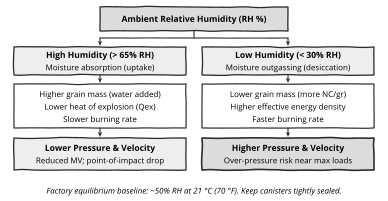
Because moisture transfer is reversible when chemical decomposition has not yet occurred, keeping factory canisters tightly sealed between uses and storing them in a stable, moderate-humidity environment prevents most environmental burn-rate drift.
Nitric Ester Decomposition Kinetics and Stabilizer Chemistry
Unlike inert metals or simple inorganic salts, every smokeless propellant is thermodynamically metastable. The nitrate-ester functional group (R–O–NO2) present in both nitrocellulose and nitroglycerin contains a relatively weak oxygen-nitrogen bond. Even at room temperature, slow thermal cleavage continuously breaks a tiny fraction of those bonds, liberating reactive nitrogen dioxide (NO2) and nitric oxide (NO) gases.12
If those nitrogen oxides remain free inside the propellant grain, they react with trace moisture to form nitric acid (HNO3) and nitrous acid (HNO2). Those acids attack adjacent nitrate-ester bonds directly, generating still more nitrogen oxides and releasing heat. Left unchecked, this self-reinforcing autocatalysis accelerates exponentially—degrading grain structure, destroying ballistic predictability, and eventually generating enough internal heat to trigger spontaneous combustion (thermal runaway or cook-off).13
Sacrificial Stabilizers
Modern smokeless propellants achieve multi-decade shelf life through sacrificial stabilizers incorporated at roughly 0.5 to 2.0 percent by weight during manufacture. Rather than halting initial O–NO2 bond cleavage, stabilizers act as chemical traps that react preferentially with free NO2 and acidic byproducts, neutralizing them into stable nitrated compounds before they can catalyze further nitrocellulose breakdown:2
- Diphenylamine (DPA) is the classic stabilizer for single-base nitrocellulose propellants. As DPA absorbs nitrogen oxides over decades, it converts sequentially through N-nitrosodiphenylamine to mono- and dinitro-diphenylamine derivatives—each step still offering residual stabilizing capacity until the chemical reserve nears exhaustion.
- Ethyl centralite, methyl centralite, and Akardite II are urea-derivative stabilizers standard in double-base and nitroglycerin-infused propellants. Traditional DPA is too basic for high-nitroglycerin formulations and can attack nitroglycerin ester linkages directly; centralites and Akardite II provide effective
NO2scavenging without hydrolyzing nitroglycerin.3
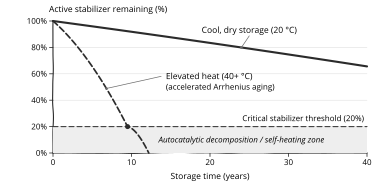
Stabilizers are strictly consumable. Once a propellant’s effective stabilizer reserve drops below a critical threshold, autocatalytic decomposition begins rapidly and cannot be reversed.
Arrhenius Thermal Acceleration
The rate of nitric ester decomposition obeys the Arrhenius equation, rising exponentially with absolute storage temperature:
k = A × exp(−Ea ÷ (R × T))

k   decomposition rate constant
A   pre-exponential frequency factor
Ea  activation energy (J/mol)
R   universal gas constant (8.314 J/(mol·K))
T   absolute storage temperature (K = °C + 273.15)
Under standard NATO and military propellant surveillance models (such as STANAG 4582 heat-flow calorimetry), nitric ester decomposition rates roughly triple to quadruple for every 10 °C (18 °F) increase in continuous storage temperature.14 That exponential penalty governs practical shelf life far more than calendar age alone. A well-stabilized rifle propellant stored continuously in a cool, dry room near 20 °C (68 °F) can remain chemically sound for several decades. The same canister left in an unconditioned garage, attic, or metal shed cycling daily to 45–55 °C (113–131 °F) burns through its stabilizer reserve many times faster, compressing decades of safe service life into just a few years.15
Lessons from Modern Stability Recalls
Although nineteenth- and early twentieth-century warship magazine disasters drove the invention of modern stabilizer chemistry, accelerated chemical aging is not purely historical. Two major twenty-first-century commercial recalls demonstrated why lot traceability and routine inspection remain essential:
- September 2015 — IMR 4007 SSC recall. Hodgdon Powder Company issued an immediate recall covering all lots of IMR 4007 SSC in both 1-pound and 8-pound containers after testing confirmed rapid chemical deterioration in specific lots. The company warned that degraded canisters could undergo spontaneous combustion or fire, and permanently discontinued the formulation.16
- November 2019 — Accurate 2495, 4064, and 4350 recall. Western Powders issued a safety recall covering designated pre-October 2016 lots of Accurate 2495, Accurate 4064, and Accurate 4350 produced in Canada (at the GD-OTS Valleyfield plant) after stability surveillance detected accelerated degradation capable of spontaneous ignition.17
Both events involved modern, factory-sealed commercial canister propellants from established manufacturing lines. Keeping powder in its original labeled container—with its factory lot number intact—is what makes it possible to check a shelf against a manufacturer recall notice years after purchase.
Field Inspection and Storage Principles
Smokeless propellant gives clear physical and sensory warnings before reaching the late stages of autocatalytic decomposition. Inspecting stored canisters periodically—especially older stock or containers exposed to warm climates—catches failing powder early.8
Sound storage practices extend safe service life directly from the underlying chemistry:
- Control temperature first. Store propellants in a cool, dry indoor location with stable ambient temperature, away from furnaces, water heaters, attics, garages, and direct sunlight.8
- Keep original containers sealed. Factory plastic and lined fiber canisters are engineered to resist static buildup, vent safely rather than fragmenting in a fire, and preserve product identity and lot numbers. Never transfer smokeless powder into heavy-walled airtight metal vessels, glass jars, or unlabeled containers.8
- Inspect older stock on a schedule. Checking odor and grain appearance whenever opening an older container—and checking lot numbers against manufacturer safety bulletins—catches isolated stability failures long before they become a bench or storage hazard.
Notes
- Nammo Vihtavuori Oy, Vihtavuori Reloading Guide, Technical documentation on N100/N500 series, storage, and lot variance, Nammo Vihtavuori Oy; Thales Australia / Australian Munitions, ADI Propellants Powder Equivalents and Technical Data, Mulwala, NSW; guidance on OEM equivalents and lot-to-lot variance, Australian Munitions.
- Rudolf Meyer, Josef Köhler, and Axel Homburg, Explosives, 6th edition, Wiley-VCH, 2007; Tadeusz Urbański, Chemistry and Technology of Explosives, Volume 3, Pergamon Press, 1967.
- Rudolf Meyer, Josef Köhler, and Axel Homburg, Explosives.
- Rudolf Meyer, Josef Köhler, and Axel Homburg, Explosives; Donald E. Carlucci and Sidney S. Jacobson, Ballistics: Theory and Design of Guns and Ammunition, 3rd edition, CRC Press, 2018.
- U.S. Army Materiel Command, Engineering Design Handbook: Interior Ballistics of Guns, AMCP 706-150, U.S. Army Materiel Command, 1965.
- Donald E. Carlucci and Sidney S. Jacobson, Ballistics.
- Thales Australia / Australian Munitions, ADI Propellants Powder Equivalents and Technical Data; Nammo Vihtavuori Oy, Vihtavuori Reloading Guide.
- Sporting Arms and Ammunition Manufacturers’ Institute, Properties and Storage of Smokeless Powder, Technical Information Bulletin, SAAMI, 2020.
- Sporting Arms and Ammunition Manufacturers’ Institute, Properties and Storage of Smokeless Powder; Hodgdon Powder Company, IMR 4007 SSC Product Safety Warning and Recall Notice, Hodgdon Powder Company, September 2015.
- Tadeusz Urbański, Chemistry and Technology of Explosives; Sporting Arms and Ammunition Manufacturers’ Institute, Properties and Storage of Smokeless Powder.
- Tadeusz Urbański, Chemistry and Technology of Explosives.
- Rudolf Meyer, Josef Köhler, and Axel Homburg, Explosives; Jacqueline Akhavan, The Chemistry of Explosives, 3rd edition, Royal Society of Chemistry, 2011.
- Jacqueline Akhavan, The Chemistry of Explosives; Tadeusz Urbański, Chemistry and Technology of Explosives.
- NATO Standardization Agency, Explosives, Nitrocellulose Based Propellants — Stability Test Procedure and Requirements Using Heat Flow Calorimetry, STANAG 4582, NATO, 2007.
- NATO Standardization Agency, Explosives, Nitrocellulose Based Propellants — Stability Test Procedure and Requirements Using Heat Flow Calorimetry; Sporting Arms and Ammunition Manufacturers’ Institute, Properties and Storage of Smokeless Powder.
- Hodgdon Powder Company, IMR 4007 SSC Product Safety Warning and Recall Notice.
- Western Powders, Inc., Product Recall Notice: Accurate 2495, Accurate 4064, and Accurate 4350, Designated pre-October 2016 lots manufactured in Canada, Western Powders, Inc., November 2019.