
Key points
- A cartridge has four parts: the case, the primer, the powder and the bullet.
- Firing is a pressure event. Pressure peaks in the first few inches of bullet travel, then falls.
- Peak pressure is what the case and the action must hold, so it is what the standards limit.
- Most bottleneck cases headspace on the shoulder.
- SAAMI and C.I.P. are two standards with different limits. Pressures in psi and in CUP cannot be converted.
Why it matters
Every pressure decision you make rests on how a cartridge works. Case capacity, seating depth, bullet weight, powder and primer each change the pressure curve. Once you know how a round fires, you can see why a small change in the workshop matters. You also see a published maximum for what it is: a number measured one way, under one standard, in one test barrel.
How it is done
Inside the barrel and after it
Internal ballistics runs from the firing pin’s strike until the bullet leaves the muzzle. It covers ignition, pressure and velocity. Every choice you make in the workshop acts there first: case capacity, charge, powder, primer, seating depth and bullet. External ballistics covers the bullet’s flight from the muzzle to the target: stability, drop and drift. The bullet you choose and the velocity you give it decide whether it flies point first and how much it drops and drifts (see The Precision Rifle Handbook).
The four components
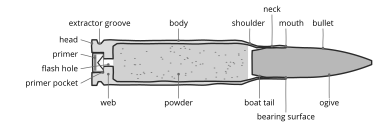
- The case. A brass container that holds the other three parts. Its head carries the extractor groove, the primer pocket and the flash hole. The body, shoulder and neck form the bottleneck, and the neck grips the bullet. When the round fires, the case walls swell against the chamber and seal the gas in. The space inside the case, its capacity, is one of the strongest levers on pressure (see Chapter 11).
- The primer. A small metal cup that holds a shock-sensitive compound and a tiny anvil. A blow from the firing pin crushes the compound against the anvil and lights it. Primers differ in size and in output (see Chapter 12).
- The powder. Smokeless powder is a propellant, not a high explosive. It burns at a controlled rate. It carries its own oxygen, so it burns without air, even sealed inside a case. It also burns faster as pressure rises (see Chapter 13).
- The bullet. The projectile. Its bearing surface is the full-diameter part that grips the rifling. Its weight, length and shape matter inside the barrel as well as in the air (see Chapter 14).
Chamber, throat, freebore and lands
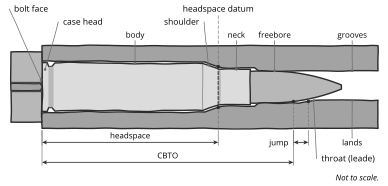
The chamber is the cavity at the rear of the barrel that holds the cartridge. It is cut to the shape of the case, with a little clearance at the body, the shoulder and the neck. Ahead of the neck, the bore begins.
- Freebore is a smooth, unrifled section just ahead of the case neck. A bullet can travel through it before it touches the rifling. Some chambers have very little. Others have a lot.
- The throat, or leade, is the tapered start of the rifling. Here the lands rise to full height.
- The lands, the raised ridges of the rifling, start at the throat. The bullet must be forced into them (see Chapter 3).
Jump is how far the bullet travels before it meets the lands. Jam means the bullet is seated into them. For seating, the length that matters is the cartridge base to ogive (CBTO). It runs from the case head to a point on the bullet’s curved nose, near where the nose meets the lands. You measure where the lands sit in your own rifle (see Chapter 24).
Headspace on the shoulder
Headspace is the distance from the bolt face to the feature in the chamber that stops the cartridge from moving forward. On most bottleneck cases, that feature is the shoulder. The measurement runs from the bolt face to a datum line. The datum is the point on the shoulder where it reaches a set diameter. Rimmed cartridges, such as the .30-30 Winchester, headspace on the rim.1 By standard, a new belted magnum case headspaces on the front of the belt.2 Once fired, size it by the shoulder like any other bottleneck case (see Chapter 19).
Two lengths meet at that datum.
- The chamber’s headspace is set when the barrel is fitted. It is checked with GO and NO-GO gauges.
- The case’s base-to-shoulder length is set by your sizing die. You measure it with a comparator on calipers (see Chapter 9).
The case must be a little shorter than the chamber so the bolt closes freely. A case that is too long makes the bolt hard to close. Never force a round into the chamber. A case whose shoulder is pushed back much too far stretches near the head each time it is fired. Repeated stretching ends in a head separation, where the case breaks in two. Too much clearance can also flatten primers at low pressure. That is one reason primer reading is unreliable (see Chapter 28).
The ignition sequence
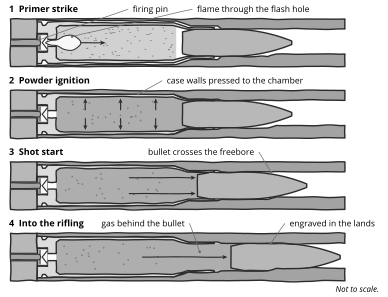
- The firing pin strikes the primer. The compound is crushed against the anvil and ignites.
- Flame and hot particles pass through the flash hole into the powder.
- The powder grains ignite at their surfaces and begin to make gas. Pressure rises inside the sealed case.
- The case walls swell against the chamber and seal it.
- The bullet starts to move once the pressure behind it overcomes the neck’s grip. This moment is called shot start.
- The bullet crosses any freebore and meets the rifling. It must be forced into the lands, which takes extra pressure. After that, friction in the bore holds it back.
- The powder burns faster as pressure climbs. At the same time, the space behind the moving bullet grows. Pressure peaks when that growing space begins to outrun the gas.
- After the peak, pressure falls. The space behind the bullet now grows faster than the powder can fill it with gas, even if some powder is still burning. The barrel walls also draw heat from the gas.
- The bullet leaves the muzzle and the pressure drops. The case springs back slightly from the chamber wall, so it can be extracted.
The pressure curve
Plot pressure against time and you get the same basic shape for every rifle load (Figure 4-4). Pressure climbs steeply from shot start. It peaks early, while the bullet has moved only a few inches.3 Then it falls along a long tail until the bullet leaves the muzzle.
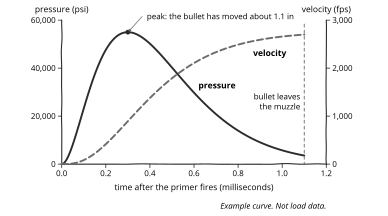
Peak pressure matters because it is the load that the case, the chamber and the action must hold. Too much of it can let gas escape around the primer or through a failed case. A large overload can wreck the rifle and injure the shooter. That is why SAAMI and C.I.P. set limits on peak pressure. It is also why published maximum loads stay at or below those limits.
Velocity is a different matter. It comes from the area under the pressure curve in Figure 4-4, not from the peak alone. That area is the push summed over the whole time the bullet is in the barrel. So a lower peak pressure is no guarantee of a lower velocity.
For one powder and one bullet, more powder raises the peak pressure and the velocity together. That is why velocity serves as your pressure gauge in a work-up (see Chapter 28). Different powders produce different curve shapes. A slower powder can peak lower than a faster one yet hold pressure longer down the barrel. Because that wider curve covers as much area or more, it can match or beat the velocity of the higher-peaking load.
Each row below changes one variable in the workshop and holds the rest of the load constant:
| Change in the workshop | Peak pressure | Velocity |
|---|---|---|
| More powder | Up | Up |
| A faster powder at the same charge | Up, and earlier | Varies |
| A heavier bullet | Up | Down |
| Less case capacity, as with thicker brass | Up | Up |
| Bullet seated deeper | Up | Up |
| Bullet seated into the lands | Up | Hard to predict |
| Warmer powder | Up | Up |
| A different primer | Can move a lot | Can move a little |
| A longer barrel | Little change | Up |
SAAMI and C.I.P.
Two bodies publish standards for cartridges and chambers.
- SAAMI, the Sporting Arms and Ammunition Manufacturers’ Institute, is the American industry body. It states pressure limits in psi.
- C.I.P., the Permanent International Commission for the Proof of Small Arms, sets the standards used by the proof houses of its member states. It states pressure limits in bar.
Each publishes drawings of the cartridge and the chamber and a maximum pressure for each cartridge. Each measures pressure its own way. SAAMI’s test barrel has a transducer set flush in the chamber wall, near the shoulder. Its face is shaped to fit the case, and the pressure reaches it through the case wall.5 C.I.P. has a hole drilled in the wall of each test case, so the gas reaches the transducer directly.6 For most rifle cartridges, C.I.P. takes the pressure 25 mm (about 1 inch) from the breech face.7 Because the two bodies measure pressure differently, their limits are not simply the same number in different units. For some cartridges, they differ widely.8
Some older European cartridges show the gap clearly. SAAMI sets their limits for older rifles, well below C.I.P.’s. SAAMI’s limit for the 8x57 IS is 35,000 psi, and for the 6.5x55 Swedish it is 51,000 psi.9 Data built to C.I.P. limits can therefore exceed SAAMI’s figure for the same cartridge. One European powder maker builds its maximum loads to the lower of the two limits.4 Know which standard your data follows and whether your rifle is built for it.
MAP versus Pmax
SAAMI’s limit is the maximum average pressure, or MAP. It is the highest average pressure a maker should load to. SAAMI’s pressure figures assume samples of 10 rounds.10 Single rounds in that sample can run above the average. SAAMI does not cap single rounds. It caps the spread instead. In a sample of 10, the highest and lowest rounds may differ by up to about 20 percent of the MAP.11 C.I.P.’s limit is called Pmax. It is also a maximum average pressure, set and measured under C.I.P.’s own rules. C.I.P. also sets a statistical ceiling for single rounds at 15 percent above Pmax.7
Two points follow. First, a MAP and a Pmax for the same cartridge are not interchangeable, even after you convert bar to psi. Second, neither is a target for your handloads. Both are ceilings for test ammunition fired in test barrels. Your rifle, your components and your weather are not the test conditions.
psi versus CUP
Older data often gives pressure in CUP, copper units of pressure. In the crusher method, a piston sits in a hole drilled through the chamber wall, with a small copper slug above it. When the round fires, the gas drives the piston and crushes the slug.12 The crushed slug is read against a table and the result is reported in CUP. Modern labs use an electronic transducer instead and report psi.
The two systems measure in different ways. Compare CUP only with CUP, and psi only with psi. For a few older cartridges, SAAMI still gives only a CUP limit.13
Contested converting CUP to psi
The claim. A fixed factor turns a CUP figure into psi.
The physics. A crusher reads the permanent dent the pressure leaves in copper. A transducer reads the pressure as it happens. The two respond to the same shot in different ways.
The test. Fire the same loads in both systems and compare the readings.
The data. Pressures are published both ways. The two systems do not give the same maximum number for each cartridge, and the gap between a cartridge’s CUP and psi limits differs from one cartridge to the next. No single factor converts them.14
The verdict. Folklore. Keep the two scales apart.
Notes
- SAAMI, SAAMI Z299.4-2025: Voluntary Industry Performance Standards for Pressure and Velocity of Centerfire Rifle Ammunition for the Use of Commercial Manufacturers, p. 227, saami.org/wp-content/uploads/2026/04/SAAMI-Z299.4-CFR-2025-Centerfire-Rifle-Approved-2-10-2025-2026-04-27.pdf.
- SAAMI, SAAMI Z299.4-2025, pp. 112 and 225–226.
- Empirical Precision, User Guide, linked from the app’s dashboard, 2026, section 15.1, empiricalprecision.com.
- Vihtavuori, Reloading Guide 2026, vihtavuori.com/wp-content/uploads/2026/04/Vihtavuori_Reloading_Guide_2026_ENG_web.pdf.
- SAAMI, SAAMI Z299.4-2025, pp. 8, 202 and 241.
- L. Elkarous, F. Coghe, M. Pirlot and J. C. Golinval, “Experimental techniques for ballistic pressure measurements and recent development in means of calibration,” Journal of Physics: Conference Series, 459: 012048, 2013, iopscience.iop.org/article/10.1088/1742-6596/459/1/012048.
- C.I.P., “Tables of Dimensions of Cartridges and Chambers (TDCC),” C.I.P. homologation database, list of TDCC, Tab I to Tab III, and the 308 Win. data sheet, bobp.cip-bobp.org/en/tdcc_public.
- SAAMI, SAAMI Z299.4-2025; C.I.P., “Tables of Dimensions of Cartridges and Chambers (TDCC).”
- SAAMI, SAAMI Z299.4-2025, pp. 12–13.
- SAAMI, SAAMI Z299.4-2025, pp. 8–9.
- SAAMI, SAAMI Z299.4-2025, p. 9.
- SAAMI, SAAMI Z299.4-2025, p. 10.
- SAAMI, SAAMI Z299.4-2025, pp. 11–28.
- Hodgdon, 2025 Annual Manual, 2024, p. 56.