
Key points
- A press supplies the force and a die supplies the shape. A rigid single-stage press suits load development and small batches.
- A sizing die restores the case, bumps the shoulder and sets neck tension. A bushing works on the outside of the neck, a mandrel on the inside.
- A universal decapping die takes out the spent primer before the first clean. Dirty brass then meets only this cheap die, never the sizing die.
- A competition seating die holds the case and the bullet on one axis. A stem that fits the ogive leaves the tip alone.
- Lube keeps a case from sticking in the sizing die. A loading block keeps every case in view between steps.
Why it matters
Sizing, expanding, seating and crimping all happen inside a die. The die gives the case and the bullet their shape. Its fit and alignment decide how straight they come out. Sizing and seating can tip the neck or the bullet off the case axis. That is runout (see Chapter 19).
Grit scratches dies (see Chapter 18). A case short of lube can stick in a sizing die.
How it is done
A press gives you the leverage to push a brass case into a hardened steel die. With it you size the body, bump the shoulder, seat primers and seat bullets straight in the neck.
Single-stage presses
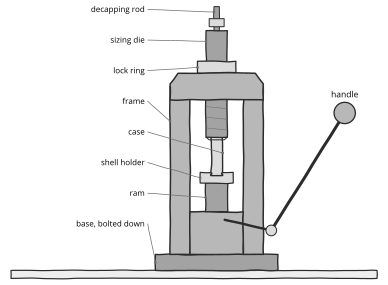
A single-stage press holds one die in a rigid frame, typically a heavy cast-iron or steel “O-frame”. A shell holder on a steel ram grips the case, and a compound toggle linkage drives the ram (see Figure 5-1).
- Rigidity and alignment. There is no moving toolhead or turning carousel. A solid O-frame stretches and flexes very little under heavy sizing loads, so the die and the ram stay in line.
- Process control. You work in batches, one step at a time. You can see and feel every case before it moves on.
Turret presses
A turret press holds three to seven dies in a rotating head above a single ram.
- How it works. You can index the head by hand or with an auto-advance linkage to bring each die over the case in turn. Or you can run a whole batch through one die before rotating to the next.
- Trade-offs. Your whole die set stays adjusted in the head. The cost is a little play in the rotating head, which lets it tilt slightly. Modern heavy-duty turrets clamp down firmly during the stroke.
Progressive presses
A progressive press works on several cases at once, across four to eight stations on a rotating shell plate. Each pull of the handle moves every case to the next station and drops a finished round off the last one.
- Stations. A typical rifle setup takes cases already sized and trimmed in a separate prep pass. Station 1 primes. Station 2 throws a powder charge by volume. Station 3 holds a powder-check die. Its rod rests on the powder and warns of an empty or double-charged case. It backs up looking into each case, but never replaces it (see Chapter 17). Station 4 seats the bullet. Station 5 applies an optional crimp.
- Primer feed. Primers feed from a vertical tube that holds 100, inside a steel blast shield (see Chapter 7).
Inline arbor presses
An arbor press is a small rack-and-pinion hand press for threadless benchrest dies, such as neck-sizing and seating dies.
- Feel. It drives the die directly, with no compound leverage. Your hand feels the force each neck needs to size and each bullet needs to seat, so you notice at once when neck tension varies (see Chapter 19).
The table sums up the four types.
| Press type | How it operates | Leverage and setup | Best suited for |
|---|---|---|---|
| Single-stage press | Holds one die at a time in a rigid O-frame. The ram strokes one case through one step. | High (compound linkage). Little frame deflection. | Precision rifle load development, small batches and learning the craft. |
| Turret press | Holds several dies in a rotating head above a single ram. The head rotates between steps. | High. Dies remain set in the head between operations. | Moderate-volume loading with fast caliber changes. |
| Progressive press | Holds multiple dies and cases simultaneously. Every stroke produces a finished round. | Moderate to high. Multi-station shell plate auto-indexes. | High-volume competition and practice ammunition. Semi-automatic rifles. |
| Inline arbor press | Hand-operated rack-and-pinion benchrest press driving threadless hand dies. | Direct hand feel (no compound link). Sensitive force feedback. | Benchrest match ammunition. Seating at the range with threadless hand dies. |
Shell holders
A hardened steel shell holder fits the press ram and grips the case rim. A standard shell holder has a nominal deck height of .125 inch, from the floor under the case head to its top face. Use the shell holder the die maker lists for your cartridge. Sizing die setup starts from the shell holder (see Chapter 19).
Sizing dies
Sizing dies restore the outside dimensions, push back the shoulder and set neck tension (see Chapter 19).
- Full-length sizing dies. A full-length die sizes the whole body, squeezes the neck and bumps the shoulder back so the case chambers freely. Most have a decapping spindle with an expander ball. As the case comes out of the die, the ball pulls back through the neck and sets its inside diameter. If the spindle is out of line, or the inside of the neck has no dry lube, the ball can pull the neck off center.
- Neck sizing dies. A neck die sizes only the neck and leaves the fire-formed body and shoulder alone. It works the brass less. But a neck-sized case has little clearance in the chamber. It can chamber stiffly or fail to extract in dust, in a semi-automatic or in another rifle.
- Bushing dies. A bushing die, full-length or neck only, replaces the fixed neck with an interchangeable steel or carbide bushing. Bushings come in steps of .001 inch in diameter. Measure the neck of a loaded round and pick a bushing a few thousandths smaller. That sets neck tension in one step without overworking the brass or pulling an expander ball back through the neck. Because a bushing sizes only the outside of the neck, any variation in wall thickness transfers to the inside diameter. Brass springs back after it leaves the bushing, so the neck reads larger than the bushing (see Chapter 19).
- Body dies. A body die sizes the body taper and bumps the shoulder back without touching the neck. Pair it with a neck die or an expander mandrel.
Expander dies
- Expander mandrel dies. An expander die pushes a polished carbide or hardened steel mandrel down through the mouth to open an undersized neck from the inside. It sets the inside diameter and pushes any variation in wall thickness to the outside. The neck springs back a little smaller than the mandrel. A mandrel can add runout too, so measure your own (see Chapter 19).
- Two-step neck expanding dies. A two-step expander has a plug with two diameters. The first step opens the neck to just under bullet diameter, for neck tension. The second is a short, larger step. It opens the mouth to bullet diameter or slightly over, so a flat-base bullet starts square. Turning the plug deeper adds a slight flare.1 It is used after sizing, for flat-base bullets (see Chapter 20).
Decapping dies
A universal decapping die pushes out the spent primer without sizing the case. Run every batch through it before the first clean (see Chapter 18). Cleaning then removes grit and grime before the case touches your sizing die. Knocking the primers out first drops their lead residue into the press’s catch tray and lets cleaning solution reach the primer pockets.
Seating dies
Seating lines the bullet up with the bore, sets the overall length and the jump to the rifling, and leaves the bullet held by the neck. Alignment and seating depth matter both for precision and for predictable pressure. The inside of the die decides how straight the bullet goes in and whether its nose gets damaged (see Chapter 24).
- Standard 7/8-14 seating dies. A standard seating die has a hardened steel body with a crimp shoulder inside and a threaded seater stem. It is machined with generous clearance to take brass fired in many different chambers. You set the bullet loosely in the case mouth, and the ram drives the round up into the die. The bullet base enters the case neck before the die body fully guides the bullet shank. If the mouth chamfer is uneven or the neck wall varies in thickness, the bullet can start crooked and add runout.
- Competition micrometer seating dies. A competition seating die has a spring-loaded sliding sleeve with close clearance. As the ram rises, the sleeve slides down over the neck and the whole bearing surface of the bullet before seating begins. It holds case and bullet on one axis while the stem pushes the bullet in. A micrometer top is graduated in steps of .001 inch and has a bezel you can zero. It gives small, repeatable changes when you switch bullets or adjust jump. These dies have no crimp shoulder, so they leave the neck tension alone.
- Arbor press seating dies. Threadless steel seating dies work in a small hand arbor press. The sized case and the bullet go inside the close-fitting die body, and you press a sliding stem down by hand or with the arbor’s rack.
- Seater stems. The stem is the part inside the die that pushes on the bullet. A standard stem has a broad, shallow cup made for round-nose and flat-base spitzer bullets. On a sleek Very Low Drag (VLD), secant or polymer-tipped bullet, a standard stem can bottom out on the point instead of the ogive (see Chapter 14). That can deform a polymer tip or crush a hollow-point meplat. A VLD stem has a deep, steep taper that meets the bullet lower on its solid ogive and leaves the tip alone. One bullet maker calls for VLD stems with its hybrid bullets.2
Crimp dies
A crimp holds the bullet against recoil and magazine feeding (see Chapters 24 and 26).
- Roll crimp dies. A roll crimp die has a curved shoulder inside that rolls the case mouth into a cannelure or crimp groove on the bullet. A roll crimp depends on case length. A case .010 inch longer than the rest is driven hard into that shoulder and can buckle the case shoulder outward, so the round will not chamber. A short case gets no crimp at all.
- Taper crimp dies. A taper crimp die has a shallow, smooth taper inside, typically 0.5 to 1 degree. The taper squeezes the mouth inward against the bullet shank. It irons out mouth flare without biting into the jacket or rounding the sharp edge of the mouth.
- Collet crimp dies. A collet crimp die uses a four-jaw spring-steel collet inside a tapered sleeve. At the top of the stroke, the shell holder pushes the collet up into the taper, and the jaws squeeze the case mouth evenly from all sides. The crimp force comes from the ram stroke, not the case length, so shoulders do not buckle. It can crimp a match bullet with no cannelure by pressing a light crimp into the jacket without pushing the bullet off center.
Case lube
A lube pad rolls a thin film onto the body. Spray lube mists cases standing in a loading block. Dry lube on a neck brush eases the expander ball through the neck (see Chapter 19).
Stuck-case removers
A case short of lube can stick in a sizing die. A stuck-case remover drills and taps its head and draws it out with a screw. Use a remover made for your die (see Chapters 19 and 31).
Bullet pullers
When a charge or a seating depth must be corrected, pull the bullet without damaging it (see Chapter 25).
- Kinetic (inertia) pullers. A plastic hammer holds a three-part aluminum collet with an O-ring, or a standard shell holder. The round sits in the collet with the bullet toward the head of the hammer. Strike the hammer sharply on a solid surface. The sudden stop lets the bullet’s momentum overcome the neck’s grip. The bullet slides out of the neck into the hollow head without damage to its shank and without spilling powder.3 A foam earplug in the bottom of the cavity keeps a soft point or a polymer tip from deforming.
- Press-mounted collet pullers. A collet puller threads into a standard 7/8-14 press station and takes a spring-steel collet sized for the caliber. The ram raises the round until the bullet sits inside the collet jaws. A lever or knurled cam on top closes the collet on the exposed bearing surface. Lowering the ram draws the case down while the collet holds the bullet. The powder stays in the upright case, so you can weigh it to find a charge error. Then dispose of it (see Chapter 2).
The workbench and loading blocks
Set up the press on a solid workbench. A loading block holds cases upright in rows between steps. When you charge, the charged cases sit on one side of the block and the empty ones on the other (see Chapter 23). Keep only one powder and one primer type on the workbench, and store the rest in their cabinet (see Chapter 2).
Notes
- Lyman Products, Rifle Neck Expanding M Dies, product page, accessed 16 October 2026, lymanproducts.com/rifle-neck-expanding-m-dies.
- Berger Bullets, How to Load a Hybrid Bullet, 2021, bergerbullets.com/shoot-better/shooting-knowledge/how-to-load-a-hybrid-bullet/.
- Western Powders, Handloading Guide 8.0, 2020, hodgdonpowderco.com/wp-content/uploads/2023/04/WesternPowdersHandloadingGuide8.0_WEB-1.pdf.