Key points
- A chronograph is your primary safety gauge in a work-up. It tracks velocity against your velocity ceiling and measures velocity spread.
- Every chronograph adds its own noise to each reading. For work-ups and load testing, prefer Doppler radar because light and weather do not affect it.
- A barrel-mounted magnetic unit works for velocity work-ups, but it can shift point of impact. Test it before you shoot groups with it on.
- A steady rest and clear targets let you check function and basic precision without shooter error blurring the result.
- A thermometer in the ammunition box and a torque driver with witness paint keep session conditions and rifle hardware under control.
Why it matters
Safe work-ups and function testing depend on the gear you bring to the range. A chronograph tells you when a work-up reaches your velocity ceiling (see Chapter 28). A noisy or inaccurate unit blurs velocity spread and can let you pass a pressure limit unnoticed. A steady rest and a clear target setup keep shooter movement out of function checks and group tests.
Conditions you cannot control still have to be recorded. Ammunition temperature, air temperature and station pressure all change from one range trip to the next. Readings taken at every session let you separate load behavior from weather later. Long-range optics, wind meters, and extended field gear are covered in The Precision Rifle Handbook.
How it is done
Chronographs
Velocity data is only as good as the instrument. Every chronograph adds its own error to each reading. That error adds to the true spread of your ammunition. The two combine like the sides of a right triangle.
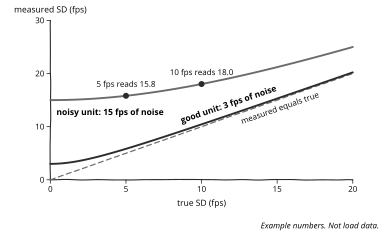
measured SD = √(true SD² + instrument SD²)For example, ammunition with a true SD of 5 fps shows 15.8 fps when read through 15 fps of instrument noise.1
Worked example. Example numbers. Not load data.
Your load has a true SD of 10 fps.
Noisy unit, 15 fps of noise:  √(10² + 15²) = √325 = 18.0 fps
Good unit, 3 fps of noise:    √(10² + 3²)  = √109 = 10.4 fps
Through the noisy unit, a 5 fps load reads 15.8 fps and a 10 fps load reads 18.0 fps. The true SD doubled, but the reading moved about 2 fps. A noisy chronograph cannot tell a good load from an ordinary one (see Figure 10-1).
If you know your instrument’s noise, you can take it back out.
true SD = √(measured SD² − instrument SD²)
Example: √(12² − 3²) = √135 = 11.6 fps
Use this only with a noise figure you trust. A guessed figure gives a guessed answer.
There are three common chronograph types used in handloading. For load testing, prefer Doppler radar.
| Type | How it reads | Practical considerations |
|---|---|---|
| Doppler radar | Tracks the bullet by radar from beside the muzzle | Points along the bullet’s path. Light and weather do not affect it. |
| Optical | The bullet passes over light sensors in front of the muzzle | Sunlight, cloud shadows, poor alignment and muzzle blast all change readings. |
| Magnetic | Senses the bullet from a bayonet mounted on the barrel | Hangs extra weight off the barrel. |
A barrel-mounted magnetic unit can shift your point of impact and change barrel harmonics and group size. The effect varies from rifle to rifle.2 You can leave the unit on during a work-up, because a work-up checks velocity, not group size. Before you shoot groups with a barrel-mounted unit attached, test the rifle with the unit on and off in interleaved strings (see The Precision Rifle Handbook, “Testing any claim yourself”).3 Until you prove it does not change your groups, remove it for group shooting and chronograph separate strings. When you shoot groups and velocities in separate strings, you cannot pair each bullet hole with its velocity to check vertical spread against speed (see Chapter 31).
Set up and check the unit at every session (see Chapter 28).
Rests, bags and targets
A steady rest holds the rifle still during work-ups and function tests, so the target shows the load rather than your hold. A solid rest on a shooting bench is best. Prone with sandbags is next. Away from a shooting bench, a bipod and a rear bag do the same job. Use targets printed at actual size with clear aim marks so you can spot hits and verify zero easily.
Spotting scopes and target cameras
A spotting scope or target camera lets you see each bullet hole from the firing line. Use it to verify safe impact on paper during a work-up and to match each hole with its chronograph reading in your log. If you call a bad shot, write down your call before you look at the target (see Chapter 27).
Thermometers and weather meters
Keep your ammunition in an insulated box with a thermometer in it, and read the ammunition temperature at every session (see Chapter 30). That reading tells you whether a velocity shift came from heat or from the load. A pocket weather meter reads the air temperature and station pressure where you stand, rather than the sea-level pressure in weather reports. Record both with the session for later reference.
Torque drivers, witness paint and scope levels
A torque driver sets each fastener on the rifle to the manufacturer’s specification. A paint pen draws a thin witness line across each screw head onto its seat. A broken line shows at a glance that a screw has turned. Both keep the hardware baseline fixed (see Chapter 3). A scope level shows cant. Level the reticle to a plumb line when you mount the scope, then use the scope level for every shot.
For long-range optics, wind meters, ballistic solver inputs, and extended field gear, see The Precision Rifle Handbook.
Notes
- Bryan Litz, Measuring Muzzle Velocity, chapter 15 of Modern Advancements in Long Range Shooting, Applied Ballistics, 2021, appliedballisticsllc.com/wp-content/uploads/2021/06/Measuring-Muzzle-Velocity.pdf.
- Bill Marr, “Does the MagnetoSpeed V3 Chronograph Change Group Size and Point of Impact?” RifleShooter, 2018, rifleshooter.com/2018/03/does-the-magnetospeed-v3-chronograph-change-group-size-and-point-of-impact/.
- “Saturday Movies: Garmin, LabRadar, Caldwell Compact Chronos,” AccurateShooter Daily Bulletin, 2024, bulletin.accurateshooter.com/2024/06/saturday-movies-garmin-labradar-caldwell-compact-chronos/.
- Jonathan Ocab, “Garmin Xero C1 Pro Chronograph Review,” OCABJ, 2023, ocabj.net/garmin-xero-c1-pro-chronograph-review/.