
Key points
- The inside of the case is the room the powder burns in. Less room for the same charge means more pressure.
- Cases of one cartridge hold different amounts of water from one maker to the next. About 2 gr of water is a real pressure difference near a maximum load.
- Your own fired cases, not the published test case, show how much room the powder has in your rifle.
- Brass comes in lots and wears out with each firing and sizing. A separating head, a split or a loose primer pocket ends a case’s life.
- Case weight is only a loose stand-in for capacity. Where capacity matters, measure the water each case holds.
Why it matters
The case holds the primer, the powder and the bullet. It swells against the chamber wall as the round fires. That seals the gas behind the bullet.
The inside of the case is the space the powder burns in. Until the bullet moves, the gas has nowhere else to go. A smaller space gives a higher pressure from the same charge. Two cases that look the same from outside can give two different pressures.
Every maker builds its cases to the outside dimensions of the cartridge standard. The standard’s drawings set no thickness for the walls or the web. That is the maker’s choice.1 Thicker walls or a thicker web leave less room for powder. Military brass is a common example of a thick case. Cases of one cartridge can differ by a couple of grains of water from maker to maker.2
Brass also wears out. Each firing stretches the case and each sizing works it back. In time the brass hardens and thins in places. A worn case can split. It can also pull apart just above the head and let high-pressure gas into the action. So you need to know three things about every case: its capacity, its firing count and its condition.
How it is done
Makers and capacity
Published load data names the case used in the test. Your cases may hold more or less water than that case. That is one reason every work-up starts at the published start load. Some published data also lists the water capacity of the test case.3 Compare your own measurement with it when you can.
A change of maker is a change of component. Treat it like a change of powder or bullet. Drop to the published start load and work up again (see Chapter 28).
Some cartridges are sold with a small rifle primer pocket by one maker and a large rifle primer pocket by another. Check the pocket of your actual case before you buy primers (see Chapter 12). Range brass of mixed makers needs sorting by headstamp before anything else (see Chapter 18).
Brass lots
A lot is a batch of cases made under one set of conditions and marked with one number. When raw material or tooling changes, the maker starts a new lot. If a batch fails a test, the lot number shows which cases to set aside.
Many makers print a lot number on the box. Copy it onto your own label.
Keep lots apart. Do not mix makers, lots or firing counts in one test. A mixed batch adds a variable you cannot see on the target.
Buy enough cases of one lot for the work ahead. A new lot from the same maker usually holds nearly the same capacity. In published comparisons, lots from one maker differed in water capacity by about 1 percent or less.4 Measure a few cases and compare them with your records. Act on a measured difference rather than an assumed one. Record the new lot. Before you load it in bulk, load 10 check rounds at your current charge, or one step lower if it sits at or near the published maximum. If the new lot runs faster by more than twice the noise (see Chapter 30), lower the charge and work up again from below.
Label each box with the maker, the lot, the firing count and the rifle.
Measuring water capacity
Water capacity is the weight of water that fills a case to the mouth. It is given in grains of water (gr H₂O). Water is used because its density is well known.
Measure cases fired in your rifle before you size them. A fired, unsized case matches your chamber and shows the true room the powder has in your rifle. If your brass is new, measure its capacity after its first firing. Your first work-up starts at the published start load either way, so you do not need to wait on this measurement to begin (see Chapter 28).
You need these items.
- A scale that reads to 0.1 gr or finer (see Chapter 8).
- A check weight close to the weight of a full case.
- Five to ten cases fired in your rifle from one lot with their spent primers still in place.
- A small cup of distilled water at room temperature, with a drop of dish soap if you like.
- A syringe or a dropper.
- Paper towels and a fine marker.
- Choose the cases. Take five to ten cases from one maker, one lot and one firing count. Do not size them. Do not remove the spent primers. A spent primer seals the flash hole.
- Clean and dry them. Wipe the outside of each case. Tip out any loose powder residue. The inside must be dry for the empty weighing.
- Check the scale. Verify it with the check weight before you weigh anything. Fix it before you go on if the reading is off (see Chapter 23).
- Number and weigh each empty case. Write a number on each case body with a marker. Weigh each case. Record its weight to the last digit the scale shows.
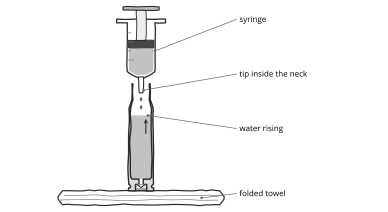
- Fill the case. Fill it from the syringe up to the mouth (see Figure 11-1). Tap the case gently to free any air bubbles. A drop of dish soap in the cup of water lowers the surface tension. It helps the water lie flat at the mouth.
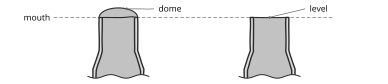
- Level the water at the mouth. Let a small dome of water stand above the mouth. Touch the corner of a paper towel to the dome. Draw water off until the surface sits level with the mouth (see Figure 11-2). Choose one rule for level and use it on every case.
- Dry the outside and weigh the full case. Wipe any water from the outside and the head. Weigh the full case at once and record its weight (see Figure 11-3). Water evaporates from the open mouth while you wait.
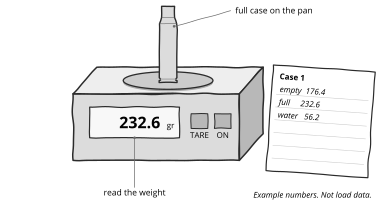
- Subtract and record. The capacity of each case is its full weight less its empty weight. Work out the mean and the spread for the lot with the formulas below.
- Empty and dry the cases. Pour out the water. Dry the cases fully before you size or prime them.
Capacity (gr H₂O) = full weight (gr) − empty weight (gr)
Mean capacity     = (c1 + c2 + ... + cn) ÷ n
Spread            = largest capacity − smallest capacity
Difference (%)    = (mean A − mean B) ÷ mean A × 100
Worked example. Five fired cases from one lot. Example numbers. Not load data.
| Case | Empty (gr) | Full (gr) | Capacity (gr H₂O) |
|---|---|---|---|
| 1 | 176.4 | 232.6 | 56.2 |
| 2 | 175.9 | 232.0 | 56.1 |
| 3 | 177.1 | 233.5 | 56.4 |
| 4 | 176.0 | 232.3 | 56.3 |
| 5 | 176.6 | 232.6 | 56.0 |
The five capacities add up to 281.0 gr. The mean is 281.0 ÷ 5 = 56.2 gr H₂O. The spread is 56.4 less 56.0, or 0.4 gr H₂O.
Now measure five cases from a second maker the same way. Say their mean is 54.4 gr H₂O. The second maker’s cases hold 1.8 gr less water. The difference is 1.8 ÷ 56.2 × 100 = 3.2 percent of the room. That is close to the 2 gr of water that makes a real pressure difference near a maximum load.2
Contested sorting cases by weight evens out their capacity
The claim. Many handloaders weigh their cases and sort them into groups by weight. Cases of equal weight hold equal water. Sorting by weight should therefore lower the velocity spread.
The physics. Weight counts all the brass in a case. Some of that brass sits in the rim and the solid head. Brass there adds weight but takes no room from the powder. Only the brass in the walls and the web changes capacity. So weight can only be a loose stand-in for capacity.
The test. Take fired cases from one lot with their spent primers in place. Weigh each empty case and sort the cases by weight into a light group and a heavy group. Then fill and weigh each case to find its water capacity (see “Measuring water capacity” above). This tests the claim directly, without firing a round. Firing the cases to judge their capacity from velocity wastes components and measures capacity poorly.
Compare the water capacities of the two groups. If case weight tracks capacity, the heavy group will hold less water than the light group by more than the spread within each group.
The data. Controlled tests of weight sorting are few. A small shooting test cannot settle the question. Heavy case prep on brass from one lot has shown no group benefit.5
The verdict. Plausible but unproven. Sorting by weight may still group cases of similar capacity. Where capacity matters, measure it directly.
Case life and inspection
A case has no fixed lifespan. Count its firings and inspect every case before loading (see Chapter 18). Too much shoulder bump stretches and thins the brass above the web, and in time the head separates. Bump the shoulder only .001 to .002 inch for a bolt action, or .003 to .005 inch for a semi-automatic (see Chapters 19 and 26). Annealing softens worked brass and extends neck life (see Chapter 21). Retire any case with a bright stretch ring above the head, an inside groove that a probe catches, a split neck or shoulder, a crack or a loose primer pocket. Crush its neck so it cannot return to the batch.
Notes
- SAAMI, SAAMI Z299.4-2025: Voluntary Industry Performance Standards for Pressure and Velocity of Centerfire Rifle Ammunition for the Use of Commercial Manufacturers, cartridge and chamber drawings, saami.org/wp-content/uploads/2026/04/SAAMI-Z299.4-CFR-2025-Centerfire-Rifle-Approved-2-10-2025-2026-04-27.pdf; C.I.P., “Tables of Dimensions of Cartridges and Chambers (TDCC),” C.I.P. homologation database, list of TDCC, Tab I to Tab III, and the 308 Win. data sheet, bobp.cip-bobp.org/en/tdcc_public.
- Empirical Precision, User Guide, linked from the app’s dashboard, 2026, section 15.1, empiricalprecision.com.
- Nosler, Nosler Reloading Guide, Number 9, 2021.
- William L. Castleman, Comparison of 223 Remington Brass for AR-15 Service Rifle, first posted 2023, revised April 3, 2025, wlcastleman.com/equip/shoot/223bt/index.htm; “.243 Winchester Brass Weight and Capacity Tested,” AccurateShooter Daily Bulletin, 2008, bulletin.accurateshooter.com/2008/09/243-winchester-brass-weight-and-capacity-tested/.
- Hornady, “Let’s Talk Load Development,” The Hornady Podcast, episode 121, 2024, hornadymanufacturing.libsyn.com/ep-121-lets-talk-load-development.