
Key points
- Construction decides how a bullet behaves in the bore and in the target.
- Monolithic bullets are longer for their weight. They need their own published data and more jump.
- The ogive decides how fussy a bullet is about seating depth. Tangent ogives are the most forgiving.
- Length decides the twist a bullet needs, so measure your own bullets.
- A new bullet is a new load, even at the same weight. Work up again after any bullet change.
Why it matters
The bullet touches every part of the load. Its weight and bearing surface set how hard the powder must push. Its length sets how deep it sits in the case and whether your twist can keep it flying point first. Its shape sets its drag, which governs drop and wind drift.
Each of these feeds pressure. A heavier bullet raises pressure for the same charge. More bearing surface adds friction in the bore and nudges pressure up. A longer bullet seated to the same overall length sits deeper and takes room from the powder (see Chapter 24).
How it is done
Construction types
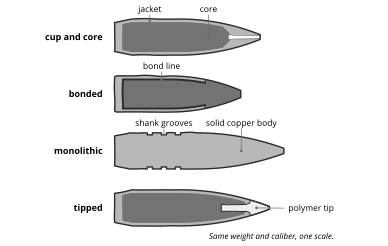
- Cup and core. A lead core inside a jacket of copper alloy. Most match bullets and many hunting bullets are built this way. Match bullets usually have a small open tip and a boat tail.
- Bonded. A cup-and-core bullet with the core fused to the jacket. Bonding is meant to keep the two together on impact, so a hunting bullet holds its weight.
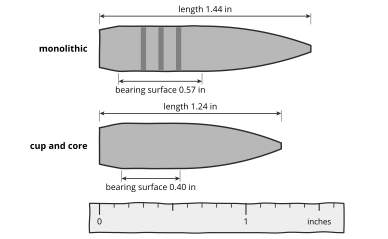
- Monolithic. One piece of copper or copper alloy, with no lead. Copper is less dense than lead, so a monolithic bullet is longer than a lead-core bullet of the same weight. Many have grooves cut around the shank to reduce bearing surface, fouling and pressure.1
- Tipped. A tip fills the nose of any of the types above. A polymer tip adds length but almost no weight. An aluminum tip adds some weight.
Choose the construction for the job first. Match bullets are built for precision and a high ballistic coefficient, or BC. A BC compares a bullet’s drag with that of a standard projectile. A higher BC means less velocity loss and less wind drift (see The Precision Rifle Handbook). Hunting bullets are built to expand and hold together in game.
The parts of a bullet
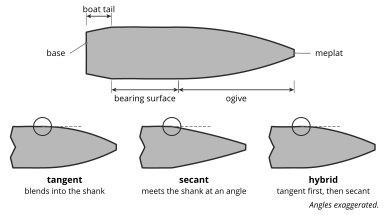
From the front, a bullet has a meplat, an ogive, a bearing surface and a base. The meplat is the small flat or opening at the very tip. The ogive is the curved nose. The bearing surface is the full-diameter shank that grips the rifling. The base is either flat or tapered into a boat tail.
Ogive types
- Tangent. The nose curve blends smoothly into the shank. There is no corner where they join. Tangent ogives are the most forgiving of seating depth.
- Secant. The nose curve meets the shank at a slight angle. It uses a larger radius than a tangent ogive of the same nose length. That gives a sleeker nose and often a higher BC. Secant bullets can be fussy about seating depth.
- Hybrid. A tangent section where the bullet meets the lands and a secant section toward the tip. Hybrids aim for the BC of a secant nose with the seating tolerance of a tangent nose.
Ogive type changes how much seating depth matters (see Chapter 24).
Boat tail and flat base
A boat tail tapers the base to reduce drag. Long-range match bullets usually have one. A flat base is shorter for its weight. It is also harder to start square in the case mouth, so it may need a slight flare (see Chapter 20). The base shape also decides which drag model, G1 or G7, fits the bullet (see The Precision Rifle Handbook).
Bearing surface
More bearing surface means more friction and more force to engrave the bullet. Both nudge pressure up.
Bearing surface is not always published. In measured bullets it is typically about a third of the bullet’s length.2
Length and stability
Length is what makes a bullet hard to stabilize, so a longer bullet needs a faster twist (see The Precision Rifle Handbook).
Measure your bullets with calipers. Catalog lengths are often nominal.2 Measure a few from each box and use the longest. For a tipped bullet, also measure the metal length, from the base to where the jacket ends. The stability check uses it (see The Precision Rifle Handbook).
Spin ceiling and jacket failure
Spin stabilizes a bullet, but spin has a ceiling too. Pushing a light or thin-jacketed bullet to high velocity in a fast-twist barrel creates high centrifugal stress on the jacket. Past that limit, the bullet can come apart in mid-air as a gray puff of smoke instead of reaching the target. From about 250,000 rpm, thin-jacketed bullets have been known to fail.2
Check the spin rate from muzzle velocity (MV, in fps) and barrel twist (in inches per turn):
RPM = MV * 720 / twistExample numbers. Not load data. A bullet fired at 3,000 fps from a 1:8 twist barrel spins at 3,000 * 720 / 8 = 270,000 rpm. That exceeds the 250,000 rpm caution, so a thin-jacketed bullet could fail in flight.
For full gyroscopic stability calculations, twist matching, and external flight physics, see The Precision Rifle Handbook.
Monolithic bullets
A monolithic bullet’s extra length sits deeper in the case. It also carries more bearing surface, which adds friction. Both raise pressure. So never use lead-core data for a monolithic bullet.
Monolithic bullets also need jump. One maker starts its copper bullets at least .050 inch off the lands.3 Seat them with the jump the bullet maker gives (see Chapter 24).
Follow these steps for a monolithic bullet.
- Find published data for the exact bullet. The bullet maker’s data is the place to start.
- Measure the bullet. Check its stability for your twist (see The Precision Rifle Handbook).
- Measure the lands with your usual method, and seat with the jump the bullet maker gives (see Chapter 24).
- Start at the published start load. Work up with a chronograph (see Chapter 28).
- Test jump once the charge is set (see Chapter 24). Increasing jump seats the bullet deeper into the case. If you seat deeper than the length you used for your work-up, drop back to the start load and work up again (see Chapter 28). Fire enough shots at each depth to tell a real change from noise (see The Precision Rifle Handbook).
- Record the jump with the load. Measure the lands again as the throat wears.
Bullet pointing and base-to-ogive sorting
Open-tip match bullets come out of forming dies with slight differences at the meplat, the small opening at the nose. Meplat trimming squares the tips to one length, and a pointing die closes the opening slightly to make the noses more uniform and reduce aerodynamic drag a little. Base-to-ogive (BTO) sorting measures bullets from the same box with a bullet comparator (see Chapter 9) and groups them into narrow length bands so seating depth (CBTO) varies less across a batch.
Choosing a bullet step by step
- Decide the job. Pick the construction for target, match or hunting use (see Chapter 16). For a hunting bullet, note the maker’s lowest impact velocity for reliable expansion. The velocity column of your drop chart gives the farthest distance at which the load still reaches it (see The Precision Rifle Handbook).
- Check stability. Measure the bullet and check its stability for your twist in your coldest air (see The Precision Rifle Handbook).
- Check the data. Make sure published data exists for the exact bullet in your cartridge (see Chapter 15).
- Check the fit. The bullet must sit at least one caliber deep in the case. If the round will feed from the magazine, it must also fit your magazine (see Chapter 24).
- Compare BCs fairly. Compare G7 numbers with G7 numbers. Prefer measured drag data where it exists (see The Precision Rifle Handbook).
- Buy enough of one lot. Record the lot on the batch record (see Chapter 27). A different bullet means working up again (see Chapter 28). A new lot of the same bullet needs a check, not a new work-up. Re-measure CBTO with the new lot, since the ogive can differ slightly between lots.5 Before you load it in bulk, load 10 check rounds at your current charge, or one step lower if it sits at or near the published maximum. If the new lot runs faster by more than twice the noise (see Chapter 30), lower the charge and work up again from below.
Notes
- Hornady, CX Bullets, hornady.com/bullets/cx; Barnes Bullets, FAQs, barnesbullets.com/faqs.
- Empirical Precision, User Guide, linked from the app’s dashboard, 2026, section 15.1, empiricalprecision.com.
- Barnes Bullets, FAQs.
- Barnes Bullets, Load Data, barnesbullets.com/load-data/.
- Bryan Litz, “Effects of COAL and CBTO, Part 2,” Berger Bullets Blog, 2013, bergerbullets.com/effects-of-cartridge-over-all-length-coal-and-cartridge-base-to-ogive-cbto-part-2/.