
Key points
- Smokeless powder is nitrocellulose. Double-base powders add nitroglycerin, but the type alone does not tell you which powder holds more energy.
- Burn rate is a relative ranking, not a number, and powders adjacent on a burn chart are never interchangeable.
- Warm powder generates more pressure. “Temperature stable” depends on the cartridge, the lot and the rifle.
- Store powder sealed, cool and dry. In one test, damp storage moved velocity more than heat or cold usually does.
- A powder that fills the case at its published maximum is the forgiving choice for a first load. A double charge cannot hide in it.
Why it matters
Powder is the energy in the cartridge. It is also the component that is easiest to get wrong. Two powders at the same charge weight can differ by 20,000 psi.1 A charge that is safe with one powder can be dangerous with its neighbor on a burn chart.
So the rules for powder are strict. Keep one powder on the workbench at a time. Use published data for the exact powder. Record the lot, and check a new lot before you rely on it.
Powder also responds to its surroundings. Warm powder burns faster when fired. Moisture changes it in storage. Age slowly uses up the chemicals that keep it stable.
How it is done
Single base and double base
All smokeless rifle powder starts as nitrocellulose. Single-base powders are nitrocellulose with stabilizers and other additives. Double-base powders add nitroglycerin. The share varies widely. One maker’s powders run from 2 percent in a shotgun powder to 40 percent in a pistol powder.2
The nitroglycerin raises the energy per grain.3 In one maker’s data, its single-base rifle powders have an energy content of about 3,500 to 3,950 kJ/kg. Its double-base rifle powders have about 3,700 to 4,000 kJ/kg.4 The ranges overlap, so the type alone does not tell you which powder holds more energy. More energy per grain can mean more velocity from a given case. The hotter gas can also wear the throat faster.
Grain shapes
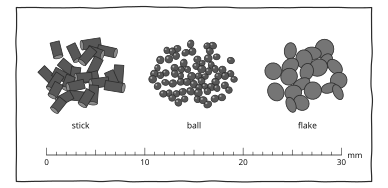
Rifle powders come in three common shapes.
- Extruded or stick powder. Short cylinders cut from a pressed strand. Most have one hole through the middle. Some have several.
- Ball or spherical powder. Small spheres. Many are rolled flatter and coated to slow the start of the burn.5
- Flake powder. Thin discs. Flake is more common in pistol and shotgun powders than in rifle powders.
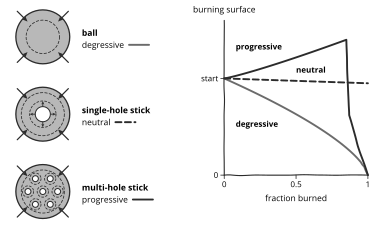
The shape decides how the burning surface changes as the grain burns. A solid sphere or flake shrinks as it burns, so its surface falls. That is a degressive shape. A stick with one hole burns from the inside and the outside at once, so its surface stays close to constant. That is a neutral shape. A stick with several holes gains surface as the holes widen, until the grain breaks into slivers. That is a progressive shape. Progressive shapes hold pressure up longer. Degressive shapes peak early.
Shape also changes how powder pours. Ball powder flows easily through a measure and packs densely, at about 950 to 1,000 kg/m³. Stick powder mostly pours a little lighter, at about 880 to 990 kg/m³. It also meters less evenly.6 Weigh every charge for a work-up or a precision load, whatever the shape (see Chapters 8 and 23).
Burn rate as a relative idea
“Burn rate” is not a number printed on the container. It is a place in an order from fast to slow. Powder makers publish burn rate charts that rank powders from fastest to slowest.
The order is only relative because powder burns faster as pressure rises. This is Vieille’s law.
r = B × Pⁿ

r = speed at which the burning surface moves into the grain
B = the powder's burn coefficient
P = pressure
n = burn exponent
Because burn speed depends on pressure, and pressure depends on the case, bullet and charge, two powders can swap places on a burn chart from one cartridge to another.
Use a burn chart to narrow your search. Never use it to set a charge (see Chapter 16).
- Start from published data for your cartridge and bullet (see Chapter 15). Note the powders it lists.
- Find those powders on a burn chart. Note where they cluster.
- Pick candidates from that region. These are the powders worth reading about.
- Find published data for each candidate. It must cover your exact cartridge and bullet. A powder with no published data for your components is not a candidate.
- Take every charge from that data. Start at its start load.
Never substitute one powder for another because they sit close together on a chart. A powder one place faster can be dangerously over pressure at the slower powder’s charge. Two powders can also share a number in their names and still be different powders. Read the full name on the container every time.
A burn chart is a guide, not load data. Burn order shifts with cartridge, bullet, pressure, temperature and lot. Where two charts disagree, trust the powder maker’s. A chart tells you which manual pages to open. It does not give you a charge. Every powder still needs its own published start load.
Case fill and compressed loads
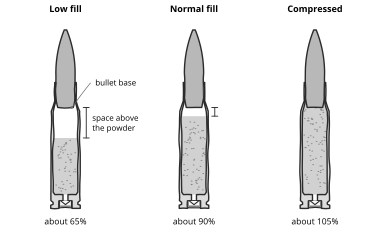
Case fill is how much of the case the powder takes up. It is the charge’s poured volume as a share of the usable capacity. Usable capacity is the case capacity (see Chapter 11) less the room the seated bullet takes. You can estimate that room by hand. Treat the part of the bullet below the case mouth as a solid cylinder of the bullet’s diameter.
Seated depth (inch)
    = bullet length − (COAL − case length)
Bullet's seated volume (gr H₂O)
    ≈ seated depth × 0.7854 × bullet diameter² × 252.4
Usable capacity (gr H₂O)
    = case capacity − bullet's seated volume
Charge volume (gr H₂O)
    = charge (gr) × 998.2 ÷ bulk density (kg/m³)
Case fill (%)
    = charge volume ÷ usable capacity × 100
The figure 998.2 kg/m³ is the density of water at about 20 °C. At that density, one cubic inch of water weighs 252.4 gr. The figure 0.7854 is π ÷ 4, so 0.7854 × diameter² is the area of the bullet’s cross-section in square inches. A boat tail takes a little less room than a cylinder, so the estimate runs a little high. Bulk density is the density of the powder as poured, air gaps included. To measure it, use the fired case you measured for water capacity. Pour powder in through a funnel until it is level with the mouth. Do not tap the case. Weigh the powder. Then bulk density (kg/m³) ≈ powder weight (gr) ÷ water capacity (gr H₂O) × 998.2.
Worked example. An imaginary case, bullet and powder. Example numbers. Not load data. The case holds 58.0 gr H₂O. A .308 inch bullet 1.165 inch long is seated in a case 2.050 inch long, to a COAL of 2.850 inch. The powder pours at 930 kg/m³.
Seated depth
    = 1.165 − (2.850 − 2.050) = .365 inch

Bullet's seated volume
    ≈ .365 × 0.7854 × .308² × 252.4 = 6.9 gr H₂O

Usable capacity
    = 58.0 − 6.9 = 51.1 gr H₂O

Weight that fills the usable capacity (100% fill)
    = 51.1 × 930 ÷ 998.2 = 47.6 gr

A charge of 90% of that weight
    = a case fill of 90%
Published data often shows fill. Some manuals print the load density or fill ratio beside each charge and flag compressed loads.7 Follow those flags.
Published loads show where case fill normally sits.1
| Case fill | What it means |
|---|---|
| Below 60% | Very low. Published loads rarely go here |
| 60 to 70% | Low fill. The powder may light less consistently |
| 70 to 80% | The low side of published loads. One rifle start load in four sits here |
| 80 to 100% | The normal range |
| 100 to 105% | Lightly compressed. One published load in six sits here |
| 105 to 110% | Compressed. Common at maximum charges |
| Above 110% | Heavily compressed. Published loads rarely go here |
A compressed load is one over 100 percent load density. In testing, compressed loads still ignite consistently.8 Seating a bullet on a compressed charge crushes the powder. Compressed powder can push the bullet out over time.1 Measure compressed rounds again before you fire them.
Low fill is not a reason to add powder. Never go past the published maximum to fill a case. If fill is low, the cure is a slower powder with its own published data.
Within the normal 80 to 100 percent range, a fuller case does not guarantee a lower velocity SD. In a test across five cartridges from .223 Remington to .338 Lapua Magnum, powders at 80, 90 and 100 percent fill showed no link between fill and SD. Both the lowest and the highest SDs came from 80 percent loads.9
Full-case loads: the forgiving first load
Some powder and cartridge pairs are hard to overcharge. The powder is bulky enough that its published maximum charge fills the case, or nearly fills it. A double charge cannot fit. It spills over the case mouth before a bullet can be seated. A gross overcharge cannot fit either. A full-case load turns the two worst charging mistakes into something you can see.
The classic example is a bulky extruded powder in the .223 Remington with a light bullet. Its published maximum charges fill the case or compress it slightly.10 Many cartridges have a powder like this. The published data shows which.
Low fill works the other way. A fast, dense powder can reach the pressure limit with the case half full.
Finding a full-case load:
- Start with the powders listed in published data for your exact bullet and cartridge.
- Look for maximum charges marked compressed or case full. Compressed is often marked with a “C” and case full with an “F”. Those powders fill the case at their maximum.12
- If the data does not mark fill, work it out with the case-fill formula above. Use your own fired brass, since brass from different makers holds different amounts of powder. If your brass is new, measure it after its first firing. Until then, use the test case’s capacity where the data lists one (see Chapter 11).
- Prefer the powder whose published maximum most nearly fills the case for the velocity you want.8
- Work up from the published start load as always (see Chapter 28). A full case at the maximum is a safeguard. It is not a reason to skip the work-up.
What a full-case load does not prevent:
- The wrong powder. A faster powder poured to the same level can be far over pressure while the case looks normal. Keep only one powder out in the workshop at a time (see Chapter 2).
- A bullet seated too deep. Deeper seating raises pressure with no change in charge (see Chapter 24).
- A changed component or hot weather. A primer swap, brass that holds less or a hot chamber can raise pressure at the same charge (see Chapter 12 and the next section).
- Compressing past the published maximum. Never add powder just to fill a case.
Temperature sensitivity
Warm powder burns faster. Faster burning raises pressure and velocity. Cold powder does the reverse. The same charge that is comfortable at 40 °F can be over pressure at 100 °F.1
Published data is shot at one set temperature, such as 68 °F.13 Your ammunition will see colder and hotter days than that.
Some powders are sold as temperature stable. The term has no fixed meaning. How a powder responds depends on the cartridge, the lot and the rifle. The response is often not a straight line, and many powders change faster in the cold than in the heat. As a rough guide, concern starts near 0.5 fps per °F.14
Heat in the chamber matters too. A round left in a hot chamber warms up before you fire it. The chamber can warm it as much as a hot day does. Do not let a round sit in a hot chamber while you wait to shoot.
Always leave a margin for heat. A near-maximum load developed in cool weather can produce dangerous pressures in summer heat. Lower your velocity ceiling by 1 fps for every °F between your work-up ammo temperature and the hottest weather you will shoot in, even with a “temperature-stable” powder (see Chapter 28).
Lot-to-lot variation
Powder is made in lots, and burn rate can vary slightly between lots. Record the lot number from every container on your batch record (see Chapter 27). Buy enough of one lot for the life of a load. Before you load a new lot in bulk, load 10 check rounds at your current charge, or one step lower if it sits at or near the published maximum. If the new lot runs faster by more than twice the noise (see Chapter 30), lower the charge and work up again from below.
Storage, shelf life and signs of breakdown
Smokeless powder breaks down slowly from the day it is made. As nitrocellulose ages, it gives off acidic nitrogen oxides. Stabilizers such as diphenylamine and ethyl centralite absorb them. Heat speeds the breakdown. Cool storage slows it.
Store powder in its original container with the lid closed tight. Keep it dry and away from heat, friction and electrical discharge. Aim to keep it below 70 °F (21 °C) and never above 100 °F (38 °C).16 Stored this way, powder keeps for many years.17 Sealed in the original container at about 68 °F (20 °C), one maker’s powders have an estimated shelf life of at least 10 years.18 Use the oldest container first. Return unused powder from the measure to its own container at the end of every session (see Chapter 2).
Check old powder before you use it. These are the signs of breakdown.
- A sharp, acrid smell. Decaying powder smells of acid. Fresh powder smells of solvent.
- Reddish-brown dust or fumes on the grains or in the container.
- Discolored grains.
Once the stabilizers are used up, the breakdown speeds itself up. In the worst case it can end in spontaneous combustion. Stop using any powder that shows these signs. Dispose of it (see Chapter 2).
Humidity in storage
Powder takes up or gives off moisture until it matches the air around it. That moisture changes how it burns, and the effect can be large.
Keep powder sealed in its original container so its moisture stays where the maker left it. Do not leave powder in an open measure or hopper for days. Store loaded rounds with the same care. A brass case is not sealed against the air unless you seal it. Ammunition kept for months in a damp garage or basement can give erratic velocities, hang-fires or duds.
Notes
- Empirical Precision, User Guide, linked from the app’s dashboard, 2026, section 15.1, empiricalprecision.com.
- Alliant Powder, Reloaders’ Guide, 2023, p. 10, alliantpowder.com/resources/catalog/AP399_2023AlliantPowderReloadersGuide_SinglePgsNoCrops.pdf.
- Vihtavuori, Reloading Guide 2026, p. 6, vihtavuori.com/wp-content/uploads/2026/04/Vihtavuori_Reloading_Guide_2026_ENG_web.pdf.
- Vihtavuori, Reloading Guide 2026, p. 148.
- SAAMI, Smokeless Powder: Properties & Storage, 2022, saami.org/wp-content/uploads/2025/08/Info-Doc-Smokeless-Powder-11-8-2022.pdf; Tenney L. Davis, The Chemistry of Powder and Explosives, John Wiley & Sons, 1943, pp. 329–330, archive.org/details/ChemistryOfPowderAndExplosives; St. Marks Powder, “Densified BALL POWDER Cased Telescoped Propelling Charge: LSAT Success,” NDIA Joint Armaments Conference, 2012, slide 4, ndia.dtic.mil/wp-content/uploads/2012/armaments/Wednesday13627drummond.pdf.
- Empirical Precision, Component library, powder records and published-load tables in the app, 2026, empiricalprecision.com.
- Nosler, Nosler Reloading Guide, Number 9, 2021; Vihtavuori, Reloading Guide 2026.
- Hodgdon, 2025 Annual Manual, 2024.
- Bryan Litz, Modern Advancements in Long Range Shooting, Volume II, Applied Ballistics Books, 2016; “Applied Ballistics: Rimfire Video, Fill Ratios, Plus 25% Off Sale,” AccurateShooter Daily Bulletin, 2026, bulletin.accurateshooter.com/2026/03/applied-ballistics-rimfire-video-fill-ratios-plus-25-off-sale/.
- Hodgdon, 2025 Annual Manual, p. 81; Nosler, 223 Rem: 50/52/53 Grain, load data, version 9.0, nosler.com/media/load_data_assets/pdfs/223-Rem-50gr-version-9-0.pdf; Nosler, 223 Rem: 55 Grain, load data, version 9.0, nosler.com/media/load_data_assets/pdfs/223-Rem-55gr-version-9-0.pdf.
- Western Powders, Handloading Guide 8.0, 2020, hodgdonpowderco.com/wp-content/uploads/2023/04/WesternPowdersHandloadingGuide8.0_WEB-1.pdf.
- Vihtavuori, Reloading Guide 2026; Hodgdon, 2025 Annual Manual.
- Vihtavuori, Reloading Guide 2026.
- Cal Zant, “Powder Temperature Sensitivity: The Hidden Factor Affecting Your Long-Range Accuracy,” Precision Rifle Blog, 2025, precisionrifleblog.com/2025/03/08/powder-temperature-sensitivity/.
- Cal Zant, “Powder Temp Stability: Hodgdon Extreme vs. IMR Enduron,” Precision Rifle Blog, 2016, precisionrifleblog.com/2016/06/19/powder-temp-stability-hodgdon-extreme-vs-imr-enduron/.
- Alliant Powder, Reloaders’ Guide.
- SAAMI, Smokeless Powder.
- Vihtavuori, How to Store Reloading Powders, vihtavuori.com/resources/education/how-to-store-powders/.
- Bryan Litz, Modern Advancements in Long Range Shooting, Volume III, Applied Ballistics Books, 2022; Cal Zant, “Powder Temperature Sensitivity.”