
Key points
- CBTO tracks the distance to the lands and COAL does not. COAL still matters for the magazine and for published data.
- Land readings depend on technique, so only one method used the same way gives numbers you can compare.
- Seating deeper, or into the lands, raises pressure. Monolithic bullets need jump.
- The magazine caps the length of rounds fed from it, and the bullet must sit at least one caliber deep.
- The lands move as the throat wears, and seating effects shrink in large samples. A jump that forgives both beats one you must chase.
Why it matters
Seating sets three things at once. It sets where the bullet starts relative to the rifling, how much room the powder has and whether the round fits the magazine.
Room for powder is a pressure question. Seating deeper takes space from the powder, so pressure and velocity rise. Even .030 inch deeper on a near-maximum load is a real and often underestimated pressure step.1
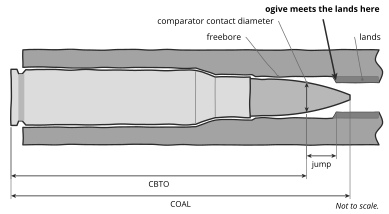
Distance to the rifling is a precision question until the bullet touches the lands. Then it becomes a pressure question too. Here is the full method for seating to your own chamber.
How it is done
COAL and CBTO
COAL is the cartridge overall length, from the base to the bullet’s tip. Tips vary from bullet to bullet, even in one box. So two rounds with the same COAL can sit at different distances from the lands.
CBTO is the cartridge base to ogive. A bullet comparator on your caliper reads it at a fixed diameter on the ogive, near where the bullet meets the lands (see Chapter 9 and Figure 24-2). So CBTO tracks the jump and COAL does not. Use CBTO, never COAL, for seating tests.2 Always use the same comparator insert and write down which one. A different insert gives a different number. Measure with bullets from the lot you will load.
COAL still matters. The magazine limits it, published data lists it and the SAAMI maximum is written as a COAL. Record both numbers.
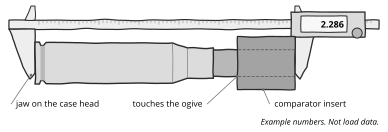
Measure the lands with one method
Land measurement depends on technique.3 Pick one method and keep it. Measure five times, then record the average and the spread.
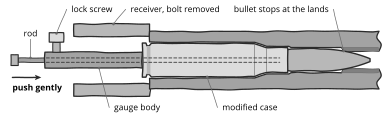
Method A. The modified-case gauge.
- Fit a modified case for your cartridge to the gauge (see Chapter 9). Drop a bullet from your loading lot into its mouth.
- With the bolt out, insert the gauge into the chamber (see Figure 24-3). Push the rod gently until the bullet stops against the lands. Use the same light push every time.
- Lock the rod, withdraw the gauge without disturbing the bullet and measure CBTO.
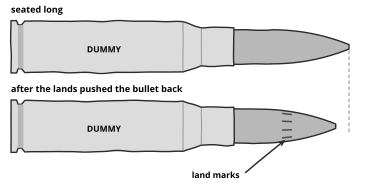
Method B. The lands-gauge dummy.
- Use a sized case with no primer and no powder. Open its neck slightly, until a bullet slides in under firm finger pressure. An expander mandrel does this. Mark the case plainly as a lands-gauge dummy, so it can never pass for a live round, and keep it for the next measurement.
- Seat a bullet long in it. The light neck grip lets the lands push the bullet back.
- Chamber the dummy and close the bolt gently. Extract it gently and measure CBTO (see Figure 24-4). Repeat until the reading stops changing.
- If a bullet sticks in the lands, push it out from the muzzle with a cleaning rod before you do anything else.
Record the bullet, method, comparator, average, spread, date and barrel round count. The lands move, so this number has a date on it.
Jump and jam
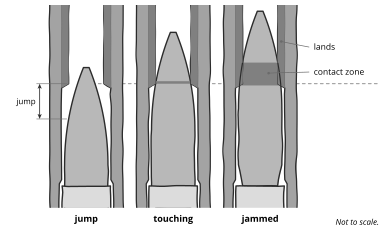
Jump is the distance the bullet travels before its ogive meets the lands. Jam means the ogive touches or presses into the lands when the round is chambered.
jump = CBTO at the lands − CBTO of your roundA jump of zero or less is jam (see Figure 24-5). Jam raises pressure. A jammed round has a second hazard. If you open the bolt without firing, the bullet can stay in the lands while the case comes out. Powder then spills into the action. That is one reason not to jam a hunting load.
The limits on length
The lands set one limit on length. Four others matter too.
The magazine. Your magazine length is the longest round your magazine feeds and cycles every time, found with dummy rounds (see Chapter 3). It can be shorter than the published SAAMI maximum. It is a hard ceiling for any round fed from the magazine, no matter how much freebore the chamber has. Rounds you load singly by hand are not bound by magazine length. Highpower service rifle shooters single-load long rounds this way during slow-fire stages (see Chapter 3).
The SAAMI maximum COAL. The SAAMI maximum is a ceiling that lets factory ammunition fit every rifle of the cartridge. It is not a measurement of your chamber. A round loaded past it to reach deep lands may chamber in your rifle and fail to fit others. Keep such ammunition for the one rifle it was built for.
The published COAL. Seating a bullet shorter than the published COAL, or deeper than in your work-up, leaves less room for the powder. Treat it as a new load and work up again (see Chapter 28).
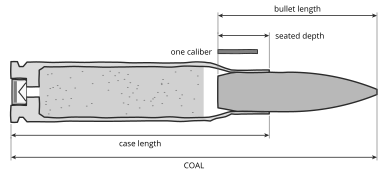
One caliber in the case. Seat the bullet at least one caliber deep, measured from the case mouth to the bullet base (see Figure 24-6). For example, seat a .308 inch bullet at least .308 inch deep.
seated depth = bullet length − (COAL − case length)
calibers     = seated depth ÷ bullet diameter
Worked example. Example numbers. Not load data. A bullet 1.250 inch long is loaded to a COAL of 2.800 inch in a case 1.920 inch long. Seated depth = 1.250 − (2.800 − 1.920) = .370 inch. For a .264 inch bullet that is .370 ÷ .264 = 1.4 calibers, so it passes.
The lands move
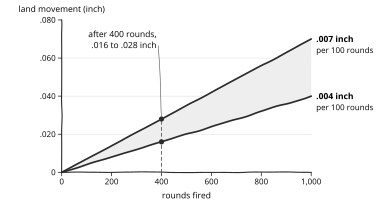
Every shot wears the throat, so the lands move forward and the jump grows (see Chapter 30). Measurements in 6 and 6.5 mm barrels show about .004 to .007 inch of land movement per 100 rounds (see Figure 24-7).3 Other calibers wear at their own rates, so measure yours rather than assume it.
Re-measure the lands every 100 to 200 rounds and before any seating test. Better still, choose a jump that needs no chasing. If a load shoots the same across a band of jump, erosion matters little.3
Seating depth for your own chamber, step by step
- Measure the lands with your one method. Record the CBTO at the lands.
- Start with the bullet maker’s guidance. Each maker knows its designs. For example, one maker starts its hybrid bullets .015 inch off the lands because of their ogive shape (see Chapter 14).2 If the maker lists no starting jump, build a marked dummy round (steps 5 and 6) to the published COAL, or to your magazine length if that is shorter. Subtract the dummy’s CBTO from the CBTO at the lands (step 1) to find the jump. If the jump is zero or less, the bullet is touching the lands. Seat it deeper until the jump exceeds the spread of your land measurements.
- Note the published COAL for your exact bullet. You will compare your round with it in step 7.
- Work out the target CBTO. Subtract the jump you chose from the CBTO at the lands.
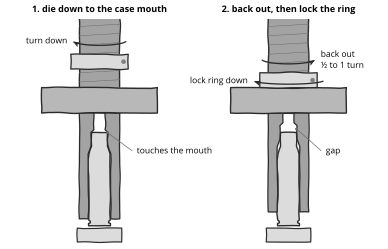
- Set the seating die. With a case at the top of the stroke, turn the die down until it touches the case mouth (see Figure 24-8). Back it out half a turn to a full turn, so its crimp shoulder clears the mouth.6 Lock the die. A competition die with a sliding sleeve has no crimp shoulder, so set its body as its maker directs (see Chapter 5).
- Build a dummy at the target CBTO. Use a sized case with no primer and no powder, and mark it. Start with the stem backed out so the bullet seats long.7 Seat, measure and turn the stem down a little until you reach the target. Then lock the stem. With a micrometer top, note the dial reading at the target CBTO and record it with the load. A stem that fits the bullet’s ogive pushes on the ogive, not the tip (see Chapter 5 for stem types).
- Check the dummy against every limit. Confirm that the bullet sits at least one caliber deep. For magazine-fed rounds, the magazine length is a hard limit: if the dummy is too long, seat the bullet deeper. Remember that seating shorter than the published COAL reduces powder space and raises pressure. Whatever length you settle on, start your charge work-up from the published start load at that seating depth (see Chapter 28).
- Check the dummy in the rifle. It should chamber without force. If the round will feed from the magazine, the dummy should feed from it too. Keep it as your reference round.
- Seat the batch. Measure CBTO on every round or a sample (see Figure 24-2), and record the average and the spread. Measure COAL on the batch too. Tips vary (see Chapter 9). So for rounds fed from the magazine, the longest round in the batch must fit it, not just the dummy.
target CBTO = CBTO at the lands − chosen jumpWorked example. Example numbers. Not load data. Five land readings with comparator A average 2.252 inch, with a spread from 2.250 to 2.254 inch. The bullet maker suggests starting .015 inch off. Target CBTO = 2.252 − .015 = 2.237 inch. The dummy’s COAL is 2.810 inch, but the magazine length is 2.800 inch. The magazine wins. Seat .015 inch deeper, to leave some room for tips that run long. CBTO becomes 2.222 inch, the jump becomes .030 inch and the dummy’s COAL becomes 2.795 inch. Tips can vary by .005 to .012 inch (see Chapter 9), so check the longest COAL in the batch against 2.800 inch.
Testing seating depth
Small-sample seating nodes rarely repeat.8 To detect a 1.5 to 1 group-size difference, two jumps need about 35 shots each. Three, four and five arms need about 45, 55 and 60 shots per arm (about 67, 77 and 84 for velocity SD; see The Precision Rifle Handbook, Chapter 16). Secant-ogive bullets can be sensitive to depth, while hybrids are much less so (see Chapters 14 and 29). Test jump in interleaved blocks (see Chapter 29 and The Precision Rifle Handbook), and test monolithic copper bullets in .025 inch steps.5 Any jump deeper than your worked-up seating, or into the lands, is a new load that must be worked up from the published start load (see Chapter 28).
Crimping
Bolt-action bottleneck loads rarely need a crimp; neck grip holds the bullet.4 Four cases call for one.
- A tubular magazine. Keeps bullets from being pushed back into their cases.4
- Heavy recoil. Heavy bullets of .375 caliber and up, and the largest magnums.9
- A semi-automatic action. When a setback test shows bullet movement or the rifle maker calls for it (see Chapter 26).10
- A flared mouth. Close any remaining flare on a flat-base bullet with a taper crimp die set just to touch (see Chapter 20).
A roll crimp needs a bullet cannelure or crimp groove at the case mouth.6 If your CBTO misses the cannelure, seat to it and work up again (see Chapter 28), or use a collet crimp, which needs none (see Chapter 5). Work up with the crimp you will use and keep the setting fixed.
If you crimp, trim the cases to one length first so each gets the same crimp (see Chapter 20). For a roll crimp in the seating die, follow this order.4
- Seat the bullet to depth. Back the seater stem out several turns so it cannot seat the bullet deeper.
- Turn the die body down in small steps, raising the round each time, until the case mouth rolls into the cannelure (see Figure 24-9). Over-crimping can buckle the case or push the shoulder back.
- Run the round back up, turn the stem down to touch the bullet and lock both.
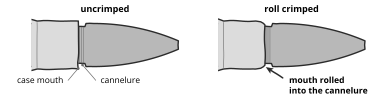
With a separate taper or collet crimp die, seat first (see Chapter 5), then turn the crimp die down in small steps until the crimp just shows.
Notes
- Empirical Precision, User Guide, linked from the app’s dashboard, 2026, section 15.1, empiricalprecision.com.
- Berger Bullets, How to Load a Hybrid Bullet, 2021, bergerbullets.com/shoot-better/shooting-knowledge/how-to-load-a-hybrid-bullet/.
- Cal Zant, “How Fast Does a Barrel Erode?” Precision Rifle Blog, 2020, precisionrifleblog.com/2020/03/24/how-fast-does-a-barrel-wear/.
- Western Powders, Handloading Guide 8.0, 2020, hodgdonpowderco.com/wp-content/uploads/2023/04/WesternPowdersHandloadingGuide8.0_WEB-1.pdf.
- Barnes Bullets, Load Data, barnesbullets.com/load-data/.
- Western Powders, Handloading Guide 8.0; Speer, Reloading Education, speer.com/reloading/reloading-education.html.
- Speer, Reloading Education.
- Hornady, “Let’s Talk Load Development,” The Hornady Podcast, episode 121, 2024, hornadymanufacturing.libsyn.com/ep-121-lets-talk-load-development.
- Barnes Bullets, FAQ, archived copy of 27 January 2016, http://web.archive.org/web/20160127035353/http://barnesbullets.com/faq/; Barnes Bullets, “April 2007 Barnes Bullet-n,” Barnes Bullets newsletter, archived copy, http://web.archive.org/web/20101201062453/http://www.barnesbullets.com/resources/newsletters/april-2007-barnes-bullet-n/; Nosler, 2021 Product Guide, p. 16, nosler.com/media/catalog/2021_Nosler_Product_Guide.pdf.
- Barnes Bullets, “April 2007 Barnes Bullet-n”; Lee Precision, “When Do I Need to Use a Factory Crimp Die?” Lee Precision Support Portal, 2019, support.leeprecision.net/en/knowledgebase/article/when-do-i-need-to-use-a-factory-crimp-die; Sturm, Ruger & Co., Instruction Manual for Ruger Mini-14 Ranch and Mini Thirty Rifles, 2026, p. 26, ruger-docs.s3.amazonaws.com/_manuals/mini.pdf.