
Key points
- A round leaves the workshop for good, so its faults are cheapest to catch before it goes.
- A case gauge finds a tight round in the workshop, before it reaches the rifle.
- The label and the record are how the facts travel with each round.
- A full record lets you trace an odd result at the range back to a lot or a workshop step.
- Powder responds to where it lives. Heat raises pressure, and storage humidity can move velocity a long way.
Why it matters
A handload leaves the workshop as a finished product. After that it gets carried, stored and shot, sometimes months later and sometimes by someone else. The label and the record are how the facts travel with it.
Storage matters because powder responds to where it lives. Heat raises pressure, and moisture can move velocity a long way (see Chapter 13).
How it is done
Inspect every round
- Wipe each round clean. Remove any sizing lube and grit. A clean round is easier to inspect and carries nothing into the chamber.
- Check the shoulder. Too much force when seating or crimping can crush or set back the shoulder. That can cause chambering problems and change headspace. Set aside any round with a bulged or crushed shoulder. Small lube dimples are usually harmless and iron out when the round is fired.1
- Check the bullet. It should sit straight in the neck. Look for shaved jacket metal at the case mouth and damage to the tip.
- Check the primer by touch. Every primer should sit below flush (see Chapter 22).
- Measure. Check CBTO and COAL on every round or on a sample. Set aside any round outside your normal spread. Check runout too if you track it (see Chapter 19).
Gauge or chamber-check
- Gauge each round, or chamber-check it at the range.
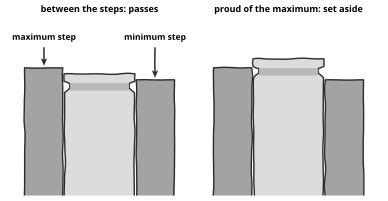
- Gauge. Drop each round into a case gauge. The case head should sit between the gauge’s minimum and maximum marks (see Figure 25-1). The case mouth should not stand above the step at the mouth end either. The gauge checks the round against standard chamber dimensions, not your rifle’s throat (see Chapter 9). The dummy round checked the throat (see Chapter 24).
- Chamber-check. If you check live rounds in the rifle, treat it as loading the rifle. Do it where you may load, with the muzzle in a safe direction and your finger off the trigger. Never chamber-check a load seated into the lands. Gauge it instead. Gauge every round for a semi-automatic too (see Chapter 26).
- Never force a round. A round that will not gauge or chamber easily goes into the reject box. If a live round sticks in the chamber, keep the muzzle in a safe direction and do not force the bolt. Clear it as the rifle’s manual directs, or take the rifle to a gunsmith.
Deal with rejects
- Pull the bullet. Take the round apart with a kinetic or collet bullet puller (see Chapter 5).1 Work over a tray so no powder ends up loose on the workbench.
- Decide what happens to the powder. Powder from a round you pull in the same session, before it has left the workbench, can go back into its container. You still know what it is. Dispose of the powder from any round that has left the workbench, because you can no longer prove what is in it (see Chapter 2). Never salvage powder from old cartridges or blend salvaged powder with new.2
- Leave the primer alone. A pulled case still holds a live primer, so do not punch it out. Sort it into the matching primed-reject container from Chapter 22. If the primer sits properly below flush, place the case in “Primed. No powder. Fire before decapping.” to fire empty at the range before decapping.3 If the primer is high, tipped, upside down or damaged, place the case in “Primed. Do not chamber. Dispose.”
- Find the cause before you load more. Crushed shoulders come from too much seating or crimping force.1 If a round will not gauge, check your sizing first (see Chapter 19). Other workshop problems are listed by symptom (see Chapter 31).
Box and label
- Box the rounds. Use a box that holds each round upright and apart. Plastic cartridge boxes work well.1
- Label the box. Put on everything someone needs to identify the load without your notebook.
- The load and batch IDs from your record (see Chapter 27).
- The cartridge and the rifle it was built for.
- The bullet, the powder and charge, the primer and the case maker with its firing count.
- The lot number of each component.
- The CBTO with the comparator used, and the COAL.
- The date loaded and the number of rounds.
- Reuse factory boxes with care. Cover or remove the factory markings and label the box as a handload.1
- Keep dummy rounds apart. Mark setup dummies and lands-gauge dummies plainly. Store them away from live ammunition.
Box test loads for the range
Test ammunition needs more care than a box of practice rounds. Your tests compare loads by every shot fired, so you must always know which load each round was (see Part VI and The Precision Rifle Handbook, Part IV).
- Box test loads by row. Standard ammunition boxes hold rounds in rows of five, which suits 5-round test blocks (see The Precision Rifle Handbook). Put one load in each row or each box, and label every row.
- Never top up a row or a box from another batch. Each row holds one batch of one load. Mixed rows make every later comparison doubtful.
- Write the firing order for each pass on the lid. The range protocol interleaves loads to spread barrel heat and shooter fatigue across them, and it rotates the starting load on each pass (see The Precision Rifle Handbook). A written order lets the range session follow the plan. A work-up is the exception. Write its steps in order, lowest first, and never interleave them (see Chapters 16 and 28).
Record the load
- Finish the record before the box leaves the workshop. Fill in the batch record as you work (see Chapter 17). Keep a log with room for shooting results.1 Record the load and the batch, each under its ID (see Chapter 27 for the IDs and what each record holds). Include the charge, the CBTO with its comparator, the COAL, every lot number, the scale check readings and anything unusual in the workshop.
- Use one format every time (see Chapter 27). A full record lets you trace an odd result at the range back to a lot or a step in the workshop (see Chapter 31).
Store dry and cool
A loaded round is not a hermetically sealed container (see Chapter 13).4 Keep closed ammunition boxes in an airtight container with a tight lid and a small desiccant pack. Aim for a steady humidity close to the one you worked up in, not the lowest. Add a humidity indicator card to watch the moisture level. If ammunition has been stored much drier than when you worked up the load, chronograph a few rounds against your records before you shoot a near-maximum load.
Keep ammunition away from heaters, sunlight and hot vehicles, at home and at the range (see Chapter 2). Never let powder or loaded rounds go above 100 °F, and keep them cooler where you can (see Chapter 13).2 A round baked in a hot chamber or a hot vehicle can give a pressure spike (see The Precision Rifle Handbook). Keep powder and primers in their factory packaging, out of reach of children (see Chapter 2).5
Check stored ammunition before you take it to the range. Compressed powder presses back on the bullet and can push it out over time (see Chapter 13).6 Measure CBTO on a few rounds from any box of compressed loads stored for months. If any have grown, reseat them to your CBTO before you shoot them (see Chapter 31). Make sure the label matches the rifle and cartridge you are taking.
Notes
- Western Powders, Handloading Guide 8.0, 2020, hodgdonpowderco.com/wp-content/uploads/2023/04/WesternPowdersHandloadingGuide8.0_WEB-1.pdf.
- Alliant Powder, Reloaders’ Guide, 2023, alliantpowder.com/resources/catalog/AP399_2023AlliantPowderReloadersGuide_SinglePgsNoCrops.pdf.
- Western Powders, Handloading Guide 8.0; Alliant Powder, Reloaders’ Guide.
- “Effects of Humidity on Powder Performance,” AccurateShooter Daily Bulletin, 2025, bulletin.accurateshooter.com/2025/01/effects-of-humidity-on-powder-performance-podcast-info-2/.
- Western Powders, Handloading Guide 8.0; Vihtavuori, Reloading Guide 2026, vihtavuori.com/wp-content/uploads/2026/04/Vihtavuori_Reloading_Guide_2026_ENG_web.pdf.
- Empirical Precision, User Guide, linked from the app’s dashboard, 2026, section 15.1, empiricalprecision.com.