
Key points
- Each record links to the one above it, so any shot traces back to its session, batch, load, lots and rifle.
- A note written on the spot is evidence. A note written later is memory.
- You can always calculate a new summary from raw readings, but you can never recover raw readings from a summary.
- Never alter raw data. An exclusion is a note beside a shot that stays in the record.
- Failed loads, stopped work-ups and a retired barrel’s logs belong in the record too.
Why it matters
Handloading asks you to write something down at almost every step. Scattered across notebooks, labels and target sheets, those facts answer nothing. Kept as one connected record, they answer three questions.
What is in this box? A slow string or a stiff bolt traces to one lot or one workshop step only if the box leads back to them.
Is this still the load I tested? Seasons change, lots run out and the throat wears (see Chapter 30). You can tell drift from noise only against a history.
What did the test really show? Most tests pool shots from several sessions, because small samples mislead (see The Precision Rifle Handbook, Chapters 14 and 15). Pooling works only if every shot carries its load. A result can be checked only while every raw shot is still there.
How it is done
Choose one format and write at the time
Two formats work, and neither needs special tools.
- A bound notebook. Pages cannot fall out, and the order of the entries shows when each was written. Number the pages and date every entry.
- A spreadsheet. It sorts, filters and does the arithmetic (see The Precision Rifle Handbook, Chapter 15).
Paper in the workshop and at the range, with a spreadsheet at home, works well. Pick one format for each kind of record and use it every time.
Write each entry when it happens. Note the lot number as you open the container and the scale check as you make it. At the range, write a shot’s call before you look at the target (see The Precision Rifle Handbook, Chapters 10 and 14). A note written later is memory. It cannot show that an error was noted before you saw where the shot went.
Build one ID chain
Give every record a short ID, and write on each record the ID of the one above it. The chain runs rifle, load, batch, session and shot. A session can fire several batches, so each shot names both its session and its batch.
| Level | What it is | Example ID | Chapters |
|---|---|---|---|
| Rifle | One barrel on one action | Rifle 1 | 3, 24 |
| Load | One recipe | B3 | 16, 25, 28 |
| Batch | Rounds loaded together from one lot of each component | B3-2 | 17, 25 |
| Session | One range trip with one rifle | 14 | 28, 30 |
| Shot | One round fired | 14-04 | 28; The Precision Rifle Handbook, Ch. 13–15 |
- Rifle. Use a short name, such as Rifle 1. A new barrel starts a new rifle record with its round count at zero. Its lands, baseline and work-ups all start over (see Chapter 30).
- Load. Use a letter for each work-up and a number for each step. Load B3 is step 3 of work-up B. Any change of charge or CBTO makes a new load ID. A change of primer, case maker, bullet or powder needs a new work-up. So does seating deeper or into the lands. Each starts a new work-up letter (see Chapter 28). A change that does not require a new work-up, such as seating B3 slightly longer (while still off the lands), takes a letter suffix: B3a, then B3b.
- Batch. Use the load ID and a running number: B3-1, then B3-2. Each loading session starts a new batch. A new lot of any component starts a new batch, even partway through a session.
- Session. Number each rifle’s sessions in order. Shoot two rifles on one trip and you have two sessions.
- Shot. Use the session number and the order fired. Shot 14-04 is the fourth round fired in Session 14. Number every round, foulers and sighters included, so the numbers follow the chronograph string.
- Write the IDs everywhere. Put them on the box label, the target sheet, the chronograph file name and the log page.
Worked example. Example numbers. Not load data.
Rifle 1      24-inch barrel, 1:8 twist, magazine length 2.800 inch
             Lands 2.252 inch CBTO at 350 rounds
             (comparator A, method A)
Load B3      For Rifle 1. Step 3 of work-up B. Bullet 1,
             powder 1, primer 1, case maker 1. CBTO 2.222 inch,
             comparator A. COAL 2.795 inch
Batch B3-2   Loaded 12 May 2026, 20 rounds
             Lots: bullet 221, powder 114, primer 07,
             brass batch D-3 at 3 firings
Session 14   19 May 2026, Rifle 1, 100 yards
             Air 58 °F, ammunition 61 °F
             Round count 350 at the start
             Batch B3-2 averaged 2,712 fps
Shot 14-04   Batch B3-2, group 1, X 1.45 inch, Y 2.15 inch, 2,709 fps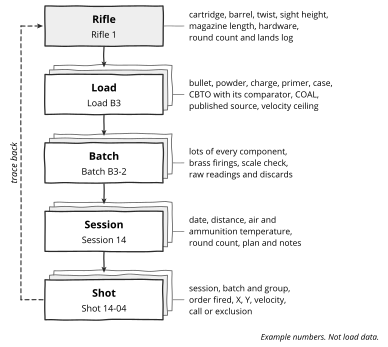
Now follow a lot check through the chain. Batch B3-3 is 10 check rounds for powder lot 120, new since B3-2. In Session 15, a week later at about the same temperature, they average 2,738 fps with an SD of 9 fps. B3-2’s 15 test shots averaged 2,712 fps with an SD of 8 fps. Nothing else in the chain changed, so any real difference comes from the lot. A velocity rise at the same charge is a warning, so judge it against its noise (see Chapter 30).
noise = √(8² ÷ 15 + 9² ÷ 10) = √12.4 = 3.5 fps
rise  = 2,738 − 2,712 = 26 fps, more than 7 times the noise
The rise is far more than twice the noise, so it is real. Lower the charge and work up again from below with the new lot before you load it in bulk (see Chapter 28). Example numbers. Not load data.
The rifle record
The rifle record holds the measurements from Chapter 3: cartridge, barrel length, twist, sight height and magazine length. Add the hardware, with its torque values and the date of the configuration.
Three parts of the rifle change, so give each one a dated log.
- Round count. Update it before each session. Add every round fired through the barrel, foulers and sighters included (see The Precision Rifle Handbook, Chapter 14).
- Lands log. Write one line per sitting. Give the bullet, method and comparator, each reading with the average and spread, the date and the round count (see Chapter 24).
- Baseline log. Write each baseline with its date, the hardware it was shot with and its result. A hardware change closes the old baseline and opens a new one (see Chapter 3).
The load and batch records
The load record is your master recipe. Write it before you load the first batch, and keep it up to date. Record the components, charge weight, CBTO (with its comparator), COAL, published data source, book start and maximum charges, and your velocity ceiling.
The batch record is the workshop log page for one batch (see Chapter 17 and Figure 17-2). Each page holds:
- The batch ID, the load ID and the date.
- The bullet, powder and primer lots, copied from each box or container as you open it (see Chapters 12 to 14).
- The brass batch, its lot, its firings and its measured capacity (see Chapters 11 and 18).
- The scale check readings (see Chapter 23).
- The die settings, the inserts, the fired base-to-shoulder average with the target sized reading, and the raw readings for shoulder bump, length and CBTO (see Chapters 19, 20 and 24).
- Each discarded case and why (see Chapter 18).
- The number of rounds loaded, and anything unusual.
Brass carries its history from batch to batch: firings, growth per firing (see Chapter 20), annealing settings (see Chapter 21) and discards. That history shows when to trim and what ends your cases’ lives.
The work-up record
A work-up has a safety job, so its record carries more (see Chapters 16 and 28).
- Before you load, write the goal, the published source, the start and maximum charges with their velocities and your velocity ceiling. List the steps with each step’s book velocity.
- At the range, record every velocity in order, and each step’s gain over the step before. Note the bolt lift, or in a semi-automatic how the action cycles, and what you saw on each case head and primer.
- Write where you stopped and which stop rule stopped you (see Chapter 28).
- Write the working charge you chose and the step it sits below.
Keep a stopped work-up as carefully as a finished one. It shows where this rifle met a stop with those components and lots, though it never replaces a new work-up.
The range session record
Write the plan before you go. Give the session ID, the rifle, the loads and batches, the block order and the shot counts. Add how many foulers and sighters you will fire (see The Precision Rifle Handbook, Chapter 14). Then record:
- The date, the distance, the aim offset, the chronograph and the barrel round count at the start.
- The air and ammunition temperature, the station pressure, the altitude and the wind (see The Precision Rifle Handbook, Chapters 14 and 19).
- Each shot in the order fired, with its group and any call, written before you look at the target.
- Each fouler and sighter on its own line, marked as such. The chronograph caught them too, so this keeps the readings in step with the shots.
- After every block, the count of chronograph readings against shots fired (see The Precision Rifle Handbook, Chapter 14).
- At home, each shot’s X and Y from its aim mark, and its velocity.
Label each target sheet with the session and the load. Photograph it with a known length in the frame and keep it. Keep the chronograph file under the session ID.
Keep raw data, and never change it
Raw data are the readings themselves: every X, Y, velocity and shoulder reading. A mean radius, an SD or an average is worked from them. Keep the readings and you can work out any summary later, with more shots or a better method. Keep only the summary and the readings are gone (see The Precision Rifle Handbook, Chapters 13 and 15). Once written, raw data never change.
- Correct by adding, never by erasing. Cross out a wrong entry with a single line so it remains legible, then write the corrected value, the reason and the date beside it. If you mismeasure a bullet hole, re-measure it and add the corrected reading the same way.
- Keep raw data on its own sheet. In a spreadsheet, do the arithmetic on another sheet that reads from it.
- Exclude by note, never by deletion. Foulers and sighters are marked as such. Leave a test shot out of its group only for a shooter or equipment error noted when it happened (see The Precision Rifle Handbook, Chapter 14). Mark the shot “excluded group”, with the reason and when you noted it. Its velocity still counts, and the shot stays in the record. Run the analysis with and without it.
- Treat a chronograph misread the same way. Keep the reading. Mark the shot “excluded velocity” and give the reason. Its hole still counts in the group.
- Keep failed loads and stopped work-ups. Dropping the losers biases your records the way dropping shots biases a group. A rejected load also shows why the winner won, and it saves you from testing the same idea twice.
One row per shot
A spreadsheet works best with one row for every round fired and one column for each fact. Keep a shot sheet with these columns.
| Column | Holds |
|---|---|
| Session | The session ID |
| Load | The load ID |
| Batch | The batch ID |
| Group | The block or aim mark |
| Shot | The order fired in the session |
| Status | Test, fouler, sighter, excluded group or excluded velocity |
| X | Inches right of the aim mark |
| Y | Inches up from the aim mark |
| Velocity | fps, as read |
| Note | The call, or the reason for an exclusion and when you noted it |
Keep a sheet for each level above it too: rifle, load, batch and session. Each sheet has one row per record, keyed by its ID. The session sheet holds the rifle, date, distance and conditions. No shot row repeats them.
To analyze one load, filter the shot sheet to that load. For composite mean radius, include all test shots and excluded velocity shots (since a chronograph misread does not affect where the bullet hit), measuring each shot from its own group’s center. For velocity SD, include all test shots and excluded group shots (since a pulled aim does not affect muzzle velocity). Calculate both as shown in The Precision Rifle Handbook, Chapter 15. You can also filter by batch or session to check whether one stands apart from the rest.
Worked example. Example numbers. Not load data.
| Session | Load | Batch | Group | Shot | Status | X | Y | Velocity | Note |
|---|---|---|---|---|---|---|---|---|---|
| 14 | B3 | B3-2 | F | 1 | fouler | 2,694 | Separate aim mark | ||
| 14 | B3 | B3-2 | 1 | 2 | test | 1.20 | 2.05 | 2,714 | |
| 14 | B3 | B3-2 | 1 | 3 | test | 1.70 | 1.75 | 2,706 | |
| 14 | B3 | B3-2 | 1 | 4 | test | 1.45 | 2.15 | 2,709 | |
| 14 | C2 | C2-1 | 2 | 9 | excluded group | 1.35 | 3.60 | 2,739 | Felt the rifle jump off the rest. Noted before looking. |
Results, decisions and long-term logs
Record each result with what it rests on. Give the sessions and shots it used, the shot count, the number of groups and the interval. Write the decision beside it, with the plan you fixed before the test, what you chose and the date (see The Precision Rifle Handbook, Chapters 15 and 16).
Keep three running logs for each load you go on shooting (see Chapter 30).
- Velocity history. One line per session: the mean, SD and shot count, the ammunition temperature, the barrel round count and the lots.
- Lot changes. The date, the component, the old and new lots and the result of the velocity check.
- Temperature response. Any session where temperature shifted velocity beyond normal noise, along with any fps-per-degree slope calculated from your velocity history, the sessions used and the temperature span covered.
The drop chart and the DOPE card, the card of sight settings for each distance (see The Precision Rifle Handbook, Chapter 20), belong to one rifle and one load too. Note the velocity and the sessions each was built from.
Back up and keep the records
A lost record is a test you have to shoot again.
- After each session, photograph or scan the new notebook pages.
- Keep a second copy of the spreadsheet, the photographs and the chronograph files in a different place from the first.
- Keep the target sheets in a folder marked with the session IDs.
- Keep every record for at least the life of the barrel. The lands rate, the velocity history and any temperature slope come from records that span it (see Chapter 30).
- When you retire a barrel, close its record with its final round count. Keep it with the rest.