
Key points
- The bolt closes by spring force alone, so every round must chamber with room to spare.
- The magazine sets the length of rounds fed from it, and the slam of feeding must not move the bullet.
- Brass works harder and lives shorter in a gas gun, and its marks need reading in context.
- A floating firing pin taps the primer as the bolt closes, so primer seating and choice are safety questions.
- The action runs on pressure at the gas port, so powder choice matters beyond peak pressure.
Why it matters
A bolt-action rifle works at your pace. A semi-automatic rifle does all of that for you, powered by gas tapped from the barrel. That changes how you load in five ways.
- The bolt closes by spring force alone. It cannot force a tight case home the way your hand can on a bolt handle.1
- Rounds strip from the magazine and slam into the chamber. The bullet must not move in the neck.2
- The case is thrown clear at speed. Brass gets dented and marked.3
- Many designs use a firing pin that floats free in the bolt. It can tap the primer as the bolt closes.4
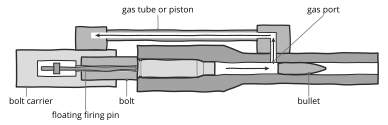
- The action runs on gas from a port partway down the barrel (see Figure 26-1). So the powder’s behavior after peak pressure matters, not just the peak.5
Here is what to do differently for a gas gun. Everything else in Part V still applies.
How it is done
Watch the brass
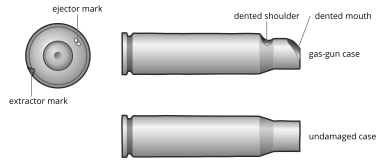
Inspect for ejection damage. Look for dented mouths, shoulder dings and heavy extractor and ejector marks on the rim (see Figure 26-2).6 Sizing usually irons out small mouth dents. Discard any case with a crack in the neck or body (see Chapter 18).7
Check often for signs of head separation. The larger shoulder bump a gas gun needs stretches the brass more on every firing and thins it near the web (see Chapter 18). Keep gas-gun brass apart from brass fired in bolt actions. Log firings for each lot, and expect shorter case life.
Treat military brass with care. Set Berdan cases aside before you deprime, and remove pocket crimps before priming (see Chapters 18 and 22). Military cases often have thicker walls and less capacity, so the same charge gives higher pressure.8 Measure water capacity (see Chapter 11). Use data for military cases where it exists, and work up with care from the published start load.
Size for sure chambering
Set up the full-length die by measurement (see Chapter 19 and Figure 19-1), with three differences.
- Bump the shoulder more. Size to .003 to .005 inch below the fired average from this rifle. A bolt action needs only .001 to .002 inch.9
- Full-length size every case. Neck sizing alone leaves the body and shoulder at fired size.10 A gas gun needs room to chamber every round under spring force.11
- Check the fit in a case gauge. The bolt’s feel tells you little. Drop the first sized cases into a case gauge (see Chapter 9).
When once-fired military brass from a generous chamber fails a case gauge near the web even after standard full-length sizing, a small-base full-length sizing die sizes the lower case body slightly smaller to restore reliable chambering. Use a small-base die only when a standard die will not bring the brass into gauge, because working the lower body harder shortens brass life slightly. Once the brass is sized to your chamber and fired only in your rifle, a standard full-length die is usually enough.
Primers and floating firing pins
Understand floating firing pins and slam fires. In many semi-automatic service designs, the firing pin floats free in the bolt with no retaining spring.12 When the bolt slams forward, the pin’s momentum carries it on to tap the primer lightly. It often leaves a small dent on a round extracted unfired.13 A high or very sensitive primer can fire from this tap before the bolt lugs lock. That is an out-of-battery slam fire. It can wreck the receiver and injure the shooter.14 The risk rises if the case is under-sized, the bolt face is fouled, or you drop a round straight into the chamber and let the bolt slam shut.15
Feed every round from the magazine. Never drop a round into the chamber and release the bolt on it. Strip friction slows the bolt (see “Single-loading long rounds in slow fire” below for slow-fire matches).
Choose primers made for semi-automatic actions. Use primers made to military sensitivity specifications. Their thicker, work-hardened cups resist firing from the pin’s tap.16 They lower the risk of a slam fire but do not remove it. Correct headspace, a clean action and correct sizing still matter.17 Any primer swap needs a new work-up from the published start load (see Chapter 28).
Do not chamber the same live round again and again. Each feed batters the bullet’s ogive, moves the bullet in the case and dents the primer again.18
Magazine length and feeding
Find the magazine’s limit. Find your magazine length with dummy rounds (see Chapter 3). In a gas gun, the longest dummy must also chamber and extract cleanly every time under spring force. If the magazine stops you well short of the lands, seat to magazine length and accept the jump. Seating effects shrink in large samples, so a long jump is not a defect (see Chapter 24).
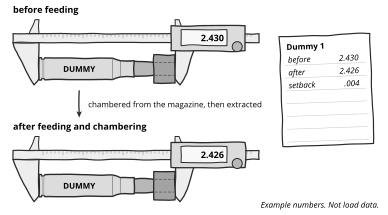
Check for bullet setback. Build a marked dummy the way you built your reference round (see Chapter 24, steps 6 to 8), sized and seated like a live round. Never use a lands-gauge dummy. Measure its CBTO. Load it into the magazine, release the bolt to strip and chamber it, and extract it unfired. Measure the CBTO again (see Figure 26-3). A change larger than your normal CBTO spread means the bullet moved. A shorter reading means setback. Repeat with two or three dummies before you decide. Hard cycling in a gas gun can move bullets either way.22 Setback seats the bullet deeper, which takes room from the powder and raises peak pressure.
Correct setback at the case neck. Check your neck tension and sizing die setup (see Chapter 19). If neck tension alone cannot hold the bullet under cycling, crimp it.23 Set the crimp die as for any crimped load (see Chapter 24). A crimp is part of the load, so work up with it (see Chapter 28). A roll crimp needs a cannelure or crimp groove on the bullet (see Chapter 24), and several bullet lines provide one for semi-automatic use.24 A collet crimp can grip a bullet without one (see Chapter 5). Where the rifle maker calls for cannelured bullets, crimped securely, use them.25
Single-loading long rounds in slow fire
Highpower Service Rifle shooters often single-load heavy bullets, such as 80 gr .223 Remington bullets seated past the standard 2.260 inch AR-15 magazine limit, during slow-fire stages (see Chapters 3 and 24). Never drop a long round straight into the chamber and release the bolt on it. Without magazine drag to slow the carrier, the bolt slams shut at full speed, raising the risk of an out-of-battery slam fire and extractor damage. Instead, insert a single-shot loading block (sled) into the magazine well and lay each round on its follower so the bolt strips and controls the cartridge into the chamber. Pair this with military-specification primers seated .003 to .005 inch below flush (see Chapter 22).
Gauge every round
Drop each finished round into a case gauge (see Chapters 9 and 25, and Figure 25-1). Do not rely on the rifle’s chamber to catch a tight round. A round that will not chamber fully jams the rifle with a live round in the chamber and the bolt not locked. Never force the bolt closed on a tight case. An inertial blow to the primer can fire the round before the bolt locks, and the case can rupture.26 Keep the muzzle in a safe direction and clear the stoppage as the rifle’s manual directs.27 A live round left in a very hot chamber can also cook off.28
Gas port pressure and powder choice
Nothing happens at the port until the bullet passes it. From then until the bullet leaves the muzzle, gas flows into the system and drives the bolt carrier. So the action responds to the pressure at the port and how long it lasts. The time from port to muzzle is called dwell time.29
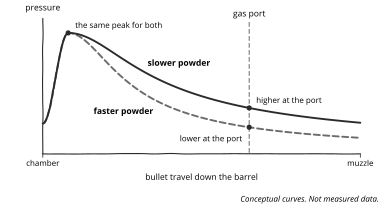
Peak chamber pressure comes early, in the first few inches of bullet travel.8 The port sits much farther down the barrel. Two loads with the same peak can have very different pressure by the time the bullet reaches the port (see Figure 26-4). A slower powder is still burning later in the barrel, so it tends to keep more pressure there.30 Too much gas can make the action cycle violently, damage brass and break parts.31 Too little can leave the action short of a full cycle.32 Peak chamber pressure is still the safety limit for the chamber.
Working up in a gas gun
Work up as for any rifle. Start at the published start load for your exact components, from gas-gun data where it exists. Step up in small increments and chronograph every shot (see Chapters 16 and 28). Load a single round into the magazine for each shot, never straight into the chamber (see “Primers and floating firing pins” above). That way the bolt locks open after firing and cannot chamber the next, heavier step before you inspect the fired case.
Read brass marks in context. Gas guns often leave ejector and extractor marks on the case head, even with mild loads well inside pressure limits.35 Judge each step’s marks against those at the start load in this rifle. Marks that are new or heavier, or a bent rim, mean the bolt is unlocking too early or too hard under residual pressure. The cause can be high chamber pressure, gas port timing or both.36 Treat such marks as a pressure sign and stop the work-up there (see Chapter 28). Find the cause before you load again.
Note mechanical function at every step. Record any failure to feed, chamber, extract, eject or lock open on an empty magazine. A low step may not cycle fully. If a shot fails to cycle the action and the chronograph did not read the expected velocity, unload and check the bore for a stuck bullet before firing again (see Chapter 2). If velocity was normal, record the short cycle and continue within the stop rules. Never pass the published maximum or your velocity ceiling to make the action cycle. A load that still cycles short, or cycles violently, near the top does not suit this rifle’s port pressure and dwell time. Try another powder from gas-gun data.
Notes
- Colt Defense, Operator’s Manual for Colt Advanced Law Enforcement Carbines, LE6940 series, 2010, p. 11, colt.com/wp-content/uploads/2023/02/LE6940ColtAdvancedLawEnforcementCarbineManual.pdf; Sturm, Ruger & Co., Instruction Manual for Ruger Mini-14 Ranch and Mini Thirty Rifles, 2026, p. 28, ruger-docs.s3.amazonaws.com/_manuals/mini.pdf; Glen Zediker, “Reloading for Semi-Automatic Rifles: Dos and Don’ts,” Shooting Illustrated, 2019, shootingillustrated.com/articles/2019/6/23/reloading-for-semi-automatic-rifles-dos-and-donts.
- Springfield Armory, M1A Operation and Safety Manual, 2020, p. 15, springfield-armory.com/wp-content/uploads/M1A-Manual.pdf; Glen Zediker, “Reloading for Semi-Automatic Rifles.”
- Colt Defense, Operator’s Manual for Colt Advanced Law Enforcement Carbines, p. 4; Duane Siercks, “Reloading 101: Case Diagnostics Part II,” Sierra Bullets blog, 2016, sierrabullets.wordpress.com/2016/03/09/reloading-101-case-diagnostics-part-ii/.
- Springfield Armory, M1A Operation and Safety Manual, p. 15; Colt Defense, Operator’s Manual for Colt Advanced Law Enforcement Carbines, p. 54; Glen Zediker, “Reloading for Semi-Automatic Rifles.”
- Sturm, Ruger & Co., Instruction Manual for Ruger Mini-14 Ranch and Mini Thirty Rifles, p. 24; Sierra Bullets, Rifle and Handgun Reloading Manual, 6th edition, 2020, p. 668; Glen Zediker, “Reloading for Semi-Automatic Rifles.”
- Duane Siercks, “Reloading 101”; Richard Mann, “Case-Head Swipe,” Shooting Illustrated, 2011, shootingillustrated.com/articles/2011/4/12/case-head-swipe.
- Western Powders, Handloading Guide 8.0, 2020, hodgdonpowderco.com/wp-content/uploads/2023/04/WesternPowdersHandloadingGuide8.0_WEB-1.pdf.
- Empirical Precision, User Guide, linked from the app’s dashboard, 2026, section 15.1, empiricalprecision.com.
- “How to Set Up Full-Length Sizing Dies and Control Shoulder Bump,” AccurateShooter Daily Bulletin, 2016, bulletin.accurateshooter.com/2016/11/how-to-set-up-full-length-sizing-dies-and-control-shoulder-bump/; Hornady, “Let’s Talk Annealing,” The Hornady Podcast, episode 136, 2024, hornadymanufacturing.libsyn.com/ep-136-lets-talk-annealing.
- RCBS, FAQ, rcbs.com/faq/; Glen Zediker, “Reloading for Semi-Automatic Rifles.”
- Lee Precision, “Classic Lee Loaders for Semi Auto, Slide and Lever Action Rifles,” Lee Precision Support Portal, 2018, support.leeprecision.net/en/knowledgebase/article/classic-lee-loaders-for-semi-auto-slide-and-lever-action-rifles; Glen Zediker, “Reloading for Semi-Automatic Rifles.”
- SAAMI, SAAMI Glossary, “Floating Firing Pin,” saami.org/saami-glossary/; CCI, CCI No. 34 and No. 41 Military Rifle Primers, archived product page, 4 December 2010, http://web.archive.org/web/20101204153023/http://www.cci-ammunition.com/products/primers/primers.aspx?id=30.
- Springfield Armory, M1A Operation and Safety Manual, p. 5; Colt Defense, Operator’s Manual for Colt Advanced Law Enforcement Carbines, p. 54; Glen Zediker, “Reloading for Semi-Automatic Rifles.”
- SAAMI, SAAMI Glossary, “Out-of-Battery”; Sierra Bullets, “Reloading for Semi-Autos and Service Rifles,” Exterior Ballistics (exteriorballistics.com), page metadata dated 2003; archived 28 January 2019, web.archive.org/web/20190128180612/http://www.exteriorballistics.com/reloadbasics/gasgunreload.cfm; Wayne Faatz, “M1 Garand Slam-Fires: Potential Causes & Solutions,” American Rifleman, first published October 1983 as “The Mysterious Slam-Fire in the M1 Garand,” 2020, americanrifleman.org/content/m1-garand-slam-fires-potential-causes-solutions/.
- Wayne Faatz, “M1 Garand Slam-Fires”; Springfield Armory, M1A Operation and Safety Manual, p. 15.
- CCI, CCI No. 34 and No. 41 Military Rifle Primers; Federal Premium, Gold Medal AR Centerfire Primer, Small Rifle AR Match, product page, part GM205MAR, federalpremium.com/reloading/primers/gold-medal-ar-centerfire-primer/11-GM205MAR.html; Sierra Bullets, “Reloading for Semi-Autos and Service Rifles”; Glen Zediker, “Reloading for Semi-Automatic Rifles”; Springfield Armory, M1A Operation and Safety Manual, p. 5.
- CCI, CCI No. 34 and No. 41 Military Rifle Primers.
- Colt Defense, Operator’s Manual for Colt Advanced Law Enforcement Carbines, p. 54; Springfield Armory, M1A Operation and Safety Manual, p. 5; Glen Zediker, “Reloading for Semi-Automatic Rifles.”
- Western Powders, Handloading Guide 8.0; Speer, Reloading Education, speer.com/reloading/reloading-education.html.
- Springfield Armory, M1A Operation and Safety Manual, p. 15; Sturm, Ruger & Co., Instruction Manual for Ruger Mini-14 Ranch and Mini Thirty Rifles, p. 26; Colt Defense, Operator’s Manual for Colt Advanced Law Enforcement Carbines, p. 9.
- Sierra Bullets, “Reloading for Semi-Autos and Service Rifles”; Wayne Faatz, “M1 Garand Slam-Fires.”
- Glen Zediker, “Reloading for Semi-Automatic Rifles”; RCBS, Small Base Taper Crimp Die Set, AR Series, shop.rcbs.com/small-base-taper-crimp-die-set-ar-series/.
- Sturm, Ruger & Co., Instruction Manual for Ruger Mini-14 Ranch and Mini Thirty Rifles, p. 26; Barnes Bullets, “April 2007 Barnes Bullet-n,” Barnes Bullets newsletter, archived copy, http://web.archive.org/web/20101201062453/http://www.barnesbullets.com/resources/newsletters/april-2007-barnes-bullet-n/; Lee Precision, “When Do I Need to Use a Factory Crimp Die?” Lee Precision Support Portal, 2019, support.leeprecision.net/en/knowledgebase/article/when-do-i-need-to-use-a-factory-crimp-die.
- Hornady, The Anatomy of a Hornady Bullet, hornady.com/bullets/the-anatomy-of-a-hornady-bullet.
- Sturm, Ruger & Co., Instruction Manual for Ruger Mini-14 Ranch and Mini Thirty Rifles, p. 26.
- Sturm, Ruger & Co., Instruction Manual for Ruger Mini-14 Ranch and Mini Thirty Rifles, p. 28; Colt Defense, Operator’s Manual for Colt Advanced Law Enforcement Carbines, p. 53.
- Springfield Armory, M1A Operation and Safety Manual, p. 8; Colt Defense, Operator’s Manual for Colt Advanced Law Enforcement Carbines, p. 51.
- Colt Defense, Operator’s Manual for Colt Advanced Law Enforcement Carbines, p. 54.
- Richard Mann, “Case-Head Swipe”; Glen Zediker, “Reloading for Semi-Automatic Rifles.”
- Glen Zediker, “Reloading for Semi-Automatic Rifles”; Richard Mann, “Case-Head Swipe.”
- Glen Zediker, “Reloading for Semi-Automatic Rifles”; Sierra Bullets, Rifle and Handgun Reloading Manual, p. 668; Robert Treece, “Thoughts for Load Development in .30 Caliber Gas Guns,” Sierra Bullets blog, 2013, sierrabullets.wordpress.com/2013/04/29/thoughts-for-load-development-in-30-caliber-gas-guns/.
- Sierra Bullets, Rifle and Handgun Reloading Manual, p. 618; Sturm, Ruger & Co., Instruction Manual for Ruger Mini-14 Ranch and Mini Thirty Rifles, p. 15.
- Hornady, “6mm ARC (Gas Gun),” Hornady load data, static.hornady.media/site/hornady/files/load-data/6mm-arc-gas-58-105gr-data.pdf.
- Hornady, “6mm ARC (Bolt Gun),” Hornady load data, static.hornady.media/site/hornady/files/load-data/6mm-arc-bolt.pdf; Hornady, Hornady Handbook of Cartridge Reloading, 12th edition, 2025; Gavin Gear, “NEW: Hornady 12th Edition Reloading Manual,” Ultimate Reloader, 2025, ultimatereloader.com/2025/12/13/new-hornady-12th-edition-reloading-manual/.
- Richard Mann, “Case-Head Swipe.”
- Richard Mann, “Case-Head Swipe”; Duane Siercks, “Reloading 101”; Glen Zediker, “Reloading for Semi-Automatic Rifles.”