
Key points
- Ladder tests, optimal charge weight and velocity nodes look for flat spots with a few shots per step. Random scatter makes flat spots in most tests.
- Nodes found with a few shots rarely hold up when the same loads are fired in large numbers.
- Seating depth matters more for some bullet shapes than others. A small-sample sweep cannot find a sweet spot reliably.
- A tuner does change how a barrel vibrates. Whether that helps by a useful, repeatable amount is still open.
Why it matters
Popular methods spend components and barrel life. Their appeal is speed, an answer from 20 or 30 rounds. Speed is not the problem. The problem is that small samples give confident answers that are often noise. A false node costs you twice. You load for it, and then it fails to repeat.
The verdicts below concern each method as it is usually practiced, with one to five shots per step. Run with enough shots, any of these becomes a fair experiment (see The Precision Rifle Handbook, “Testing any claim yourself”).
How it is done
Contested ladder tests
The claim. Fire one shot at each of a series of rising charges, usually at long range. The bullets land at different heights. Where several steps in a row land at about the same height, the load is in a node. A charge in the middle of that node forgives small variations. Some shooters read each shot’s velocity instead of its height.
The physics. The usual explanation is barrel vibration. The muzzle moves while the bullet travels down the bore. A bullet that exits near a turning point of that motion should be less affected by small changes in exit time. Another proposed explanation is that slower bullets leave the muzzle a little higher, which offsets their extra drop.
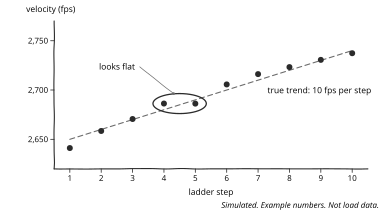
The test. Each step has one shot, and each shot carries the load’s normal scatter in height and in velocity. Whether a run of steps looks flat depends as much on that scatter as on any node. Here is how often scatter alone makes a step look flat.
Worked example. Example numbers. Not load data.
Take a velocity ladder of ten steps. Each step should add 10 fps. The load’s shot-to-shot SD is 8 fps. There is no node at all. Call a step flat if it rises 5 fps or less.
Each step’s rise is the gap between two shots that each wander about 8 fps. So the rise itself wanders about 11 fps (8 × √2). A rise that should be 10 fps reads 5 fps or less about one time in three.
A ten-step ladder has nine rises. A computer simulation of a million such ladders shows a flat step in nearly every one. Two flat steps in a row, three shots that look like a plateau, turn up in about 3 ladders in 10.
The data. A ladder that showed a flat spot did not show it again when it was fired a second time.1 Fired in samples of 20 to 35 shots per step, the nodes disappeared.2 Separate 30-shot tests in three rifles found no nodes.3 Lighter charges tended to group tighter.4
The verdict. Folklore. One shot per step cannot find a node (see Figure 29-1). A ladder is still the right way to work up for pressure and velocity (see Chapter 28).
Contested optimal charge weight
The claim. Fire 3-shot groups at a series of charges. Rotate through the charges so each group builds up a shot at a time. Look for three neighboring charges whose groups center on the same point. The middle charge is the optimal charge weight. Its point of impact should not move with small changes in velocity.
The physics. The same barrel-timing idea as the ladder. If the point of impact holds still across a range of charges, small charge and velocity variations should not move the shots.
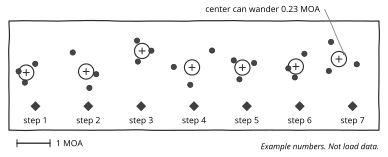
The test. A 3-shot group’s center is uncertain. It wanders from the true center by about the shot spread divided by the square root of three.
center wander on one axis = σ ÷ √n
σ on one axis             = mean radius ÷ 1.2533
Here is how far a center wanders for one load.
Worked example. Example numbers. Not load data.
A rifle and load with a true mean radius of 0.50 MOA have a σ of 0.50 ÷ 1.2533 = 0.40 MOA on each axis. A 3-shot group’s center wanders by 0.40 ÷ √3 = 0.23 MOA. The centers of two groups of the same load then differ with an SD of about 0.33 MOA on each axis. Groups from different charges can line up by chance. Groups from the same charge can look apart.
Group sizes are just as noisy. The best of seven 5-shot groups from one load averages 0.66 times the load’s average 5-shot group (see The Precision Rifle Handbook). Groups of 3 shots are noisier still.
The data. Large-sample testing found that optimal charge weight results disappeared, as charge nodes did (see “Contested: ladder tests” above).3 Users of the method disagree. In their view, real effects are large enough to see with few shots.
The verdict. Folklore. You cannot choose a charge from the centers of 3-shot groups. Those centers wander by more than the effect sought (see Figure 29-2). A charge chosen for your velocity goal, with margin, does the same job with less ammunition.
Contested velocity nodes
The claim. Somewhere in a load’s charge range is a node where velocity barely changes with charge. Loads there give a low velocity SD. Shooters usually look for the node with one shot per step or with short strings.
The physics. Internal ballistics models show velocity rising smoothly as charge rises. A real plateau would need a cause these models do not include.
The test. One shot per step and short strings are both too noisy. In the ladder example above, chance alone makes a flat step in nearly every ladder and a three-shot plateau in about 3 ladders in 10. A short string’s SD is noisy too. A 5-shot SD has a 90 percent interval of 0.65 to 2.37 times the measured value. So a 5-shot SD of 6 fps fits a true SD anywhere from about 4 to 14 fps. Example numbers. Not load data.
The data. Two of the large-sample tests above went back to apparent velocity flat spots with 20 to 35 shots per charge. The flat spots did not hold, and average velocity rose in a nearly straight line with charge.5
The verdict. Folklore. One shot per step or a short string cannot find a velocity node. Choose the charge for the velocity you need. Measure its SD with 20 to 30 shots. If the SD is too high, look at ignition, neck tension and charge weighing rather than at 0.1 gr.
Contested seating depth sweeps
The claim. Each bullet has a seating depth sweet spot. Seat the same load at a series of jumps to the lands, fire a small group at each and pick the best.
The physics. Jump does change things. It changes how the bullet meets the rifling and how hard it is to start moving. Ogive shape changes how much this matters. Some secant-ogive bullets have a sweet spot .030 to .040 inch wide, anywhere from jammed into the lands to .150 inch off them.6 Hybrid-ogive bullets are much less sensitive.7 Monolithic bullets need jump (see Chapter 24).8
The target also moves: as the throat erodes, the lands move forward and jump grows (see Chapters 24 and 30, and Figures 24-1 and 24-7). Over a few hundred rounds, this movement can shift a bullet completely out of a narrow seating window.
The test. A sweep is a set of loads fired as small groups. It has the same problem as any small-group comparison. Seven settings shot as one 5-shot group each will show a best group about 0.66 times the load’s average 5-shot group, even if seating does nothing.
The data. In one large-sample test with 20 to 30 shots per seating depth, the difference between the best and worst depths was small enough to be random noise.9 Meanwhile, the .030 to .040 inch sweet-spot claim rests on shooter reports without published sample sizes, and its recommended test procedure fires only two 3-shot groups at each of four jumps.6
The verdict. Folklore. A small-sample sweep cannot find a sweet spot reliably. Start at the bullet maker’s guidance. Never jam a hunting load. Prefer a jump band where groups change little, so throat erosion does not matter. Test seating only with adequate samples.
Contested barrel tuners
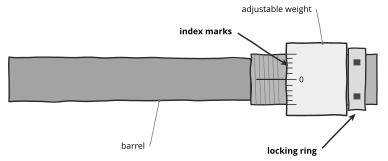
The claim. A tuner is a weight on the muzzle that you can move in small steps. Moving it changes how the barrel vibrates, so the bullet leaves at a better moment. It tunes the barrel to the ammunition rather than the ammunition to the barrel. The effect is large enough to see with few shots.10
The physics. Mass at the muzzle does change how a barrel vibrates. That much is basic mechanics. The question is whether the change improves dispersion by a useful and repeatable amount.
The test. Tuner settings are compared by their groups. Settings that differ a little need many shots to separate. Settings tested with small groups suffer the same best-of-many luck as any sweep.
The data. One test fired more than 1,800 rounds through four tuners on four rifles.11 The tuners showed no repeatable effect.12 Critics fault the test protocol. The objections are that the tuners may have been too light, and that a tuner’s weight, position and range of adjustment must suit the barrel and the load.13 The test also did not check whether slower shots leave the muzzle higher and so offset their extra drop. That would take long-range shooting with every shot tracked by radar.14 Added weight at the muzzle did seem to shrink groups, a result that needs more testing.10
The verdict. Plausible but unproven. The physics is real. Whether the effect is large and repeatable enough to matter is not settled. If you use a tuner, test it with the protocol in The Precision Rifle Handbook (“Testing any claim yourself”). Each setting you compare is one arm. With more than two arms the statistical threshold tightens, so each arm needs more shots. To find a 1.5 to 1 difference in group size, three arms need about 45 shots each. Four arms need about 55 and five about 60. For velocity SD, three, four and five arms need about 67, 77 and 84.
Notes
- Bryan Litz, Modern Advancements in Long Range Shooting, Volume III, Applied Ballistics Books, 2022; Cal Zant, “Creighton Audette’s Ladder Test,” Precision Rifle Blog, 2012, comments, 2 February 2025, precisionrifleblog.com/2012/07/13/creighton-audette-ladder-testing/.
- Hornady, “Your Groups Are Too Small: Sample Size,” The Hornady Podcast, episode 50, 2022, hornadymanufacturing.libsyn.com/ep-050-your-groups-are-too-small-sample-size; Hornady, “Let’s Talk Load Development,” The Hornady Podcast, episode 121, 2024, hornadymanufacturing.libsyn.com/ep-121-lets-talk-load-development.
- Tyler Freel, “Rifle Nodes: How You’ve Been Wasting Your Time and Money on Load Development,” Outdoor Life, 2024, outdoorlife.com/guns/rifle-nodes/.
- Hornady, “Let’s Talk Load Development”; Tyler Freel, “Rifle Nodes.”
- Hornady, “Your Groups Are Too Small”; Hornady, “Let’s Talk Load Development”; Tyler Freel, “Rifle Nodes.”
- Berger Bullets, VLD – Making It Shoot, 2014, bergerbullets.com/vld-making-shoot/.
- Berger Bullets, How to Load a Hybrid Bullet, 2021, bergerbullets.com/shoot-better/shooting-knowledge/how-to-load-a-hybrid-bullet/.
- Barnes Bullets, Load Data, barnesbullets.com/load-data/.
- Hornady, “Let’s Talk Load Development.”
- Applied Ballistics, “#82 – Barrel Tuning with Erik Cortina,” The Science of Accuracy, episode 82, 2023, web.archive.org/web/20251217122932/https://thescienceofaccuracy.com/podcast/82-barrel-tuning-with-erik-cortina/.
- Cal Zant, “Sneak Peek of Bryan Litz’s New Book: Volume III of Modern Advancements in Long Range Shooting,” Precision Rifle Blog, 2022, precisionrifleblog.com/2022/08/14/sneak-peek-of-bryan-litzs-new-book-volume-iii-of-modern-advancements-in-long-range-shooting/.
- Bryan Litz, Modern Advancements in Long Range Shooting, chapter 4.
- Applied Ballistics, “Barrel Tuner Testing,” The Science of Accuracy, episode 55, replies by Bryan Litz in the comments, archived copy, 2022, web.archive.org/web/20260120155228/https://thescienceofaccuracy.com/podcast/55-barrel-tuner-testing/; Applied Ballistics, “#82 – Barrel Tuning with Erik Cortina.”
- Applied Ballistics, “Barrel Tuner Testing.”