
Key points
- Hold the ammunition at a steady temperature when you fire it, and the velocity you recorded stays true.
- A new lot can change pressure. Your velocity records, not an assumption that it matches, tell you whether it did.
- The throat wears with every shot, so jump and velocity drift over a barrel’s life.
- Every change to a component, the rifle or the season reopens a finished load.
Why it matters
A load is not finished when it wins. Seasons change. Powder lots run out. The throat wears a little with every shot. Each change moves velocity, pressure or both. The data you gathered stays true only if you keep checking it.
How it is done
Hold the ammunition temperature
Powders respond to temperature, and each load responds in its own way (see Chapter 13). Measuring that response takes more control than a home range gives. A round warms or cools toward the air as soon as it leaves its box, and a warm chamber heats it further. What you can control is the temperature of each round when you fire it. Keep that temperature steady, and your recorded velocity holds true even if you do not know the powder’s exact temperature curve.
- Read the ammunition temperature at every session, with a thermometer in the ammunition box (see Chapter 10). Record it with the session (see Chapter 27 and The Precision Rifle Handbook, Chapter 13).
- At the range, keep the ammunition in a closed, insulated box in the shade. Never leave it in the sun, on a dark mat or in a closed vehicle.
- In the field, carry the rounds in an inside pocket, or in a pack away from the sun. Body heat holds them far steadier than the air around you.
- Keep the action open until you are ready to fire. Chamber each round only then. In a hold or a cease-fire, unload.
- If a round sits in a warm chamber before it fires, note it on its shot line before you look at the target (see Chapter 27).
- Chronograph the load the way you carry it. A hunter’s drop chart comes from rounds carried in the pocket, and a competitor’s from rounds kept in the shaded box (see The Precision Rifle Handbook, Chapter 20).
Watch for heat
Some heat reaches the rounds however careful you are. Your velocity records show it, with no special test.
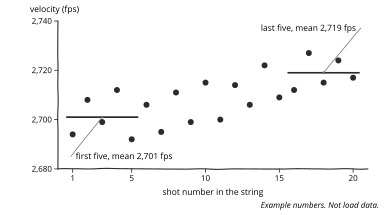
In a long string. Barrel and chamber heat climb through a long string, and each round that waits in a warm chamber takes up some of it. In any string of 15 shots or more, compare the mean velocity of the last five shots with the first five. Judge the gap against its noise.
noise = SD × √(2 ÷ 5)       SD = the string's velocity SD
A rise of more than twice the noise is heat reaching the rounds.
Worked example. Example numbers. Not load data.
A 20-shot string has a velocity SD of 10 fps. Its first five shots average 2,701 fps and its last five average 2,719 fps.
noise      = 10 × √(2 ÷ 5) = 6.3 fps
twice that = 12.6 fps
rise       = 2,719 − 2,701 = 18 fps
The rise is more than twice the noise, so heat is reaching the rounds (see Figure 30-1). Slow the pace, shorten the strings or keep the action open longer between shots. Fire load tests in interleaved 5-round blocks, so no load meets only the hottest barrel (see The Precision Rifle Handbook, Chapter 14).
On a hot day. When the ammunition is warmer than it was at the work-up, fire one round alone first and read its velocity. If it reaches your velocity ceiling, the load is too hot for that day. Stop and reduce the charge (see Chapter 28). Any pressure sign means stop now.
On any day far from your records. On a day much hotter or colder than any in your records, compare the session’s mean velocity with the record nearest its ammunition temperature. Note the gap in the velocity history (see Chapter 27).
Over a season. The velocity history holds each session’s mean velocity and ammunition temperature. Once it spans cold and warm days, it shows how the load responds. Use sessions from one lot, fired after the barrel’s first 200 rounds, so lot changes and a new barrel’s speed-up stay out. Group the sessions into cold days and warm days and compare their averages.
slope = (warm mean − cold mean) ÷ (warm temperature − cold temperature)
        in fps per °F
Worked example. Example numbers. Not load data.
Four cold sessions average 2,712 fps with the ammunition at 34 °F. Four warm sessions average 2,748 fps at 78 °F.
slope = (2,748 − 2,712) ÷ (78 − 34) = 36 ÷ 44 = 0.82 fps per °FDay-to-day changes in setup and barrel condition add extra scatter beyond single-session shot noise. Trust a calculated temperature slope only after you have several sessions at both cold and warm temperatures, and apply it only within the temperature span you have measured. Use a measured slope to increase the 1 fps per °F heat margin from Chapter 28 if needed, never to reduce it.
Powder lot changes
Powder is made in lots, and two lots of the same powder can burn at slightly different rates. With modern powders the difference is usually small. Your chronograph shows it.
- When you can, buy enough of one lot for the life of a load.
- Record the lot number with every load.
- Do not assume the new lot is different. Do not assume it is the same. Test it.
- Load new-lot and old-lot rounds at the same charge: your current charge, or one step lower if it sits at or near the published maximum. Load 10 rounds of each lot.
- Fire new-lot rounds interleaved with old-lot rounds in one session. If the old lot is gone, compare with the velocity in your records at that same charge, for the same rifle and similar conditions.
- Judge the difference against its noise: √(old SD² ÷ old shots + new SD² ÷ new shots), in fps. A difference under about twice the noise is not shown to be real. A larger one probably is (the barrel-wear example below works the same sum). With 10 shots of each lot and SDs of 9 and 10 fps, the noise is √(8.1 + 10.0) = 4.25 fps, and twice the noise is 8.5 fps. Example numbers. Not load data.
- If the new lot’s mean velocity exceeds the old lot’s by more than twice the noise from step 6, the velocity rise (and the pressure rise behind it) is real. Reduce the charge and work up again from below. If you tested one step below a near-maximum charge and saw no real velocity rise, step up to your working charge while respecting your velocity ceiling (see Chapter 28). If velocity dropped by more than twice the noise, the new lot burns slower. If you adjust the charge upward to restore velocity, never exceed the published maximum charge or your velocity ceiling, whichever comes first.
- Confirm the new-lot load with 20 to 30 shots before you rely on it at long range.
Barrel wear, velocity drift and the lands
Every shot erodes the throat a little, and the lands move forward (see Chapter 24). At a fixed CBTO the jump grows as far as the lands move.
Keep an accurate round count for the barrel. Re-measure the distance to the lands at regular intervals. Use the same tool and the same technique every time (see Chapter 24).
Decide in advance how you will handle the moving lands. You can chase them, seating the bullet longer to keep the jump the same. Or you can keep a fixed CBTO and let the jump grow. A load developed in a wide, flat jump band usually tolerates moderate throat erosion without losing precision. If you seat longer to follow the lands, check that the longer round still fits the magazine and feeds reliably.
Worked example. Example numbers. Not load data.
At the rate measured in 6 and 6.5 mm barrels, .004 to .007 inch per 100 rounds (see Chapter 24), the lands move .016 to .028 inch over 400 rounds. A load seated .020 inch off the lands at the start could then be .036 to .048 inch off.
Velocity also drifts over a barrel’s life. Many new barrels speed up over their first 100 to 200 rounds. The rise varies from barrel to barrel, and one measured rise was about 80 fps.3 A load worked up to your velocity ceiling in a new barrel can pass it as the barrel speeds up. Through the first 200 rounds, check its velocity against the ceiling. If it reaches the ceiling, drop the charge and work up again (see Chapter 28).
Later, as the throat erodes toward the end of the barrel’s accurate life, velocity usually falls.4 How fast it falls varies too. Track the mean velocity from session to session. Compare each session only with sessions fired at a similar ammunition temperature, and check the change against its noise before you blame wear.
Worked example. Example numbers. Not load data.
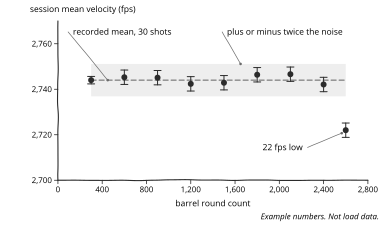
Your recorded velocity is 2,744 fps from 30 shots, with the ammunition at 62 °F and an SD of 9 fps. The barrel has now fired 2,600 rounds. Today, with the ammunition held at 60 °F, 10 shots average 2,722 fps with an SD of 10 fps. Is the barrel slowing down?
noise = √( (9 ÷ √30)² + (10 ÷ √10)² )
      = √(1.64² + 3.16²) = 3.6 fps
drop  = 2,744 − 2,722 = 22 fps, about 6 times the noise
The ammunition was held within 2 °F of the record, so temperature cannot explain a 22 fps drop. The drop is real. Before you blame wear, rule out a new lot and the chronograph setup (see Chapter 31). Had today’s ammunition been 25 °F colder, this comparison would say nothing about wear. Compare such a day with a session near its own temperature instead (see Figure 30-2).
When to re-test
Re-test when one of these changes:
| Change | What to do |
|---|---|
| New primer, case maker, bullet or powder | Work up again (see Chapter 28). Confirm with 20 to 30 shots. |
| New lot of the same component | Load 10 check rounds at your current charge, or one step lower if it sits at or near the published maximum. Compare their velocity with your records. If the new lot runs faster by more than twice the noise, lower the charge and work up again from below (see “Powder lot changes” above). Load in bulk only after the check. |
| New scope, rings, stock or trigger | Start a new baseline (see Chapter 3 and The Precision Rifle Handbook, Chapter 14). |
| New barrel or a changed barrel length | Start over: new lands, new baseline and a new work-up. |
| Velocity drift beyond noise and temperature | Look for the cause. Re-measure the lands. |
| Lands moved out of your jump band | Re-seat and confirm with 20 to 30 shots. |
| Seating deeper than your worked-up seating, or into the lands | Work up again from the start load at that seating (see Chapter 28). |
| A new season | Re-check your zero and drop chart (see The Precision Rifle Handbook, Chapters 10 and 20). |
Notes
- Cal Zant, “Powder Temperature Sensitivity: The Hidden Factor Affecting Your Long-Range Accuracy,” Precision Rifle Blog, 2025, precisionrifleblog.com/2025/03/08/powder-temperature-sensitivity/.
- Karl W. Kleimenhagen, “Chronographs and Pressure,” Karl’s Soapbox, 2006, http://kwk.us/chronographs.html.
- “Velocity Increase in New Gun Barrels,” AccurateShooter Daily Bulletin, reprints a Sierra Bullets blog article by Mark Walker, 2018, bulletin.accurateshooter.com/2018/06/tech-tip-velocity-increase-in-new-gun-barrels/.
- Cal Zant, “How Fast Does a Barrel Erode?” Precision Rifle Blog, 2020, precisionrifleblog.com/2020/03/24/how-fast-does-a-barrel-wear/; Lilja Precision Rifle Barrels, Frequently Asked Questions, riflebarrels.com/support/faq/.