
Key points
- Rifle primers come in two sizes, large and small. The pocket in the case decides which one fits.
- There are four common types: standard, magnum, match and military-specification. Use the type the published data names.
- A high primer can misfire, or fire as a semi-automatic’s bolt closes. A pocket that takes a primer too easily belongs to a worn case.
- A different primer makes a different load. In percentage terms, pressure can move 10 times as much as velocity, so the chronograph may not warn you.
Why it matters
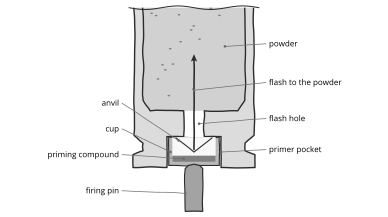
The primer starts the fire. The firing pin dents the cup and crushes a small pellet of priming compound against the anvil. The compound flashes. The flash passes through the flash hole and lights the powder.
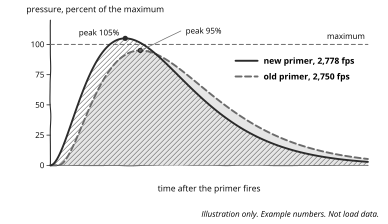
The strength and duration of that flash matter. A hotter flash lights more powder at once, so pressure builds sooner and peaks higher. Because velocity comes from the total push down the barrel rather than the peak alone, a primer change can raise peak pressure sharply while velocity barely moves.
Velocity is your best pressure gauge at home, but after a primer swap it can understate the change. Pressure signs on the case are poor warnings too (see Chapter 28).
How it is done
Sizes
Rifle primers come in two diameters, large and small. The primer pocket in the case head decides which one you use. The two sizes are not interchangeable.
Most cartridges use one size. A few are made with small primer pockets by one maker and large primer pockets by another. Look at your actual cases before you buy primers.
Pistol primers come in the same two diameters. Do not use them in rifle cases. Pistol and rifle primers are not safely interchangeable.1 A large pistol primer, for example, is shorter than a large rifle primer and fits a shallower pocket.2
Types
| Type | Use it for | What differs |
|---|---|---|
| Standard | Most rifle loads | The baseline |
| Magnum | Loads whose data names a magnum primer | A stronger or longer flash |
| Match | Precision loads | Sold as more uniform |
| Military-specification | Rifles with a floating firing pin | Less sensitive to a light strike |
Standard rifle primers suit most rifle loads.
Magnum primers give a stronger or longer flash. Published data sometimes names one for large charges or for ball powders. Ball powders light less readily than stick powders in a case that is not full.3 Use a magnum primer when the published data for your load names one. Do not switch to one on a hunch.
Match primers are sold as more uniform from one primer to the next. Whether a given match primer lowers the velocity spread in your rifle is a question for a test (see The Precision Rifle Handbook).
Military-specification primers are made less sensitive. Some semi-automatic rifles have a floating firing pin. When the bolt slams home, the pin can tap the primer. A sensitive primer can fire from that tap. This is called a slam fire. Military-specification primers have thicker, harder cups than standard commercial primers, so the tap is less likely to fire them.6 They lower the risk of a slam fire but do not remove it (see Chapter 26).7
Pocket fit
A primer should need firm, even pressure to seat. Seated fully, it bottoms in the pocket and sits about .003 to .005 inch below the case head (see Chapter 22).
A high primer stands proud of the head. It can misfire because part of the firing pin’s blow is spent seating it the rest of the way.8 In a semi-automatic rifle it can fire as the bolt closes.9
A primer that slides in with little effort means a loose pocket, stretched by pressure or many firings. A loose primer can leak gas or back out of the pocket. Retire the case (see Chapter 11).
A pocket that fights the primer needs attention, not force. Never force a primer. Military brass often has a crimped pocket, and the crimp must come out before a new primer will seat (see Chapters 7 and 22). Some handloaders also uniform pockets or deburr flash holes, though the evidence for both is thin (see Chapter 22).
Storage and handling
Keep primers in the maker’s packaging until you load them. Keep one primer type on the workbench at a time, just as with powder. Store primers cool and dry. Never store them loose or in a bulk container, where one primer that goes off can set off the rest (see Chapter 2).10 Primers are made in lots like every other component. Write the lot number on your batch record (see Chapter 27). Before you load a new lot in bulk, load 10 check rounds at your current charge, or one step lower if it sits at or near the published maximum. If the new lot runs faster by more than twice the noise (see Chapter 30), lower the charge and work up again from below.
Why a primer change requires a new work-up
Published data names the primer used in the test (see Chapter 15). That primer is part of the load. A different primer makes a different load, even at the same charge.
Count any of these as a primer change:
- A different maker.
- A different type from the same maker, such as standard to magnum.
- A different model of the same type.
A rule of thumb puts numbers on the risk. In percentage terms, pressure moves about 3 times as much as velocity for a change of charge, and 10 times or more for a primer swap (see Chapter 28).11
Velocity change (%)          = (V new − V old) ÷ V old × 100
Possible pressure change (%) ≈ 10 × velocity change (%)
Worked example. Example numbers. Not load data. A load averages 2,750 fps with its old primer. At the same charge, the new primer averages 2,778 fps.
Velocity change         = (2,778 − 2,750) ÷ 2,750 × 100 = 1.0%
Pressure change, primer ≈ 10 × 1.0%                     = about 10%
A 1 percent rise in velocity looks harmless. Read with the primer ratio, it may mean about 10 percent more pressure. Suppose the old load ran at 95 percent of the maximum pressure. A 10 percent rise takes it to about 105 percent. That is over the limit, and nothing at the chronograph looked alarming.
Record the new primer and its lot on your batch record (see Chapter 27).
Notes
- Western Powders, Handloading Guide 8.0, 2020, “Priming,” hodgdonpowderco.com/wp-content/uploads/2023/04/WesternPowdersHandloadingGuide8.0_WEB-1.pdf.
- CCI, FAQ, cci-ammunition.com/faq.html; SAAMI, ANSI/SAAMI Z299.3: Voluntary Industry Performance Standards for Pressure and Velocity of Centerfire Pistol and Revolver Ammunition for the Use of Commercial Manufacturers, 2015, p. 26, saami.org/wp-content/uploads/2018/01/205.pdf.
- Empirical Precision, User Guide, linked from the app’s dashboard, 2026, section 15.1, empiricalprecision.com.
- Bryan Litz, Modern Advancements in Long Range Shooting, Volume II, Applied Ballistics Books, 2016; “Great Book: Modern Advancements in Long Range Shooting II,” AccurateShooter Daily Bulletin, 2020, bulletin.accurateshooter.com/2020/09/great-book-modern-advancements-in-long-range-shooting-ii/.
- Hornady, “Make Reloading Great Again: Does Primer Seating Depth and Type of Primer Matter?” The Hornady Podcast, episode 253, 2026, hornadymanufacturing.libsyn.com/ep-253-make-reloading-great-again-does-primer-seating-depth-and-type-of-primer-matter.
- Sierra Bullets, “Reloading for Semi-Autos and Service Rifles,” Exterior Ballistics (exteriorballistics.com), page metadata dated 2003; archived 28 January 2019, web.archive.org/web/20190128180612/http://www.exteriorballistics.com/reloadbasics/gasgunreload.cfm; Glen Zediker, “Reloading for Semi-Automatic Rifles: Dos and Don’ts,” Shooting Illustrated, 2019, shootingillustrated.com/articles/2019/6/23/reloading-for-semi-automatic-rifles-dos-and-donts; Springfield Armory, M1A Operation and Safety Manual, 2020, p. 5, springfield-armory.com/wp-content/uploads/M1A-Manual.pdf.
- CCI, CCI No. 34 and No. 41 Military Rifle Primers, archived product page, 4 December 2010, http://web.archive.org/web/20101204153023/http://www.cci-ammunition.com/products/primers/primers.aspx?id=30.
- CCI, “Primer Evolution,” CCI Education, archived 17 December 2007; page since retired, http://web.archive.org/web/20071217025445/http://www.cci-ammunition.com:80/education/primer_evolution.aspx.
- Sierra Bullets, “Priming,” Reload Basics, archived 20 January 2025; page since retired, http://web.archive.org/web/20250120214944/https://www.sierrabullets.com/reload-basics/priming/; Springfield Armory, M1A Operation and Safety Manual, p. 5.
- Vihtavuori, Reloading Guide 2026, p. 14, vihtavuori.com/wp-content/uploads/2026/04/Vihtavuori_Reloading_Guide_2026_ENG_web.pdf; Western Powders, Handloading Guide 8.0, “Primer Warnings.”
- Karl W. Kleimenhagen, “Chronographs and Pressure,” Karl’s Soapbox, 2006, http://kwk.us/chronographs.html.